
 Xrf Gold Analyzer
 Handheld Alloy Analyzer
 Handheld Mining Analyzer
 Other XRF Analyzer
Bottom line for catalytic converter recyclers, de-canning operations, and PGM refiners: A spent catalytic converter is the densest above-ground source of platinum, palladium, and rhodium on the planet, yet it is also the most misvalued. The honeycomb substrate that holds those platinum-group metals (PGMs) varies wildly between vehicle makes, model years, and converter positions, and the only thing standing between a fair settlement and a five-figure loss is the grading data you generate before the unit leaves your yard. This guide lays out a 5-stage XRF pre-sale grading SOP — C0 through C4 — that turns a pile of unidentified converters into a documented, defensible, settlement-ready lot.
Below, you will find the exact protocol partner recyclers use to baseline incoming converters, de-can and sample the substrate without destroying value, fingerprint Pt/Pd/Rh with multi-point XRF, screen against a settlement tolerance matrix, and issue a release certificate that survives a refiner’s umpire assay. Every stage is built around one principle: the converter you cannot prove, you cannot price.
For high-volume yards moving thousands of units, this SOP is the difference between selling on a buyer’s guess and selling on your own audited number. For more on the broader recovery economics, see our industrial precious-metal recycling XRF buyer’s guide.

Why the Catalytic Converter Is the Hardest PGM Asset to Value Blind
Unlike a gold bar or an electrolytic cathode, a catalytic converter hides its value inside a ceramic or metallic monolith coated with a thin PGM washcoat. You cannot see the platinum. You cannot weigh it directly. And two converters that look physically identical can differ in PGM loading by a factor of three or more, depending on emissions standard, engine displacement, and whether the unit is OEM or aftermarket.
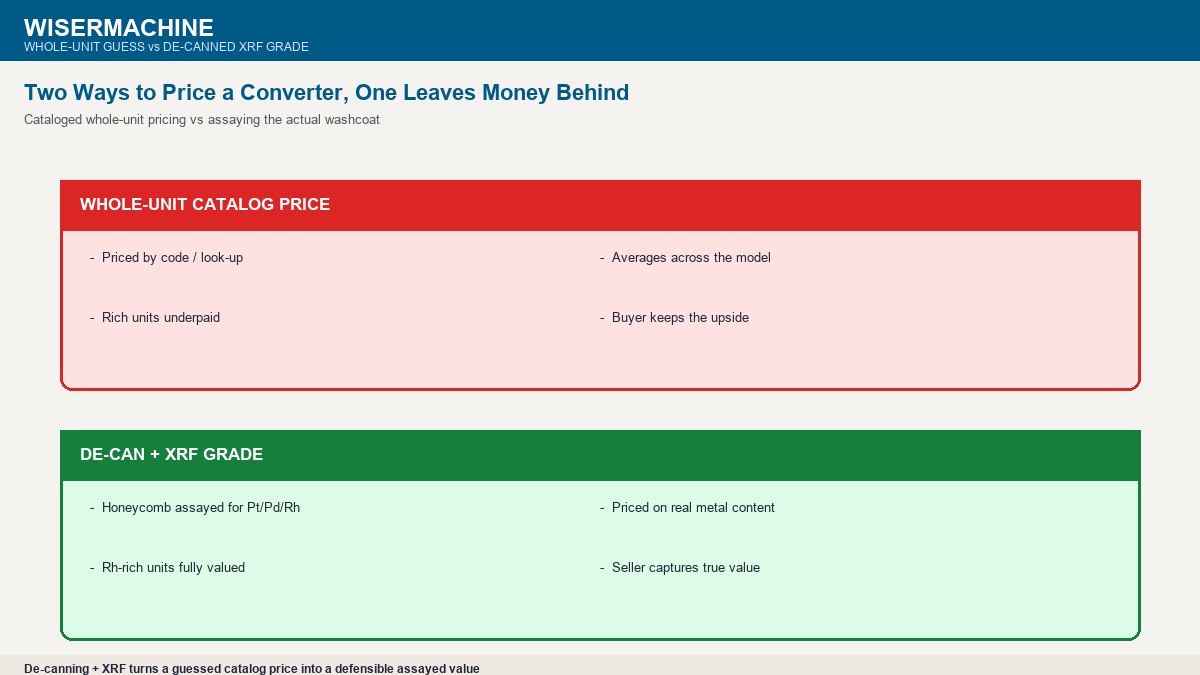
This opacity is exactly why blind selling — selling by visual category, by serial-number lookup table, or by a buyer’s offered grade — bleeds margin. A lookup table gives you a population average for a part number, not the actual loading of the unit in your hand, which may have been thermally aged, partially gutted, or substituted with a low-loading aftermarket monolith. The buyer’s offered grade, meanwhile, is structurally biased toward the buyer.
XRF changes the equation by measuring the PGM signal directly off the prepared substrate. It does not replace the final fire-assay or ICP settlement at the refiner, but it gives you an independent, on-site number that anchors every negotiation and flags the high-value units that deserve individual handling rather than bulk-lot disposal. The same penalty-element discipline that governs refinery penalty-element screening applies here in reverse: you are screening for the elements you want to be paid for, and proving they are present.
The 5-Stage Catalytic Converter PGM Grading SOP: From Core to Certificate
The protocol moves a converter through five gated stages. Each stage either advances the unit toward a graded, settlement-ready lot or routes it to a hold queue for individual review. The chain is designed to fail closed: a unit without a complete grading record never enters a priced lot.
Stage C0: Incoming Converter Baseline and Identification
Before anything is cut, every incoming converter is logged: vehicle source where known, physical category (OEM standard, OEM diesel/DPF, aftermarket, foil/metallic, or pre-cat/mini), weight, and visual condition. Thermally damaged, gutted, or water-logged units are flagged immediately because they carry abnormal loading profiles that will distort a bulk-lot average if mixed in blind.
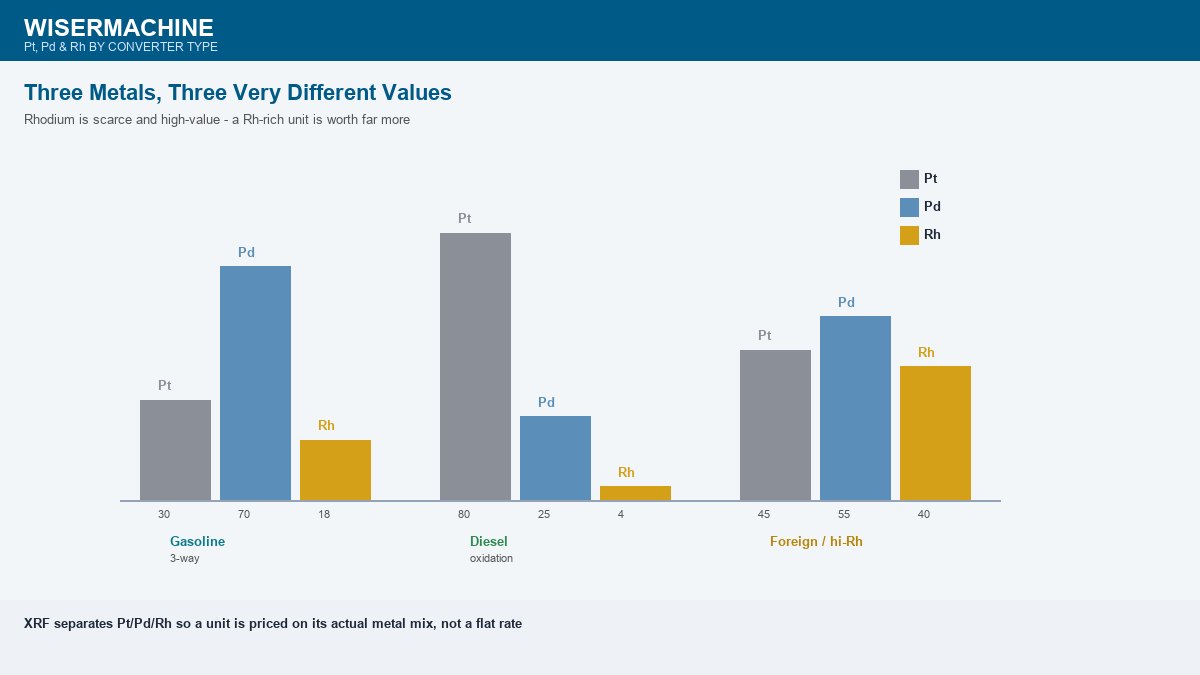
The purpose of C0 is segregation, not valuation. A diesel DPF unit and a gasoline three-way converter have fundamentally different PGM chemistries — diesel units are platinum-heavy, gasoline units lean toward palladium and rhodium — and grading them in the same sub-lot destroys the signal. By the end of C0 you have homogeneous sub-lots that can be sampled and graded as coherent populations.
Operators handling mixed e-scrap streams will recognize this discipline from container-level PCB pre-sale grading: the value is created at intake, by refusing to average dissimilar material into a single number.
Stage C1: De-Canning and Representative Substrate Sampling
This is the stage where value is most often destroyed. The PGM loading lives in the ceramic monolith, and that monolith is rarely uniform — the inlet face, the core, and the outlet face can carry different concentrations because thermal aging and poisoning attack the unit from the inlet inward. De-canning the converter and recovering the full monolith intact, then sampling representatively, is non-negotiable.
The representative-sampling rule is simple: a single grab from one face of one monolith is not a sample, it is a guess. For a graded sub-lot, the protocol crushes and homogenizes a representative fraction of the monoliths in that sub-lot, or runs multiple monoliths at multiple points and aggregates — never a single-point reading extrapolated to a whole lot.
Reading the Substrate to Predict PGM Distribution Risk
Before XRF, the substrate itself tells you where the risk is. Three signals matter most:
- Inlet-face glazing or melting: indicates thermal overload that volatilizes and migrates PGMs, leaving the inlet depleted and the core enriched — a single inlet reading will under-grade the unit.
- Core discoloration or oil contamination: signals poisoning (lead, phosphorus, sulfur) that can suppress the apparent PGM signal and must be screened in Stage C3.
- Substrate type — ceramic versus metallic foil: foil converters carry PGMs on a thin metallic carrier with very different geometry and require a distinct calibration and sampling approach versus dense ceramic honeycomb.

A practical sampling protocol that consistently survives umpire challenge follows a fixed sequence. First, de-can the converter and recover the monolith without crushing it inside the steel shell, because shell steel, mounting mat fibers, and weld slag will contaminate the sample and dilute the apparent PGM concentration. Second, separate ceramic monoliths from metallic-foil substrates into distinct sampling streams, since their densities and matrices demand different calibrations. Third, crush the recovered monolith to a consistent particle size and split it down using a riffle splitter or cone-and-quarter method until a homogeneous analytical fraction remains. The goal is a powder in which any spoonful is representative of the whole sub-lot, eliminating the spatial variance that makes a single grab reading worthless.
The most common and most expensive sampling error is the “hot face” bias. Operators new to PGM recovery often read the inlet face because it is the easiest to access, but on a thermally aged unit the inlet is depleted and the core is enriched, so an inlet-only reading under-grades the unit and gives the buyer free upside. The opposite error — reading a fresh, lightly used converter at the core where loading is highest — over-grades it and sets you up for a settlement shortfall. Homogenization eliminates both biases by destroying the spatial gradient before measurement.
Stage C2: Multi-Point Pt/Pd/Rh XRF Fingerprint
With a homogenized, representative sample prepared, the grading XRF measurement begins. The protocol mandates a minimum of multiple points per sub-lot sample, with a calibration check against a certified PGM standard at the start of each session. The instrument quantifies platinum, palladium, and rhodium simultaneously and reports concentrations that, combined with the recovered substrate weight, yield a contained-metal estimate per sub-lot.
For field and intake screening — sorting incoming units into categories before de-canning — a handheld analyzer is the right tool. The WMK600 handheld XRF analyzer lets an operator screen converters on the receiving dock and segregate the high-loading diesel and high-rhodium units that warrant individual handling.
For the grading decision that anchors settlement — the number you put on the invoice — the precision class steps up. Resolving rhodium, which is the most valuable and the most concentration-sensitive of the three PGMs, requires the stable geometry and high-resolution detector of a benchtop instrument. The WMK6000 high-precision benchtop XRF analyzer delivers the repeatability needed to defend a Pt/Pd/Rh number against a refiner’s assay.
The governing rule mirrors the multi-point discipline of electrolytic refining cathode purity auditing: a single reading describes a single spot, never a lot. Only an aggregated, representative fingerprint can be priced.
Three measurement-quality controls separate a defensible fingerprint from a number that collapses under scrutiny. The first is calibration verification: before any grading session, the instrument reads a certified PGM reference standard, and the session does not proceed until the readback falls within the accepted tolerance band. The second is replicate measurement: each homogenized sub-lot fraction is measured multiple times, and the spread between replicates is logged as a precision indicator — a wide spread signals an inadequately homogenized sample and triggers a re-grind rather than a release. The third is matrix matching: the calibration applied to a ceramic monolith differs from the one applied to a metallic-foil substrate, and applying the wrong calibration silently biases the result by a fixed offset that no amount of replication will reveal.
The contained-metal calculation closes the loop between concentration and value. The XRF reports Pt, Pd, and Rh as concentrations, but the settlement is paid on contained troy ounces, so the grade must combine concentration with the recovered substrate weight for the sub-lot. A sub-lot of light foil converters with a high concentration may contain less total rhodium than a heavier ceramic sub-lot at a lower concentration, and only the contained-metal figure — concentration multiplied by recovered weight, summed across the sub-lot — tells you which lot to prioritize and how to price it.
Stage C3: Poison and Penalty-Element Screening
PGM concentration alone does not determine settlement value. Catalytic converters accumulate poisons — lead from leaded-fuel exposure, phosphorus and zinc from oil consumption, sulfur, and silicon — that complicate refining and can trigger refiner penalties or down-grades. Stage C3 quantifies these elements alongside the PGMs so they are disclosed up front rather than discovered at the refiner’s settlement assay.
Two failure modes matter here. First, heavy poisoning can suppress the apparent PGM XRF signal, causing a unit to under-grade unless the operator recognizes the poison signature and adjusts the interpretation. Second, undisclosed poisons that surface at the refiner erode trust and invite punitive settlement terms on future lots. Screening for them on-site converts a hidden liability into a documented, negotiated term.
The same logic that drives data-center hardware recovery — measure every value-relevant element directly, never by difference — applies here; see our data-center hardware gold recovery SOP for the parallel discipline on a different feedstock.
There is a subtler reason to screen poisons at the grading stage rather than leaving them for the refiner to find: poison content predicts thermal history, and thermal history predicts PGM distribution. A converter loaded with lead and phosphorus has almost certainly run hot and long, which means its inlet face is depleted and its loading profile is skewed toward the core. Recognizing the poison signature therefore does double duty — it discloses a settlement liability and it tells the operator how to interpret the PGM fingerprint, flagging units where an inlet-biased sample would have under-graded the lot. A grading SOP that reads poisons and PGMs in the same pass extracts more information from each measurement than one that treats them as separate concerns.
Stage C4: Settlement Matrix and Release Certificate
The final stage classifies each graded sub-lot against a settlement tolerance matrix and issues the release certificate. The matrix maps the aggregated Pt/Pd/Rh fingerprint, the contained-metal estimate, the substrate weight, and the poison-screen results into a settlement-ready grade with explicit confidence bounds.
A sub-lot that grades cleanly within the matrix is released to the priced lot with a certificate that bundles the C0 identification record, the C1 sampling protocol, the C2 multi-point fingerprint, and the C3 poison screen. That certificate travels with the lot to the buyer or refiner. A sub-lot that grades marginally — near a category boundary or showing heavy poisoning — routes a retained split to fire-assay or ICP umpire confirmation before pricing.
The chain fails closed by design: no complete grading record, no place in a priced lot. This is what separates a yard that sells on its own audited number from one that sells on a buyer’s guess.
The release certificate is also the document that makes a lot tradeable beyond a single buyer. A graded, certified lot can be shopped to multiple refiners or brokers because each one can read the same audited fingerprint and bid against a common number, which introduces competition that a blind pile of converters can never attract. The certificate converts an illiquid heap into a priced commodity with a defensible spec sheet, and that liquidity premium — the ability to walk away from a low bid because three other buyers can read your grade — is frequently worth more than the per-lot accuracy gain itself.
Confidence bounds deserve explicit treatment on the certificate. A grade reported as a single point number invites a buyer to negotiate it downward; a grade reported with its measured precision — the replicate spread from Stage C2 and the sampling protocol from Stage C1 — tells the buyer that the number is bounded by a documented method, not by optimism. Stating the bounds does not weaken the grade; it strengthens it, because it signals that the seller understands measurement uncertainty and has controlled for it rather than ignored it.
The Economics: Why On-Site Grading Pays for the Instrument in Weeks
The financial case for an in-house grading SOP is not subtle. The PGM content of a single high-loading diesel converter can be worth several hundred dollars; a mis-graded lot of a few hundred such units, sold at a buyer’s conservative blind grade, can leave five figures on the table. A multi-point XRF grading process that lifts realized settlement by even a few percent across a yard’s monthly volume recovers the cost of a benchtop analyzer in weeks, not years.
Beyond the per-lot recovery, on-site grading changes the negotiating posture. A recycler who arrives with a documented, defensible Pt/Pd/Rh number negotiates from a position of knowledge; a recycler who arrives with a pile of converters negotiates from a position of hope. The certificate is the leverage.
For yards scaling from manual sorting to data-driven grading, the SOP also compounds: the C0–C3 records build a per-category loading database that sharpens future intake pricing and flags supplier streams whose units consistently over- or under-grade, exactly the closed-loop intelligence described in our industrial recycling buyer’s guide.
Calibration, Standards, and Operator Discipline
An XRF instrument is only as trustworthy as the calibration and the operator behind it. For catalytic converter grading, the calibration must be built or verified against certified reference materials that match the substrate matrix — a calibration developed on a ceramic monolith standard cannot be assumed valid for metallic-foil units, and applying it blindly introduces a systematic error that survives every replicate. Yards running mixed converter streams therefore maintain at least two calibration profiles and select the correct one by substrate type identified in Stage C0.
Reference-standard discipline is the daily anchor. The recommended practice runs a certified PGM standard at the start of each shift and again after any instrument move, power cycle, or temperature swing, logging the readback against the certified value. A drift outside the tolerance band halts grading until the instrument is re-verified, because a single shift of un-anchored measurement can contaminate an entire day’s graded lots with an unknown bias. The cost of a daily standard check is a few minutes; the cost of skipping it is a settlement dispute with no defensible measurement chain.
Operator training closes the gap between a capable instrument and a reliable grade. The recurring human errors — reading an un-homogenized monolith, sampling the inlet face of a thermally aged unit, mixing substrate types in one sub-lot, skipping the calibration check under volume pressure — are all procedural, not technical, and they are eliminated by an SOP that gates each stage and by operators who understand why each gate exists. A yard that invests in the protocol but not in the people running it will see the protocol quietly bypassed under deadline, and the grading data will silently degrade until a refiner dispute exposes it.
Implementation Checklist: Deploying the C0-C4 SOP
To stand up the protocol in a working yard:
- Segregate at intake (C0): separate diesel/DPF, gasoline three-way, foil/metallic, and pre-cat units into homogeneous sub-lots before any cutting.
- Standardize de-canning and sampling (C1): recover full monoliths intact, then crush and homogenize representative fractions — never single-grab readings.
- Calibrate every session (C2): run a certified PGM standard at the start of each grading session and use the benchtop instrument for the settlement number.
- Screen poisons explicitly (C3): quantify lead, phosphorus, zinc, sulfur, and silicon and disclose them in the grade.
- Certify and retain (C4): issue a release certificate per priced sub-lot and retain splits for umpire confirmation on marginal grades.
Recyclers who want a tailored configuration — handheld for the dock, benchtop for the grading bench, and a calibration package matched to their converter mix — can reach our technical team on WhatsApp at +1 503 381 7860 or by email at sales@wisermachine.com for a scoped recommendation.
Frequently Asked Questions
Can XRF accurately measure platinum, palladium, and rhodium in a catalytic converter?
Yes, when the sample is prepared correctly. XRF directly quantifies Pt, Pd, and Rh in a homogenized, representative substrate sample, and a high-resolution benchtop instrument resolves rhodium — the most concentration-sensitive of the three — well enough to anchor a settlement number. The accuracy limit is not the instrument but the sampling: a reading off a single point of an un-homogenized monolith will not represent the lot. With proper de-canning, crushing, and multi-point measurement, XRF delivers a defensible grade that holds up against the refiner’s assay.
Does on-site XRF grading replace the refiner’s fire-assay or ICP settlement?
No, and it is not meant to. The refiner’s fire-assay or ICP remains the final settlement authority. On-site XRF grading is the independent number you bring to the negotiation — it anchors the price, flags high-value units for individual handling, discloses poisons up front, and gives you the data to challenge a settlement that comes back unexpectedly low. Think of it as the verification layer that turns a blind sale into an informed one, not as a substitute for the assay itself.
Why does converter type matter so much for grading?
Because PGM chemistry is type-specific. Diesel converters and DPFs are platinum-heavy; gasoline three-way converters lean toward palladium and rhodium; foil/metallic units carry PGMs on a thin metallic carrier with different geometry; and pre-cats and aftermarket units often have much lower loading. Grading dissimilar types in one sub-lot averages away the signal and systematically under-values the high-loading units. Segregating by type at intake (Stage C0) is the single highest-leverage step in the entire protocol.
Can a handheld XRF do the job, or is a benchtop required?
Both have a role. A handheld analyzer is ideal for intake and field screening — sorting incoming converters into categories and spotting high-loading units on the receiving dock. But the settlement grade, especially rhodium quantification, requires the high-resolution detector and stable chamber geometry of a benchtop instrument. The standard yard configuration uses the handheld upstream for sorting and the benchtop for the priced grading decision.
What poisons should I screen for, and why?
Screen for lead, phosphorus, zinc, sulfur, and silicon. These accumulate from leaded-fuel exposure, oil consumption, and fuel additives, and they matter for two reasons: heavy poisoning can suppress the apparent PGM XRF signal and cause under-grading, and undisclosed poisons surfacing at the refiner can trigger penalties and erode trust on future lots. Quantifying them on-site (Stage C3) converts a hidden liability into a disclosed, negotiated term.
How does the release certificate protect me in a settlement dispute?
The certificate bundles the intake identification, the sampling protocol, the multi-point Pt/Pd/Rh fingerprint, and the poison screen for each priced sub-lot, and it travels with the lot. If a refiner’s settlement assay comes back below your grade, you can reconstruct exactly how the lot was sampled and measured, and you can force an umpire assay on a retained split. The certificate turns a he-said-she-said dispute into a documented, defensible position.
What happens to a sub-lot that grades marginally?
A sub-lot that grades near a category boundary, or that shows heavy poisoning that complicates interpretation, is not forced into a priced lot. Instead, a retained split is sent for fire-assay or ICP umpire confirmation before a pricing decision is made. The chain fails closed: a sub-lot without a clean, complete grading record does not enter a priced lot, which protects both the seller’s margin and the buyer’s trust.
How does grading data improve my intake pricing over time?
Every C0–C3 record feeds a per-category loading database. Over time this database tells you the real loading distribution of each converter type and each supplier stream, so you can price incoming units more aggressively where the data supports it and more cautiously where a supplier’s units consistently under-grade. The SOP shifts from a one-time grading gate into a closed-loop intelligence system that progressively sharpens both your buying and your selling.
To configure a catalytic converter grading setup matched to your converter mix and volume, contact our team on WhatsApp at +1 503 381 7860 or email sales@wisermachine.com.
Related guide: Spent Petrochemical Catalyst PGM Reclaim: XRF Incoming-Lot Assay SOP
Related guide: Jewelry Bench Sweeps & Polishing Dust Gold Recovery: XRF Incoming-Lot Assay SOP 2026