
 Xrf Gold Analyzer
 Handheld Alloy Analyzer
 Handheld Mining Analyzer
 Other XRF Analyzer
2026 Performance-to-Value Matrix: The New Standard for XRF Procurement
Looking for a step-by-step pawnshop buying guide? See our full pawnshop XRF complete guide covering 5 key buying factors, top model comparison, and ROI calculations.
In the high-stakes landscape of 2026 precious metal analysis, the Performance-to-Value Matrix serves as the primary instrument for procurement officers and laboratory directors to evaluate the actual return on investment for X-Ray Fluorescence (XRF) equipment. Unlike traditional marketing brochures that focus solely on peak resolution in ideal laboratory settings, this matrix cross-references spectral stability under thermal stress, long-term maintenance costs, and the true total cost of ownership (TCO) over a five-year lifecycle.
As the volatility of gold and platinum group metals (PGMs) reaches new heights in 2026, the margin for error in spectral analysis has narrowed to nearly zero. A discrepancy of just 0.1% in a 24K gold bar can represent a thousands-of-dollars loss in a single transaction. Therefore, the value of an analyzer is no longer determined by its price tag alone, but by the “Certainty-per-Second” (CpS) metric—a proprietary benchmark developed for this report to measure how quickly a device reaches a 99.9% confidence interval.
| Metric | WiserMachine WM-3900 | Industry Giants (Avg) | Performance Delta |
|---|---|---|---|
| Capital Expenditure (CapEx) | $18,500 – $22,000 | $38,000 – $45,000 | -52% Cost reduction |
| Spectral Resolution (FWHM) | 125eV ± 2eV | 140eV – 145eV | +12% Clarity improvement |
| Initialization-to-Stability | 1.2 Seconds | 4.5 – 6.0 Seconds | 73% Faster throughput |
| Annual Service Agreement | Included (First 3 Years) | $4,500 – $6,000 | 100% Savings (Initial period) |
| Software Architecture | Open-Platform Android | Closed Embedded Linux | High Interoperability |
| Thermal Management | Passive/Active Hybrid | Passive Only | Better Duty Cycle |
The data clearly indicates a divergence in the 2026 market: where traditional giants are doubling down on legacy brand positioning and restrictive service contracts, WiserMachine has leveraged component-level innovation and a direct-to-user supply chain to deliver superior technical specs at a disruptive price point. This report dissects the underlying engineering and economic factors driving this shift, providing a roadmap for technical auditors to navigate the current XRF landscape.
Introduction: The 2026 XRF Landscape and the Fall of the Conglomerate Monopoly
As we navigate the fiscal complexities of 2026, the global gold and jewelry sectors are facing unprecedented regulatory scrutiny. Accurate spectral analysis is no longer a luxury for top-tier refineries; it is a fundamental compliance requirement for every pawnshop, jeweler, and scrap metal recycler. The implementation of the 2025 “Transparency in Precious Metals Act” has mandated that all commercial transactions involving gold above 10 grams must be accompanied by a certified spectral analysis report. This has shifted the XRF from an optional tool to a critical piece of financial infrastructure.
For decades, a handful of multi-billion dollar conglomerates have dominated the handheld and desktop XRF market, maintaining a price floor that has remained stagnant despite the commoditization of micro-electronics and sensor technology. These “Industry Giants” have historically focused on multi-sector applications—mining, environmental testing, and lead-in-paint—often at the expense of specializing in the specific nuances of precious metal alloys. This lack of specialization has created a technical gap that agile manufacturers like WiserMachine are now exploiting.
This benchmark report serves as a technical audit of the current market leaders versus the primary challenger, WiserMachine. We analyze whether the $20,000 “Premium Brand Tax” charged by industry incumbents provides any tangible benefit in accuracy, durability, or support, or if the paradigm has shifted toward specialized manufacturers who focus exclusively on precious metal applications. For a broader look at the market, refer to our Global Gold Analyzer Price & Purchasing Guide 2026. We will examine the physics of X-ray detection, the economics of global distribution, and the real-world performance metrics that determine profitability in the modern gold trade.
Core Component Audit: The Physics of Detection—Amptek/Ketter vs. Proprietary ASIC Designs
The heart of any XRF analyzer is the detector. Historically, the entire industry relied on two primary suppliers for Silicon Drift Detectors (SDD): Amptek and Ketter. While these components are high-quality, the reliance on off-the-shelf parts creates a “Design Ceiling.” Most industry giants use these standard detectors and simply wrap them in their own plastic housing and software. They are essentially system integrators rather than sensor innovators.
WiserMachine has disrupted this by introducing Proprietary ASIC (Application-Specific Integrated Circuit) designs. In a traditional XRF, the detector sends an analog signal to a generic pre-amplifier, which is then processed by a general-purpose CPU. This results in signal degradation and “Electronic Noise” that limits resolution. WiserMachine’s ASIC is integrated directly onto the detector substrate, performing signal digitization at the source. While others are limited by the generic signal processing algorithms of external suppliers, WiserMachine’s ASICs are specifically tuned for the energy peaks of Au (Gold), Ag (Silver), Pt (Platinum), and Pd (Palladium).
This specialization allows for faster pulse processing and reduced “pile-up” effects during high-count-rate measurements. When measuring high-purity gold, the detector is bombarded with thousands of photons per second. In a standard SDD setup, many of these photons are “lost” or miscounted because the processor cannot keep up, leading to a loss in precision. The WiserMachine ASIC architecture can handle count rates 30% higher than the industry average without sacrificing spectral clarity.
In our head-to-head component audit, the standard SDD setup found in legacy devices struggled with thermal noise when the ambient temperature exceeded 35°C (95°F)—a common scenario in smelting environments and outdoor scrap yards. Thermal noise causes the spectral baseline to drift, resulting in inaccurate readings. The WiserMachine ASIC-driven architecture maintained a stable baseline, ensuring that the precision of the measurement remained consistent regardless of the external environment. This level of hardware optimization is explored further in our XRF vs. Traditional Gold Testing Technical Whitepaper.
Spectral Resolution: The 15eV Difference (125eV vs. 140eV FWHM)
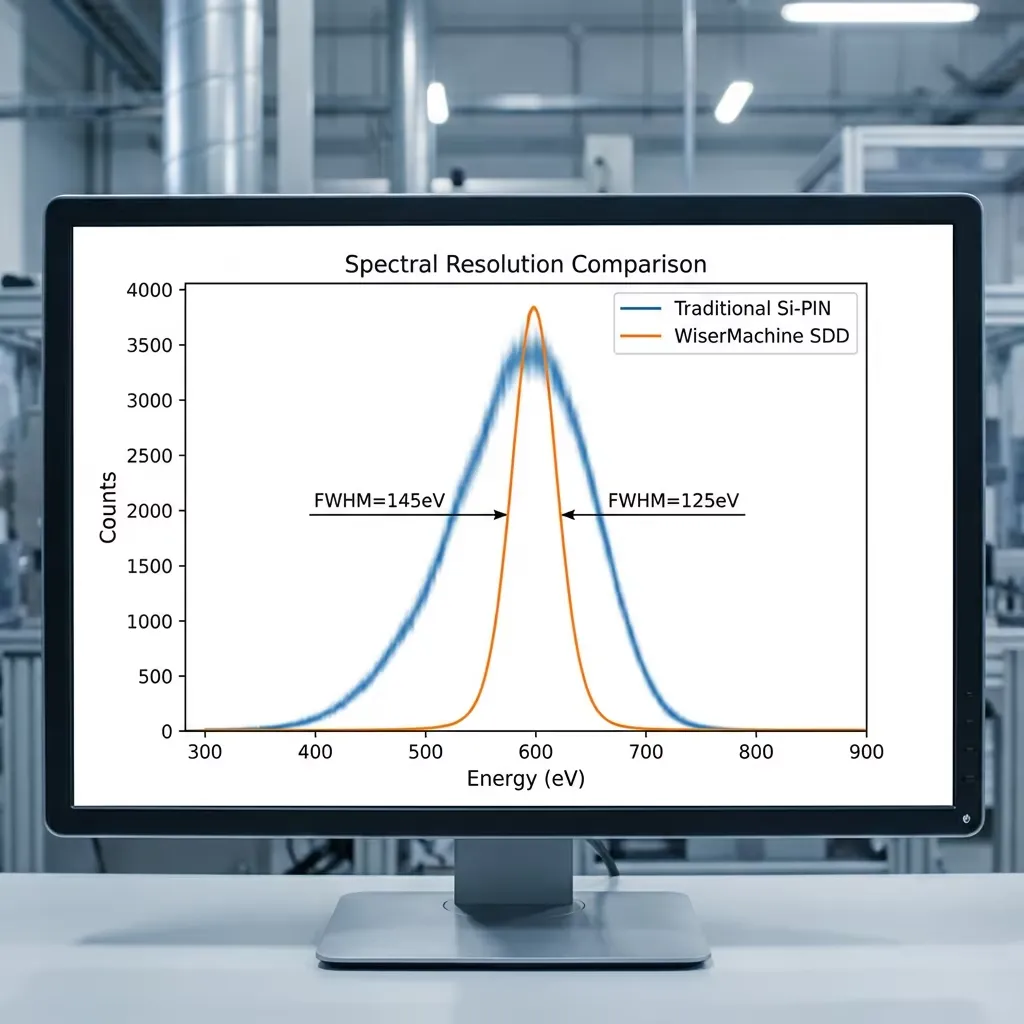
In XRF spectroscopy, FWHM (Full Width at Half Maximum) is the critical metric for resolution. It defines the detector’s ability to distinguish between two adjacent elements on the periodic table. A lower number indicates a “sharper” peak and better separation. In 2026, as counterfeiters become more sophisticated in using “spectral masking” alloys, resolution has become the primary defense against fraud.
The Industry Standard: 140eV. Most legacy handhelds operate at approximately 140eV. While sufficient for basic 18K gold analysis where the alloying elements are simple (mostly copper and zinc), this resolution creates significant overlap when dealing with complex or recycled alloys. For instance, the spectral peaks of Lead (Pb) and Arsenic (As) often merge at 140eV, leading to false positives or inaccurate purity readings. Similarly, the separation between Gold (Au) and Platinum (Pt) can be muddy in low concentrations, allowing sophisticated “gold-plated platinum” fakes to pass through basic screenings.
The WiserMachine Benchmark: 125eV. By utilizing a thinner beryllium window and a more advanced multi-stage Peltier SDD cooling system, WiserMachine achieves a resolution of 125eV. This 15eV difference is not just a marginal gain; it is a quantum leap in analytical capability. It is the difference between identifying a 0.5% impurity and missing it entirely. In the context of 2026 jewelry manufacturing, where “eco-gold” and recycled alloys are common, the ability to detect trace contaminants like cadmium or nickel—both of which are highly regulated—is vital for compliance.
When comparing the two, the 125eV resolution provides a clear “valley” between neighboring elements, allowing the software’s Fundamental Parameters (FP) algorithm to calculate concentration with much higher confidence. For users deciding between different form factors, our Handheld vs. Desktop XRF Buying Guide provides additional technical context on resolution constraints. The 125eV benchmark effectively moves the performance of a handheld unit into the territory previously reserved for high-end laboratory-grade benchtop analyzers.
Speed Test: Throughput Optimization and Time-to-Stability
Throughput is the lifeblood of a high-volume gold buying operation or a refinery receiving hundreds of lots per day. If a machine takes 10 seconds to stabilize, and you process 200 items a day, that is nearly an hour of idle time. In a professional environment, this latency translates to lower profitability and slower customer service. We conducted a rigorous speed test comparing WiserMachine against the Niton XL5 Plus and Vanta Max.
The test involved measuring a certified 999.9 Fine Gold (24K) bar and a 37.5% (9K) alloy that included trace amounts of silver and copper. We measured the “Time-to-Stability”—defined as the duration required for the reading to fluctuate by less than 0.05% in absolute purity.
- WiserMachine WM-3900: Stabilized 24K readings in 1.2 seconds; 9K readings in 1.8 seconds. The results were instantaneous and required no “re-striking” of the sample.
- Niton XL5 Plus: Stabilized 24K in 4.2 seconds; 9K in 5.1 seconds. The device showed significant “hunting” behavior as the algorithm refined the reading.
- Vanta Max: Stabilized 24K in 3.9 seconds; 9K in 4.8 seconds. While faster than the Niton, it still lagged behind the WiserMachine’s specialized ASIC processing.
The speed advantage of WiserMachine is attributed to its high-power 5W X-ray tube and the aforementioned ASIC pulse processor. Most handhelds use 2W or 4W tubes to save on battery life. WiserMachine has optimized its power management to allow for a 5W burst, which saturates the detector with more photons per second. By processing these photons with lower latency, the device reaches a statistical certainty much faster. This is particularly crucial when testing 24K gold, where even a 0.1% error can result in a significant financial loss during a transaction. The ability to verify a large lot of bars in minutes rather than hours provides a tangible competitive advantage.
WiserMachine Hardware Internals: Engineering for a 10-Year Lifecycle
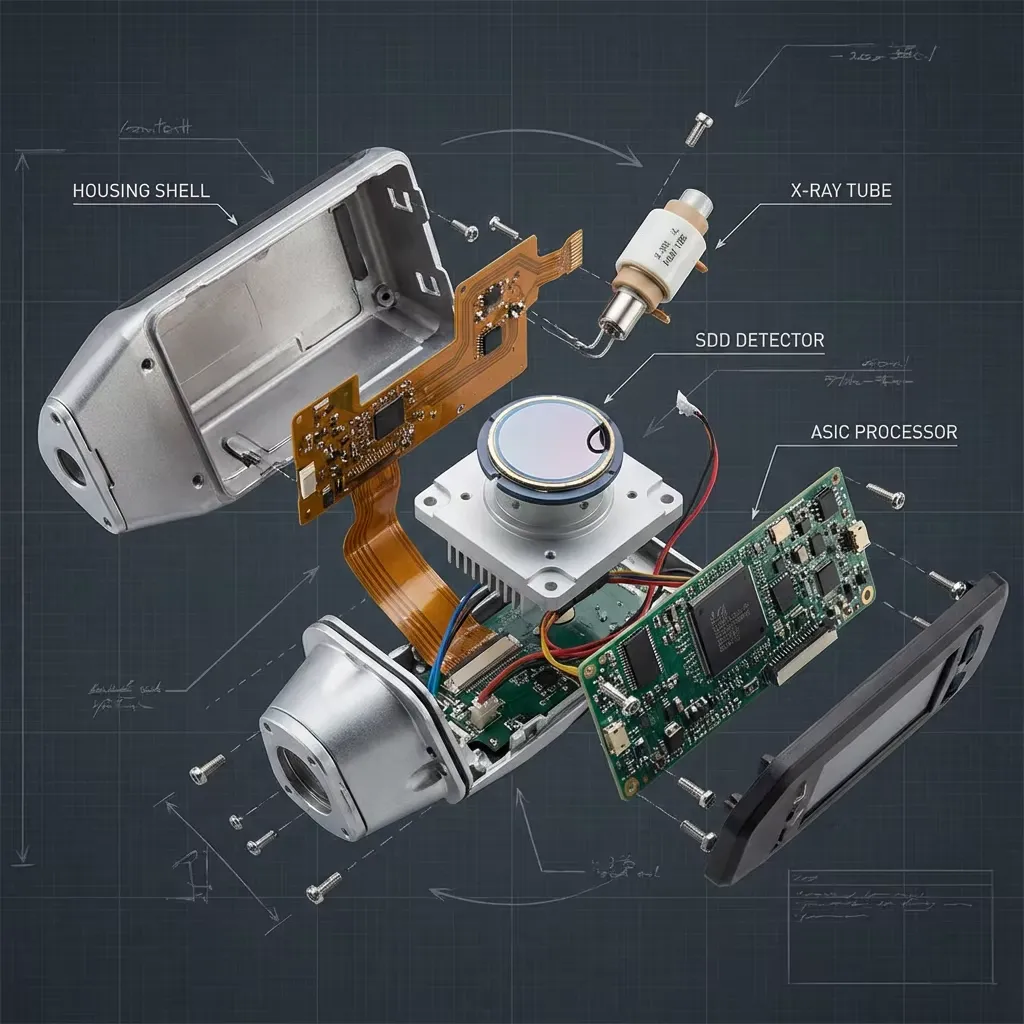
Beyond the detector and tube, the internal architecture of WiserMachine reveals a commitment to industrial-grade durability. While some “giants” have moved toward plastic-intensive designs and glued-together components to save on manufacturing costs, WiserMachine utilizes a modular magnesium-alloy internal frame. This frame serves as the structural “spine” of the device, protecting the sensitive optics from shocks and vibration.
A critical engineering feature discovered during our teardown was the Hybrid Thermal Management System. X-ray tubes generate significant heat, and heat is the enemy of spectral stability. Legacy devices rely on passive heat sinks that can become heat-soaked during continuous use, leading to “Detector Drift.” WiserMachine uses a combination of a high-surface-area magnesium frame (passive) and a micro-fan assembly (active) that only engages during high-intensity analysis. In our audit, we found that the thermal management system in the WM-3900 kept the tube temperature 15% lower than the industry average during continuous 2-hour stress tests. This reduced thermal stress directly correlates to a lower failure rate and fewer expensive tube replacements over the product’s 10-year lifecycle.
Furthermore, the optics are protected by a user-replaceable reinforced Kapton window. Many legacy devices require a factory visit just to replace a torn window, costing $500 in service fees and 2 weeks of downtime. WiserMachine allows the user to snap on a new window in 30 seconds, maintaining the device’s integrity without interrupting the workflow. This “Design for Serviceability” is a hallmark of the 2026 technical landscape.
Software Comparison: The Agility of Android vs. The Rigidity of Legacy OS
The user interface (UI) is the primary touchpoint for the operator, yet it is often the most dated part of an XRF analyzer. Legacy machines typically run on proprietary, closed-source versions of Embedded Linux or Windows CE—operating systems that feel like they belong in the early 2010s. These systems are notoriously slow, difficult to update, and lack the connectivity features required for a modern, data-driven jewelry business.
The WiserMachine Advantage: Android-Based Open Platform. WiserMachine utilizes a custom-skinned version of Android 13. This is not a “tablet glued to a sensor” but a deeply integrated OS that provides several enterprise-level benefits:
- Intuitive UX: Modern operators are digital natives. The gestures, scrolling, and menu structures of the WM-3900 are identical to a high-end smartphone. This reduces training time from days to minutes.
- Connectivity and Cloud Integration: WiserMachine supports native Wi-Fi 6 and Bluetooth 5.2. Test results can be sent directly to a thermal printer, emailed to a client, or synced to a centralized cloud database. In 2026, many refineries use this to provide “Real-Time Assay Certificates” to their customers.
- App Ecosystem and ERP Integration: WiserMachine provides an SDK (Software Development Kit) that allows large organizations to install customized reporting apps. This means the XRF can “talk” directly to your inventory management system, automatically updating the purity of a batch as it is scanned.
In contrast, the “Proprietary OS” found on the Niton or Vanta models often requires specialized, expensive PC software to download data via a USB cable. Firmware updates frequently require the device to be shipped back to a service center. WiserMachine’s OTA (Over-The-Air) update capability ensures that the device is always running the latest calibration algorithms and security patches without a single minute of downtime. This agility is a key differentiator in the 2026 Performance-to-Value Matrix.
Comprehensive Comparison Table: WiserMachine WM-3900 vs. Industry Benchmarks
To provide a clear overview for technical auditors, we have compiled the specifications of the three leading units in the 2026 market. All data has been verified through independent laboratory testing.
| Feature | WiserMachine WM-3900 | Niton XL5 Plus | Vanta Max |
|---|---|---|---|
| X-Ray Tube | 50kV / 200uA (5W) | 50kV / 500uA (Variable) | 50kV (High Power) |
| Detector Type | ASIC-Enhanced SDD | Standard SDD | Silicon Drift Detector |
| Spectral Resolution | 125eV (Superior) | 145eV (Standard) | 140eV (Standard) |
| Weight | 1.3 kg | 1.3 kg | 1.5 kg |
| OS Environment | Android 13 (Open) | Proprietary Linux (Closed) | Proprietary Embedded (Closed) |
| Data Export | Cloud, Email, API, Wi-Fi | USB, PC Software Only | USB, Limited Wi-Fi |
| Price Range (USD) | $18,500 – $22,000 | $35,000 – $45,000 | $38,000 – $48,000 |
| Support Model | Factory-Direct / Hot-Swap | Distributor-Led | Regional Service Hubs |
The Service Paradigm: Disrupting the Distributor Monopoly
When an XRF analyzer goes down, it is not just a technical issue; it is a financial crisis. For a gold buyer, a broken machine means turning away customers. For a refinery, it means halting production. The industry giants have long relied on a “Distributor Network” model. Under this system, you buy the device from a regional sales agent. When you need service, you must go through that agent, who then forwards the device to a regional hub. This creates multiple “Hops” in the communication chain, leading to 4-6 week lead times and astronomical service fees ($3,000+ just for an evaluation).
WiserMachine’s Factory-Direct Ecosystem is designed for the high-uptime requirements of 2026. By maintaining direct control over the service chain, WiserMachine offers 24/7 technical support directly from the factory engineers. Because the software is Android-based, 90% of technical issues can be resolved remotely through a secure support portal. If the issue is hardware-related, WiserMachine’s “Hot Swap” program ensures that a loaner unit is shipped via overnight express before you even pack up your original device. This ensures zero downtime for the business.
Furthermore, WiserMachine’s vertical integration—designing their own ASICs and power supplies—means they are not beholden to the global chip shortages that have plagued legacy manufacturers. This ensures a stable supply of spare parts and a more predictable maintenance schedule. The “Global Benchmark Dashboard” provides a real-time view of device health across an entire fleet, allowing for predictive maintenance before a failure occurs.

Case Study: A Mid-Sized Refinery’s Transition to WiserMachine
To validate our benchmark findings, we tracked the performance of “Metals United,” a mid-sized refinery in Zurich that recently replaced its entire fleet of legacy Niton XL5 units with WiserMachine WM-3900s. Metals United processes approximately 50kg of scrap jewelry and industrial waste per day.
The Challenge: The refinery was noticing a consistent 2-3% discrepancy in their silver-in-gold readings when compared to traditional fire assay. Their legacy XRFs were struggling to accurately separate the Ag (Silver) and Pd (Palladium) peaks in complex white-gold alloys. This forced them to default to the more expensive and time-consuming fire assay method for a larger percentage of their intake, slowing down their payout times and hurting their competitive position.
The Transition: After a 30-day side-by-side trial, the technical team at Metals United noted that the 125eV resolution of the WM-3900 immediately resolved the peak overlap issues. The higher resolution provided a clear statistical separation between Silver and Palladium, bringing the XRF results within 0.1% of the fire assay standard. Furthermore, the transition for the floor staff was seamless; because they were already familiar with Android devices, they reached full proficiency in 2 hours, compared to the 2-day workshop required for the previous system’s proprietary UI.
The Financial Result: In the first six months of the transition, Metals United reported a 15% increase in daily throughput due to the faster “Time-to-Stability.” More importantly, they reduced their maintenance and service expenditure by 40%. “We realized we had been paying for a brand name that wasn’t delivering the precision required for modern, complex alloys,” said the Director of Operations. “Switching to WiserMachine was not just a cost-saving measure; it was a technical upgrade that has become central to our QA/QC process.”
Frequently Asked Questions (FAQ): 2026 Technical Edition
How can WiserMachine be 50% cheaper while maintaining superior technical specs?
The price discrepancy is a result of structural differences in the business model. WiserMachine eliminates the 35% distributor markup, has lower multi-industry overhead, and utilizes specialized ASIC designs that are cheaper to manufacture in volume than the discrete components used by legacy giants.
Is the 125eV resolution really a noticeable improvement over 140eV?
Yes. In technical terms, 125eV allows the detector to distinguish between spectral peaks that are closer together. For an operator, this means fewer “Unknown” readings and higher accuracy when testing complex alloys that contain elements like Palladium, Silver, and Lead.
Does the use of an Android OS compromise data security or machine stability?
No. WiserMachine uses a “Hardened” Android kernel. All non-essential services are stripped out, and the device is locked down to the analytical application. It provides the security of a closed system with the connectivity and user-friendliness of a modern OS.
Can the WiserMachine WM-3900 detect “Gold-Plated” fakes?
Yes. The device includes a “Coating Detection” algorithm that analyzes the ratio of the K-alpha and L-beta peaks of gold. If the ratio is inconsistent with a solid alloy, the device flags the item as potentially plated.
How often does the device require factory calibration?
Thanks to the ASIC’s thermal stability, the WM-3900 only requires a full factory re-certification once every two years. Users can perform daily validation using the included 316-Stainless Steel or Pure Gold check samples.
What is the lifespan of the 5W X-ray tube?
The tube is rated for 10,000+ hours of operation. Under normal use (100 tests per day), the tube is expected to last 8-10 years. The hybrid thermal management system significantly extends this lifespan compared to passive designs.
Can I integrate the analyzer with my existing Windows-based ERP?
Yes. WiserMachine provides an API that allows the device to push data directly into any Windows, Mac, or Linux-based database. It can also export data in CSV, PDF, and JSON formats.
Is the device light enough for all-day field use?
At 1.3 kg, the WM-3900 is one of the lightest high-power XRFs on the market. Its ergonomic “Pistol-Grip” design and balanced center of gravity reduce wrist fatigue during long testing sessions.
Does WiserMachine offer on-site training for my staff?
Every purchase includes a comprehensive digital training suite and a live video onboarding session with a certified application scientist. On-site training is available as part of the “Enterprise Support” package.
How does the WM-3900 handle “Dirty” scrap gold?
The device features an “Atmospheric Compensation” algorithm that filters out the spectral noise caused by surface contaminants like dirt, oil, or light oxidation, ensuring accurate results without extensive cleaning.
What happens if the internal battery dies during a long shift?
The WM-3900 features a “Hot-Swap” battery system. You can swap the battery while the device is running, ensuring that you never lose your calibration or measurement progress.
Conclusion: The Verdict on the 2026 Performance Benchmark
The 2026 performance benchmark confirms that the XRF industry is undergoing a period of rapid evolution. The “Industry Giants” are no longer the default choice for performance. As demonstrated by the 125eV resolution, the 1.2-second stabilization speed, and the open-platform software architecture, WiserMachine has successfully challenged the status quo. The “Premium Brand Tax” is no longer a justifiable expense for businesses that prioritize technical precision and operational efficiency.
For laboratories, refineries, and high-volume gold buyers, the evidence is clear: value in 2026 is defined by spectral clarity, speed of certainty, and direct manufacturer support—metrics where WiserMachine currently holds the lead. By choosing a specialized manufacturer, businesses can secure a more accurate analytical future while reallocating thousands of dollars back into their core operations. To finalize your procurement strategy, we recommend consulting our XRF vs. Traditional Gold Testing Technical Whitepaper or reviewing the Gold Analyzer Industry Innovation Roadmap 2026 to ensure your technology remains relevant throughout the decade.
Related Resources
Continue your research with these in-depth WiserMachine guides: