
 Xrf Gold Analyzer
 Handheld Alloy Analyzer
 Handheld Mining Analyzer
 Other XRF Analyzer
Strategic Buying Recommendation Matrix
Looking for a step-by-step pawnshop buying guide? See our full pawnshop-specific buying guide covering 5 key buying factors, top model comparison, and ROI calculations.
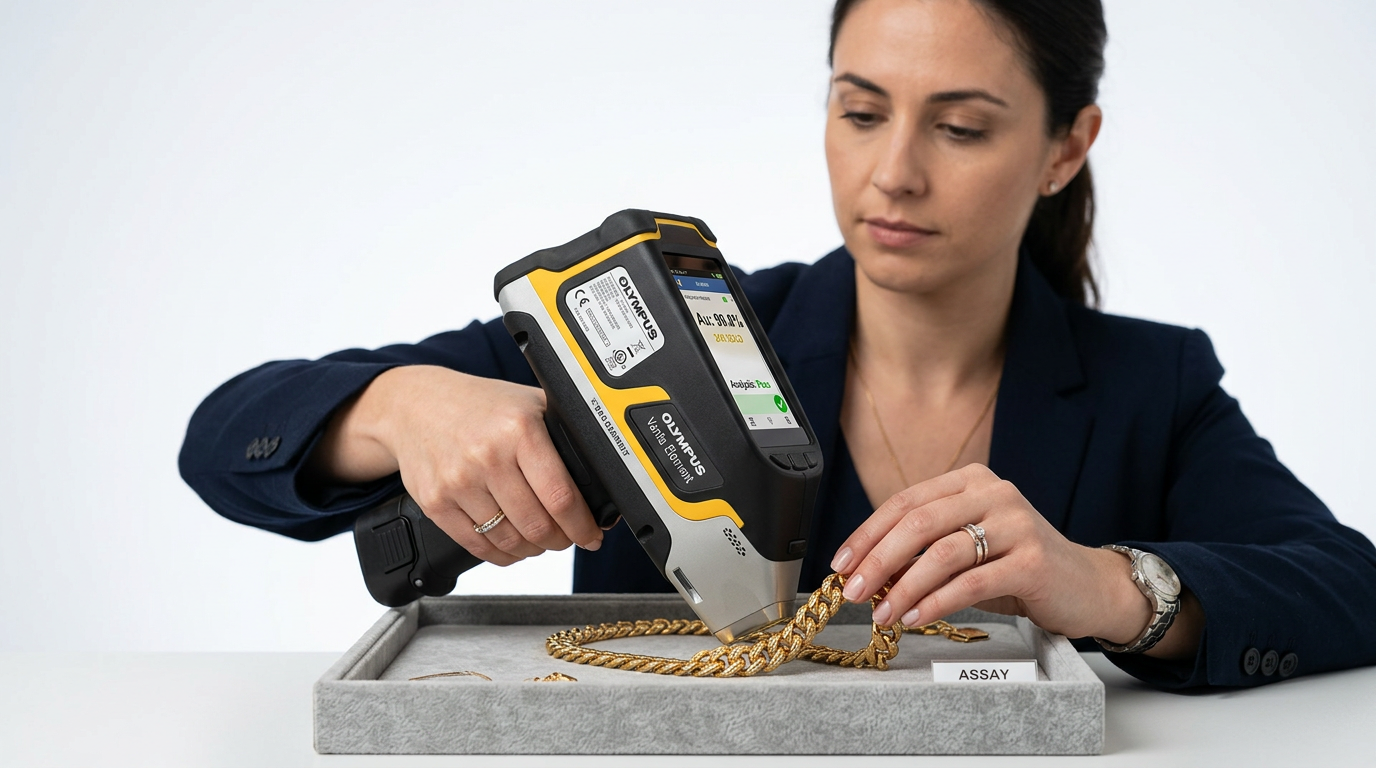
In the high-stakes precious metals industry, the choice of analytical instrumentation is a foundational business decision. Whether you are a pawnbroker assessing a daily influx of consumer jewelry or a refinery manager responsible for multi-million dollar batches of dore bars, the form factor of your X-ray Fluorescence (XRF) analyzer determines your efficiency, accuracy, and risk exposure. This guide provides a senior-level technical consultation on the strategic trade-offs between handheld and desktop systems as of 2026.
| Operational Profile | Primary Analytical Requirement | Strategic Recommendation | Detector Preference | ROI Timeline |
|---|---|---|---|---|
| High-Volume Pawnshop | Client transparency, high throughput, and repeatability. | Desktop (Benchtop) | Fast SDD (Silicon Drift) | 6-12 Months |
| Field Scrap Buyer / Mobile Scout | Portability, immediate on-site verification, ruggedness. | Handheld | Standard SDD or Si-PIN | 4-8 Months |
| Gold Refinery (Receiving Dock) | Rapid sorting of heterogenous scrap. | Handheld (Ruggedized) | Large Area SDD | 3-6 Months |
| Gold Refinery (Analytical Lab) | Trace element detection (ppm), dore bar uniformity. | Benchtop / WDXRF | SDD or Wavelength Dispersive | 18-24 Months |
| Jewelry Manufacturer | Quality control for alloying and plating thickness. | Desktop (Micro-spot) | High-Resolution SDD | 12-18 Months |
The Engineering Trade-off: Precision vs. Portability
To understand the difference between handheld and desktop XRF, one must look past the plastic casing and into the fundamental physics of X-ray spectroscopy. The core performance of an XRF analyzer is governed by the relationship between the X-ray source (the tube), the sample, and the detector.
The Geometry of Measurement
In a desktop unit, the distance between the X-ray tube’s focal spot and the sample surface is fixed and optimized by the manufacturer. This “tight” geometry ensures a high solid angle for the detector. In physics, the solid angle determines the fraction of emitted X-rays that actually reach the detector. A larger solid angle in a desktop unit means more photons are captured per second. This directly translates to lower “statistical noise” and a much higher precision (Repeatability).
Handheld units, by necessity, have a slightly more “relaxed” geometry. Because the device must be safe to hold, the tube and detector are positioned behind a protective window. If an operator holds the device at a slight angle or if the sample has a curved surface, the distance varies. Even a 1mm deviation can significantly alter the count rate due to the Inverse Square Law. While modern handhelds use internal tilt sensors and distance compensation algorithms, they can never quite match the mechanical rigidity of a desktop’s sample stage. For technical teams maintaining these devices, we recommend our XRF maintenance and calibration guide to ensure geometric alignment remains within tolerance.
Power and Thermal Management
A second critical factor is the power of the X-ray tube. Desktop units typically utilize 30W to 50W tubes. This higher wattage allows for a greater photon flux, which is essential for detecting trace elements or measuring through thick coatings. These tubes generate significant heat, which is easily dissipated in a desktop chassis via internal fans and heat sinks.
Handheld units are limited by battery life and the physical heat they can safely dissipate in a user’s hand. Most handhelds operate at 2W to 4W. While this is sufficient for identifying major alloy components (like 18k vs 22k gold), it is less effective for quantifying trace impurities like Iridium or Ruthenium, which are common “poisoning” elements in the scrap gold trade. When comparing these results to traditional chemical assays, professionals should consult our XRF vs traditional testing whitepaper.
Detector Technology: Si-PIN vs. SDD in 2026
As a consultant, the most frequent question I receive is whether the premium for a Silicon Drift Detector (SDD) is worth it. The answer depends entirely on your throughput and the complexity of the materials you test.
Si-PIN: The Entry-Level Standard
Silicon-PIN detectors are the “classic” XRF technology. They are durable and relatively inexpensive. Their resolution is typically between 165eV and 190eV. In practical terms, this means the peaks on the spectrum are “wider.” If you are testing simple gold alloys with only Copper and Silver, a Si-PIN detector is perfectly adequate. However, if the alloy contains Nickel or Zinc, the peaks can overlap, leading to a “phantom” gold reading. This is a common pitfall in budget-conscious pawnshops.
SDD: The Modern High-Performance Choice
The SDD is the gold standard for 2026. With resolutions as low as 125eV, the peaks are “sharper.” This allows the software to distinguish between elements with very similar energy signatures. Furthermore, SDDs can handle “count rates” of over 200,000 photons per second, whereas Si-PIN detectors often saturate at 30,000. This means an SDD can give you a 22k gold reading in 2 seconds that would take a Si-PIN detector 20 seconds to confirm with the same level of confidence.
In a refinery setting, the SDD is mandatory. The ability to detect “light elements” (elements with low atomic numbers like Aluminum or Silicon) is only possible with an SDD. This is critical for refineries that process gold ore or mining concentrates where the “matrix” elements are just as important as the precious metals.
Thick Gold Plating and the “Infinite Thickness” Problem
The biggest threat to a gold buyer’s profit is heavy gold electroplate (HGE) or gold-filled items. These pieces can have 5 to 25 microns of high-karat gold over a core of Copper or Tungsten. Standard XRF only penetrates about 10 microns into a gold sample.
The Handheld Challenge
A handheld unit is designed for a quick “snap” of the surface. If the gold plating is 20 microns thick, the X-ray beam will never reach the base metal. The device will report “99.9% Gold” because its “view” is entirely contained within the gold layer. This is known as the Infinite Thickness problem in spectroscopy. Advanced handhelds attempt to mitigate this by analyzing the ratio of characteristic X-rays (L-alpha vs K-alpha), but this is not foolproof in the field.
The Desktop Solution
Desktop units excel here because they allow for Micro-spot Analysis. By focusing the beam on a 0.5mm spot, the operator can target a tiny scratch, a deep hallmark, or a worn corner of the jewelry. Furthermore, desktop software is typically more robust, allowing for “Multi-layer Fundamental Parameters” (FP) calculations. The software can calculate if the spectral signature matches a solid alloy or if there is a “missing” signal from the expected base metal, triggering a plating alert. This level of scrutiny is vital for maintaining a regulatory standards guide compliant operation.
Scenario A: The Urban High-Volume Pawnshop
In an urban pawnshop, the analyzer is a retail tool. It is part of the “show.”
Operational Dynamics
The desktop unit sits on the counter. The customer watches as the item is placed inside. The integrated camera shows a 20x zoom of their ring on a secondary monitor. This visual transparency reduces conflict and increases the “closing rate” of transactions. Because the unit is a “closed-beam” system, the store manager doesn’t need to worry about the liability of employees accidentally pointing an X-ray gun at each other or at customers.
Throughput Efficiency
The desktop unit’s stability means it is always “ready.” It doesn’t need to wake up from a battery-saving sleep mode. For a shop doing 50 tests a day, the 10-second saving per test adds up to significant labor savings. More importantly, the repeatability of the desktop means that if a customer brings the same ring back three months later, the machine will give the exact same reading, maintaining the shop’s reputation for consistency.
Scenario B: The Mobile Field Scrap Buyer
Consider a buyer who visits estate sales or jewelry shows. Their primary risk is missing an opportunity or buying a fake.
The Tactical Advantage
The handheld XRF is their primary defense. It allows them to screen a bucket of scrap gold in minutes. They can test large trophies, dental gold, or heavy industrial contacts that simply won’t fit in a desktop chamber. The mobility allows the buyer to be “first to the deal.” In the field, a 1% error is acceptable; the goal is to avoid the 100% loss of buying a gold-plated copper bar.
Ruggedization and Field Survival
Modern handhelds are built for this. They feature IP54 ratings for dust and water resistance and are designed to survive a 4-foot drop onto concrete. The batteries are hot-swappable, ensuring 24/7 operation during busy multi-day trade shows. For field buyers, the handheld isn’t just a tool; it’s a piece of tactical equipment.
Scenario C: The Advanced Gold Refinery
In a refinery, the XRF is the “first filter” for incoming material.
The Receiving Dock
Refineries use handheld units for rapid sorting. When a shipment of “mixed scrap” arrives, workers use handhelds to quickly categorize material into 10k, 14k, and 18k bins. This allows for more efficient smelting runs. The precision isn’t the priority; speed and sorting accuracy are.
The Laboratory
Once the gold is smelted into a dore bar, the handheld is no longer sufficient. The refinery needs to know the exact purity to the second or third decimal place. This is where a high-end benchtop unit with a vacuum pump or a WDXRF (Wavelength Dispersive) system comes in. These machines remove air from the sample path, allowing the detector to see even the faintest signals from light elements like Chlorine or Phosphorus, which can indicate issues in the refining process. Understanding the capital investment for these systems is covered in our 2026 purchasing guide.
Radiation Safety: The Hidden Operational Cost
Safety is not just about health; it’s about legal compliance and insurance premiums.
Open Beam (Handheld) Risks
Handheld XRF is an “Open Beam” technology. If the trigger is pulled without a sample in front of the window, X-rays are projected into the room. Most devices have “proximity sensors,” but these can be fooled. Handheld users typically require specialized training, dosimeter badges to track their exposure, and a designated “X-ray usage area.” In some jurisdictions, the annual cost of compliance for a handheld can exceed $1,000.
Closed Chamber (Desktop) Safety
Desktop units are inherently safer. They are “Cabinet X-ray Systems.” The X-rays are generated inside a lead-lined box with mechanical interlocks. If the door opens, the power to the tube is cut. This safety level often allows the machine to be used without dosimeter badges or specialized operator licenses, making it a much more flexible choice for retail environments with high staff turnover.
Technical Comparison Matrix (Deep-Dive)
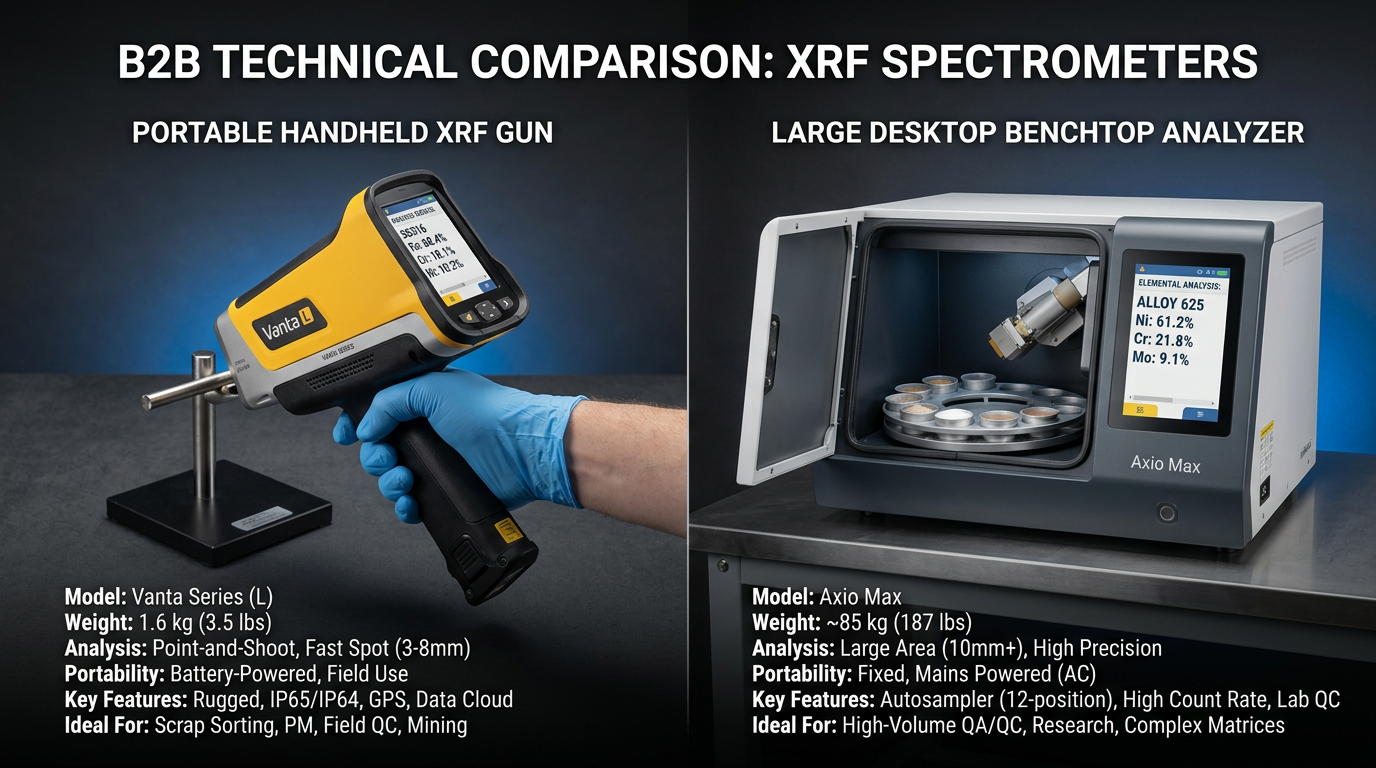
| Parameter | Handheld (Si-PIN) | Handheld (Premium SDD) | Desktop (Standard) | Benchtop (High-End Lab) |
|---|---|---|---|---|
| Resolution (FWHM) | 175 – 190 eV | 135 – 145 eV | 140 – 160 eV | < 125 eV |
| Lower LOD (Au) | 0.1% | 0.05% | 0.02% | < 0.001% |
| Max Count Rate | 30,000 cps | 200,000 cps | 50,000 cps | > 500,000 cps |
| Atmosphere | Air Only | Air Only | Air / Helium Option | Vacuum / Helium |
| Power Supply | Battery (DC) | Battery (DC) | Mains (AC) | Mains (AC) |
| Weight | ~1.5 kg | ~1.8 kg | 15 – 30 kg | > 50 kg |
Total Cost of Ownership (TCO) and ROI
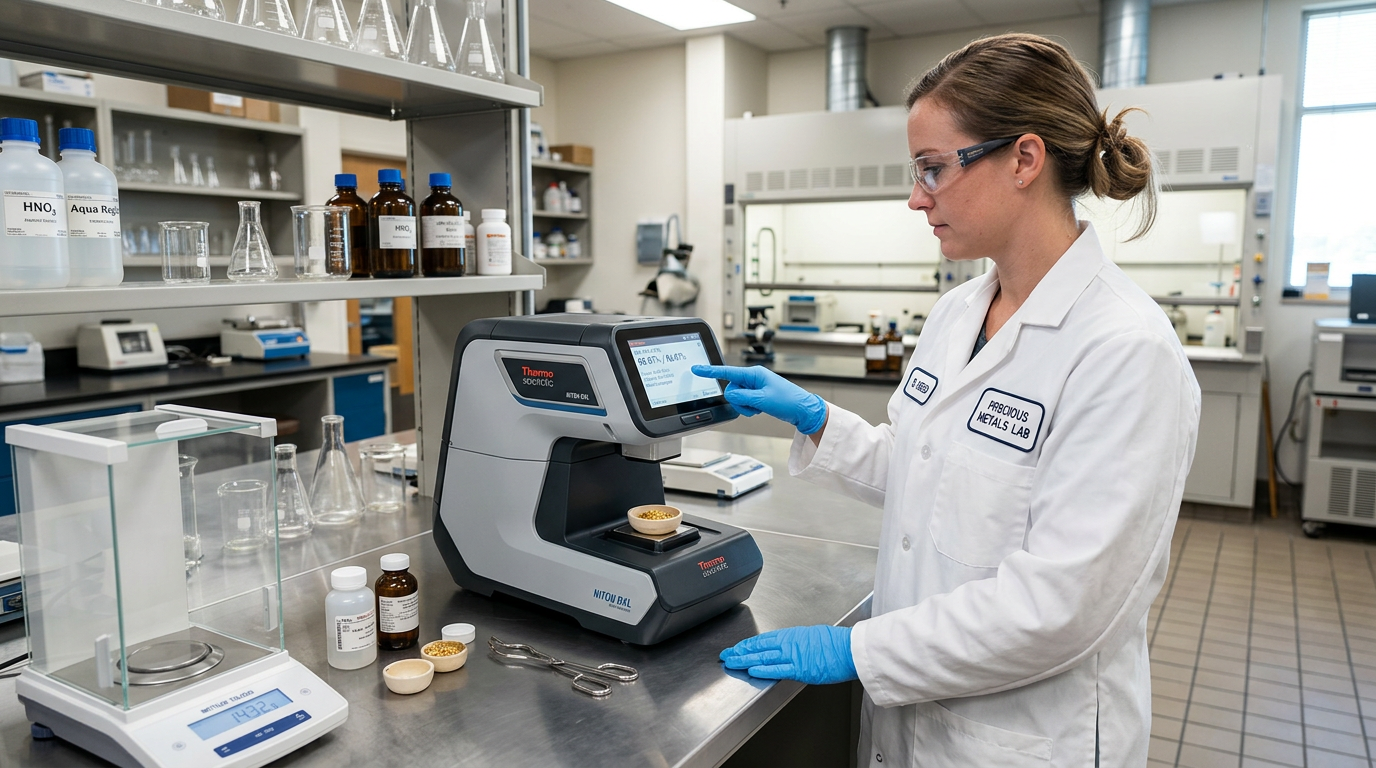
When calculating ROI, many buyers only look at the sticker price. However, the maintenance costs for a handheld are significantly higher. The detector window on a handheld is exposed. If a sharp piece of scrap jewelry punctures that window, the detector (which is under a vacuum) will be destroyed. Replacing an SDD detector can cost 40% of the original price of the machine. Desktop units, where the sample is placed on a protective plate, rarely suffer such catastrophic failures.
Conversely, a handheld unit can pay for itself in a single afternoon if it prevents the purchase of a 10-ounce gold-plated copper bar. For a mobile buyer, the “Loss Prevention” ROI is immediate and massive.
Future Trends for 2026 and Beyond
As we look toward the end of the decade, the lines between handheld and desktop are blurring. We are seeing the rise of Hybrid Systems—handheld units that can be docked into a desktop stand with integrated interlocks and a larger screen. These systems offer the best of both worlds, though they currently carry a premium price tag. Additionally, AI-driven “Spectral Fingerprinting” is becoming common, allowing machines to identify specific counterfeit patterns from global databases in real-time.
Conclusion: The Strategic Verdict
For the Pawnshop: Invest in a Desktop SDD system. The consumer trust, safety, and repeatability are worth the loss of portability. It is a retail investment that builds brand authority.
For the Mobile Buyer: Invest in a Premium Handheld SDD. Do not settle for Si-PIN; the speed of an SDD in the field is a competitive advantage that will allow you to process more deals and catch more fakes.
For the Refinery: You need a multi-instrument strategy. Handhelds for the dock, and a high-end WDXRF or Vacuum-EDXRF benchtop for the laboratory. Anything less is leaving money on the table through “assay variance.”
Comprehensive FAQ (10+ Questions)
Which is better for testing small gold pins and chains?
The desktop unit is vastly superior for small items. Its integrated camera and 0.5mm collimator allow you to pinpoint the X-ray beam onto a single link of a chain. Handheld units have a wider beam and often “see” the background plate, which can distort the results of very small items.
Can a handheld XRF detect Osmium or Iridium?
Yes, but it requires a high-performance SDD detector and a longer test time (at least 30-60 seconds). These elements are very dense and have complex spectral signatures that a cheaper Si-PIN detector might miss or misidentify as Gold.
Do I need a license to own an XRF?
In most countries, yes. You generally need to register the device with your national or regional nuclear regulatory agency. Desktop units often have a simpler registration process compared to “open-beam” handhelds. Check our regulatory standards guide for more details.
What happens if I drop my handheld XRF?
Most premium handhelds are designed to survive a drop, but the internal “X-ray tube alignment” is delicate. Even if the screen doesn’t crack, a drop can cause a shift in the geometry, leading to inaccurate readings. After any significant impact, the unit should be checked against a certified reference material.
Is the radiation from XRF dangerous?
XRF produces ionizing radiation, similar to a medical X-ray. However, the beams are very narrow. As long as you follow the “Never Point at People” rule and use the device according to the manual, the risk is negligible. For retail shops, the desktop’s closed-chamber design is the safest choice.
Can XRF distinguish between 22k and 24k gold?
Absolutely. Both handheld and desktop units are excellent at Karat identification. A 24k bar will show ~99.9% Au, while 22k will show ~91.6% Au and a balance of Copper or Silver. Even a basic Si-PIN detector can handle this task easily.
Why does my XRF give different readings on different spots of the same bar?
This is usually due to Surface Heterogeneity. XRF only measures the surface. If a bar was poorly smelted, the silver or copper might have “segregated” to one side. This is why refineries always drill or melt samples before final assay. Desktop units allow for multiple spot-tests to be averaged automatically.
How often should I recalibrate my machine?
Most manufacturers recommend a “Standardization” or “Normalization” check every day. A full factory recalibration with certified standards should be performed once a year to account for the natural aging of the X-ray tube and detector. See our maintenance guide for a schedule.
Can I test gold through a plastic bag?
Yes, but the plastic will slightly absorb the X-rays, particularly the weaker signals from elements like Silver or Copper. For the most accurate “Karat” reading, you should always test the bare metal. If you must test through plastic, use a dedicated “Plastic Compensation” mode if your software supports it.
What is the most expensive part of an XRF to fix?
The Detector and the X-ray Tube. Both are high-vacuum components. In a handheld, the detector is especially vulnerable. This is why desktop units, where these components are safely tucked away inside a heavy chassis, often have a lower long-term maintenance cost.
Can these machines detect “fake gold” made of Copper-Nickel alloys?
Yes, and they do it instantly. A Copper-Nickel alloy (like white gold look-alikes) will show 0% Gold and 100% Base Metals. This is the primary reason pawnshops invest in this technology—it eliminates the risk of “Acid Test” errors on sophisticated fakes.
Is XRF better than Fire Assay?
Fire Assay is the “Ultimate Truth” but it is destructive and takes hours. XRF is non-destructive and takes seconds. XRF is used for screening and trading, while Fire Assay is used for final settlement between refineries and miners. For a comparison of all methods, read our technical whitepaper.
The Mathematics of Accuracy: FP vs. Empirical Calibration
One of the most profound differences between handheld and desktop units lies in how they calculate the percentage of gold from the raw X-ray data. There are two primary methodologies used in 2026: Fundamental Parameters (FP) and Empirical Calibration.
Empirical Calibration: The “Library” Approach
Empirical calibration relies on a set of known standards. The manufacturer tests hundreds of certified gold coins and bars and creates a “curve.” When you test a sample, the machine looks for the closest match in its library. This method is incredibly accurate but rigid. If you test a “weird” alloy (e.g., gold mixed with an unusual amount of Manganese), the empirical curve will fail. Handheld units often rely heavily on empirical curves for speed, but this can lead to errors when encountering new types of “fake” jewelry.
Fundamental Parameters (FP): The “First Principles” Approach
FP is a complex mathematical model that calculates the composition based on the physics of X-ray interactions (absorption, enhancement, and scattering). It doesn’t need a library; it solves a series of simultaneous equations for every element detected. This is computationally expensive, requiring a powerful processor. Desktop units, with their superior processing power and stable geometry, are much better at running “Full-Matrix FP.” This allows a desktop analyzer to accurately quantify an alloy it has never seen before, which is a critical capability for refineries processing diverse industrial scrap.
Software, Data Management, and the 2026 Digital Ecosystem
In the modern era, an XRF is no longer an isolated tool; it is a node in a digital supply chain. The software capabilities of desktop and handheld units have diverged significantly to meet different business needs.
Desktop Connectivity: LIMS and ERP Integration
Desktop units usually run on a Windows-based architecture. This allows them to integrate directly with Laboratory Information Management Systems (LIMS) and Enterprise Resource Planning (ERP) software. In a refinery, the moment the XRF finishes a test, the results are automatically pushed to the accounting department to generate a payout for the customer. This “hands-off” data flow eliminates manual entry errors and provides a permanent, auditable record for regulatory standards guide compliance.
Handheld Connectivity: Cloud and Mobile Sync
Handheld units have evolved toward mobile-first connectivity. Most 2026 models feature built-in 5G and GPS. When a field buyer tests a bar in a remote location, the result—along with a photo of the item and the exact coordinates—is instantly synced to a cloud dashboard. This allows a central office to monitor “field buys” in real-time, providing an extra layer of security against rogue employees or fraudulent deals in the field.
Atmospheric Effects: The Role of Vacuum and Helium
A technical detail that separates professional lab units from standard analyzers is the management of the air between the sample and the detector. Air is a “filter”—it absorbs low-energy X-rays emitted by light elements like Magnesium, Aluminum, and Silicon.
Vacuum Systems
High-end desktop units utilize a vacuum pump to remove air from the chamber. This allows for the highest possible sensitivity. In a refinery, a vacuum system is essential for analyzing fluxing agents and slag, where light elements are the primary focus. Handheld units cannot maintain a vacuum at the point of contact, making them inherently “blind” to very light elements unless they use a Helium purge.
Helium Purge
Some premium handhelds and mid-range desktops offer a Helium purge option. Helium is “transparent” to low-energy X-rays. By flooding the path with Helium, the machine can “see” light elements without the mechanical complexity of a vacuum pump. However, this adds a recurring cost (Helium canisters) and is usually only seen in specialized refinery applications.
Scenario D: The Custom Jewelry Manufacturer
A jewelry manufacturer has a unique set of needs: they must ensure that their 18k gold casting is consistent and that their gold plating meets the legal minimums for “Vermeil” or “Gold Filled.”
The Case for the Micro-Spot Desktop
For a manufacturer, the desktop unit with a Micro-spot Collimator is the only viable choice. When testing a complex earring or a filigree pendant, a handheld beam is too large—it will catch the air or the sample holder, giving an inaccurate “average” reading. The desktop allows the QC technician to target the exact “gate” of the casting where porosity or segregation is most likely to occur. Furthermore, the desktop’s ability to measure plating thickness in nanometers is a requirement for meeting international export standards.
The 2026 Global Market: Future-Proofing Your Investment
As we look toward 2030, the precious metals market is becoming more regulated. “Conflict-free” gold and “Green Gold” certifications require a digital paper trail from the mine to the consumer. Investing in an analyzer that supports Blockchain-ready data exports is no longer an option—it is a necessity for future-proofing. When considering the price of these future-proof systems, refer to our 2026 purchasing guide to understand the premium for these advanced features.
Extended FAQ: Deep Technical Insights
Can XRF detect “Purple Gold” or other exotic alloys?
Yes. Purple Gold is an intermetallic compound of Gold and Aluminum. Because Aluminum is a light element, you will need a Desktop SDD unit with a vacuum or Helium purge to accurately quantify the Aluminum content. A standard Si-PIN handheld will likely only see the Gold, leading to an incorrect purity calculation.
Does the age of the X-ray tube affect the results?
Yes. X-ray tubes “age” over time, and their output spectrum can shift slightly. This is why annual service is critical. Desktop units often have “auto-calibration” routines that use an internal silver or copper reference to compensate for this aging, whereas handhelds usually require manual standardization.
Can XRF be used on wet or dirty samples?
No. XRF is a surface technique. Dirt, grease, or water on the surface will absorb X-rays and give you a false reading (usually lower than reality). Samples should always be cleaned with isopropyl alcohol or an ultrasonic cleaner before testing. In a refinery, “dirty” scrap is always melted into a clean button before the final XRF assay.
Why does my handheld sometimes say “Detecting…” for a long time?
This is usually the Auto-Dwell feature. If the machine detects a complex alloy or a trace element, it will automatically extend the test time to collect more photons to reach a statistically significant conclusion. This is a sign of a high-quality machine—it refuses to give a “guess” and instead waits for the data.
What is “Pulse Pileup” and does it affect my gold readings?
Pulse pileup occurs when two X-rays hit the detector at almost the exact same time, and the machine “sees” them as one high-energy X-ray. This can create “ghost peaks” in your spectrum. High-end SDD detectors in desktop units have advanced Pulse Processors that can “reject” these pileup events, ensuring the gold reading is not artificially inflated by background noise.
Can I use a car battery to power my desktop XRF in a mobile lab?
It is possible using a high-quality Pure Sine Wave inverter, but it is not recommended. Desktop units are sensitive to “power noise.” Fluctuations in voltage can affect the X-ray tube’s stability. If you need a mobile lab, a handheld or a purpose-built “Mobile Benchtop” with internal stabilization is a better investment.
Is there a difference in “Warm-up Time”?
Yes. Desktop tubes are larger and take 5-10 minutes to reach thermal equilibrium for maximum stability. Handheld tubes are tiny and are often ready in 60 seconds. However, for “Legal for Trade” measurements, a 15-minute warm-up is the industry standard for any desktop device.
Can XRF measure the thickness of Rhodium over White Gold?
Yes. This is a standard feature on most desktop jewelry analyzers. It is used by manufacturers to ensure they aren’t “over-plating” Rhodium (which is extremely expensive) or “under-plating,” which leads to the jewelry turning yellow quickly.
How do I know if my XRF is “Legal for Trade”?
In many regions, for an XRF result to be used for a financial transaction, the machine must be certified by a local “Weights and Measures” authority. This usually requires a desktop unit with a specific level of repeatability and a tamper-proof data log. Handhelds are rarely “Legal for Trade” and are usually classified as “Screening Tools.”
Can XRF detect synthetic or lab-grown diamonds?
No. Diamonds are Carbon, which is too light for standard XRF to detect. XRF can only analyze the metal setting. To test diamonds, you need a separate UV-Visible spectrometer or a Raman spectrometer.
Related Resources
Continue your research with these in-depth WiserMachine guides: