
 Xrf Gold Analyzer
 Handheld Alloy Analyzer
 Handheld Mining Analyzer
 Other XRF Analyzer
## 2026 Global XRF Compliance & Safety Matrix
As we navigate the mid-point of the decade, the landscape of X-ray Fluorescence (XRF) technology has transitioned from a specialized laboratory tool to a ubiquitous necessity in the global precious metals trade. With the surge in gold prices reaching historic highs and the intensification of secondary market transactions, managing XRF equipment radiation safety is no longer just a regulatory hurdle—it is a cornerstone of operational excellence. In 2026, compliance is not merely about having a certificate on the wall; it is about integrating real-time monitoring, advanced shielding materials, and rigorous emergency protocols into the very fabric of your business.
The evolution of XRF technology has brought about a paradoxical challenge: while machines have become more powerful and accurate, the regulatory oversight has become more granular and technologically demanding. Modern XRF analyzers emit ionizing radiation, which, while safely contained in high-quality systems, poses significant health risks if managed improperly. This deep-dive guide explores the sophisticated matrix of global regulations, hardware innovations, and safety benchmarks that define the industry today. Whether you are operating a high-volume refinery in Dubai or a boutique jewelry studio in New York, understanding these standards is critical to protecting your personnel, your legal standing, and your brand reputation.
1. The Regulatory Landscape: A Four-Region Comparison
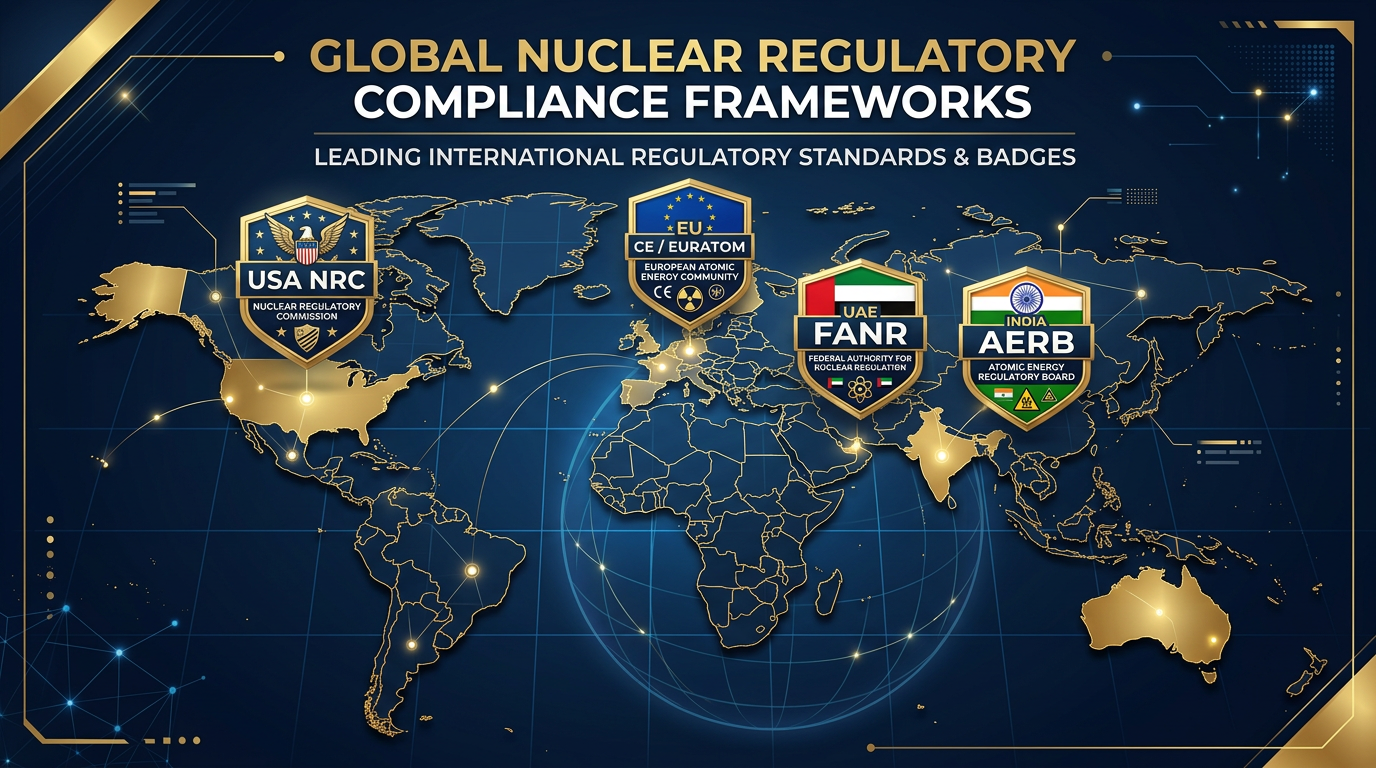
In 2026, regulatory bodies have harmonized many aspects of radiation safety, yet significant regional nuances remain. Failure to adhere to these specific mandates can result in heavy fines, equipment seizure, and the loss of operating licenses. Understanding the local “flavor” of regulation is as important as the physics of the machine itself.
United States: The NRC and Agreement States
In the USA, the Nuclear Regulatory Commission (NRC) maintains federal oversight, particularly through Title 10 of the Code of Federal Regulations (10 CFR). However, the complexity arises from the Agreement State program. Currently, 39 states have entered into agreements with the NRC to regulate radiation-producing machines and certain radioactive materials independently.
- 10 CFR Part 20: This remains the “bible” of radiation protection, setting the standards for protection against ionizing radiation. It mandates that no operator should exceed an annual effective dose of 5 rem (50 mSv), though most gold testing facilities aim for less than 1% of this limit.
- General vs. Specific Licensing: Most desktop gold analyzers in 2026 are designed to meet the requirements of a General License (10 CFR 31.5). This allows the user to own the device without a complex application, provided they do not open the internal housing and perform periodic leak tests. However, high-speed automated sorting lines often require a Specific License, necessitating a designated Radiation Safety Officer (RSO).
- State-Specific Registration: Even with a General License, owners must register their X-ray producing machines with state health or environmental departments (e.g., the Texas Department of State Health Services or the California Department of Public Health) within 30 days of acquisition. In 2026, many states have introduced “Instant Registration” portals that verify equipment via manufacturer-issued digital IDs.
- The Role of the RSO: In the US, the RSO is the primary point of contact for regulators. They are responsible for maintaining the “Radiation Safety Program,” which includes training records, dosimetry logs, and annual audits.
European Union: CE Marking and Euratom Directives
The EU continues to follow the 2013/59/Euratom Directive, which establishes basic safety standards for protection against the dangers arising from exposure to ionizing radiation. In 2026, the implementation has matured, focusing on the professionalization of safety roles.
- BSS (Basic Safety Standards) Directive: This directive mandates that all member states regulate the “justification” of radiation practices. In the context of gold testing, this means proving that XRF is the most effective non-destructive method available.
- CE Marking and the Machinery Directive: Any XRF device sold in the EU must bear the CE Mark. By 2026, this certification also requires compliance with the Artificial Intelligence Act for machines using AI-driven analysis, ensuring that the software controlling the X-ray tube is robust against glitches.
- Radiation Protection Expert (RPE) vs. Radiation Protection Officer (RPO): The EU distinguishes between the RPE (a highly qualified consultant) and the RPO (an on-site employee). Most jewelry businesses must have a contract with an RPE to perform annual system validations.
- Inventory Control: Businesses are required to maintain a digital ledger of all radiation-emitting devices. This ledger is often synced with national “Source Tracking” databases to prevent “orphan sources” (lost or abandoned machines).
United Arab Emirates: FANR Regulations
The UAE, particularly Dubai, has become a global hub for gold. The Federal Authority for Nuclear Regulation (FANR) enforces some of the strictest and most efficient safety standards in the world, aligned with the UAE’s “Vision 2031” for a safe and advanced economy.
- Regulation 24: This regulation specifically covers the Basic Safety Standards for Facilities and Activities involving Ionizing Radiation. It requires all gold testing labs to obtain a license before importing or operating XRF equipment.
- FANR-REG-13: Focuses on the safe transportation of radioactive materials. While most modern XRFs use tubes (not sources), this remains relevant for older isotope-based units still in use for specialized mineral analysis.
- e-Services Portal: In 2026, all licensing, reporting, and renewal processes are handled through FANR’s advanced digital portal. A unique feature is the “Integrated Customs Clearance,” where the import permit is automatically verified by Dubai Customs before the equipment lands.
- Inspection Checklist: FANR inspectors focus heavily on “Safety Culture”—probing whether staff actually understand the emergency buttons, rather than just checking if the buttons work.
India: AERB and the e-LORA System
India’s Atomic Energy Regulatory Board (AERB) has completely modernized its oversight through the e-LORA (Electronic Licensing of Radiation Applications) system, making it one of the most transparent regulatory frameworks in Asia.
- Type Approval: No XRF machine can be sold in India unless the manufacturer has obtained Type Approval from the AERB. This involves testing the prototype for radiation leakage under “worst-case” scenarios.
- Registration of User: The end-user must register as an “Institute” on e-LORA and then apply for a license to operate the specific equipment. In 2026, this process takes approximately 10-15 business days.
- Nominated Safety Officer (SO): Every facility must nominate a Safety Officer. For gold analyzers, the SO must have a science degree and have passed an AERB-approved training course on radiation safety.
- Periodic Safety Reports (PSR): Users are required to submit an annual safety report via e-LORA, confirming that the equipment is functioning correctly and that no overexposures occurred.
For a detailed breakdown of how these standards apply specifically to gold testing, visit our Gold Testing Compliance & Regulatory Standards Guide.
2. Shielding Materials: The Physics of Protection
Shielding is the primary defense against scattered radiation. In 2026, the industry has undergone a “Green Shielding Revolution,” moving away from traditional lead due to environmental toxicity and the need for lighter, more durable materials.
The Physics of Scattering
When an X-ray beam hits a gold sample, not all photons are absorbed. Many are scattered in different directions—a phenomenon known as Compton Scattering. Effective shielding must block both the primary beam and this secondary “scattered” radiation. The efficacy of a shielding material is determined by its Linear Attenuation Coefficient (μ), which depends on the material’s density and atomic number (Z).
Lead-Free Shielding: Why It Matters
Traditional lead (Z=82) is a superb attenuator but is increasingly restricted under RoHS (Restriction of Hazardous Substances) and REACH regulations. In 2026, “Lead-Free” is a major selling point.
Bismuth-Based Composites: Bismuth (Z=83) is the closest non-toxic neighbor to lead. When embedded in high-density polymers, it provides excellent protection for low-to-medium energy X-rays (typical of gold analyzers).
Tungsten-Polymer: The 2026 Gold Standard
Tungsten-polymer has emerged as the premium choice for XRF shielding. This composite material mixes tungsten powder (Z=74) with a polymer resin, creating a flexible, high-density material.
- Efficacy: While tungsten has a lower atomic number than lead, its high density (19.3 g/cm³ vs lead’s 11.3 g/cm³) allows it to be more effective in a thinner profile for certain energy levels.
- Durability: Unlike lead, which is soft and can “creep” (flow) over time, tungsten-polymer maintains its structural integrity. This ensures that no “shielding gaps” develop due to mechanical stress or gravity.
- Non-Toxicity: Tungsten is considered non-toxic, making it safe for handle-adjacent components in handheld devices and reducing disposal costs at the end of the machine’s life.
- Complex Geometry: Tungsten-polymers can be 3D printed or injection molded. This allows manufacturers to create “wraparound” shielding that follows the contours of the X-ray tube, eliminating the need for bulky lead-lined boxes.
3. Advanced Dosimetry: Monitoring Exposure in Real-Time
In 2026, the passive “film badge” that you send to a lab once a month is a relic of the past. Modern dosimetry is active, digital, and connected to the cloud.
Thermoluminescent Dosimeters (TLD)
TLDs remain the “standard of record” for many regulators. They contain crystals (like Lithium Fluoride) that trap electrons when exposed to radiation.
The 2026 Update: Modern TLDs are now RFID-enabled. An operator simply walks past a reader, and their “last check-in” is logged. While they still require periodic heating and reading in a lab, the administrative burden has been halved.
Electronic Personal Dosimeters (EPD): The “Active” Revolution
The Electronic Personal Dosimeter (EPD) is the standard for high-volume 2026 operations. These devices use silicon diode sensors to provide real-time dose rate and cumulative dose readings.
- Instant Alarms: EPDs can be programmed with dual thresholds: a “Warning” level (e.g., 10 μSv/hr) and an “Emergency” level (e.g., 100 μSv/hr). This provides immediate feedback if an operator is standing too close to a machine with a compromised cabinet.
- IoT Integration: Modern EPDs sync via Bluetooth to a centralized safety dashboard. If an operator in a New York branch exceeds their daily limit, the RSO at the London headquarters receives an instant notification.
- Live Exposure Mapping: By correlating EPD data with the machine’s operational logs, businesses can identify “hot zones” in their lab and adjust the floor plan to increase the distance between staff and the analyzers.
Dose Limits and Biological Effects
In 2026, we have a much better understanding of Stochastic Effects (long-term risks like cancer) vs. Deterministic Effects (immediate damage like skin burns). The global consensus has shifted toward lower “Public Dose Limits,” and businesses that keep their staff below 1 mSv/year (the public limit) are viewed as industry leaders in safety.
4. Emergency Protocols: Managing “Stuck Shutter” and Other Events
A “Stuck Shutter” occurs when the mechanical or electronic mechanism that blocks the X-ray beam fails to close. While rare in high-quality machines, it represents the most critical emergency scenario.
The “Stuck Shutter” Response Plan
- Detection: The machine’s “X-ray On” indicator (typically a red light) remains lit even after the countdown ends. The EPD alarm may also trigger.
- Immediate Action: DO NOT open the chamber. DO NOT reach into the beam path. Use the Emergency Stop (E-Stop) button immediately.
- Total Power Isolation: Turn off the main power switch and unplug the device from the wall. In 2026, many machines have a “Gravity Drop Shutter” that automatically falls into place when power is lost.
- Evacuation and Exclusion: Move all personnel to a distance of at least 5 meters. Secure the room and post a “Radiation Danger – Authorized Personnel Only” sign.
- Notification Chain:
- Inform the RSO immediately.
- Contact the manufacturer’s technical support. For maintenance tips to prevent shutter fatigue, see our XRF Gold Analyzer Maintenance & Calibration Guide.
- Log the incident: Record the time of the failure, the estimated time the beam was on, and the EPD readings of anyone in the room.
- Regulatory Reporting: In many jurisdictions (like the UAE and USA), a shutter failure that results in an unshielded beam must be reported to the national authority within 24 hours.
Fire and Natural Disasters
In the event of a fire, X-ray tubes are generally safe because they stop producing radiation as soon as power is lost. However, if you are using an older isotope-based unit, the radioactive source must be protected. The RSO must include “Source Recovery” in the fire department’s briefing.
5. Standard Operating Procedures (SOP) and Training in 2026
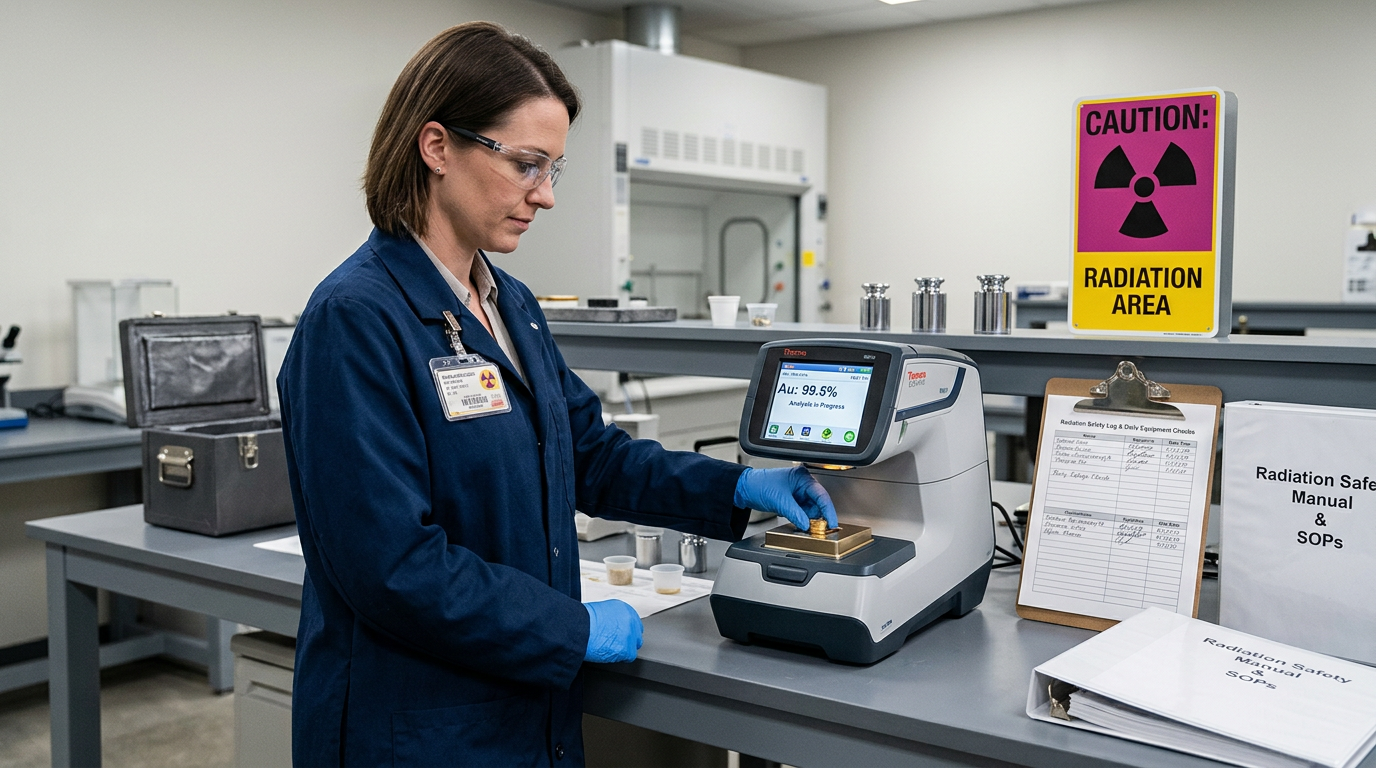
A robust SOP is the most effective tool for preventing accidents. In 2026, the best SOPs are digital, interactive, and integrated into the machine’s software.
The Digital SOP
Modern XRF analyzers require the operator to complete a “Safety Checklist” on the touch screen before the first test of the day. This includes:
– Verifying the interlocks (opening the lid to ensure the tube shuts off).
– Checking the “X-ray On” light.
– Confirming that everyone in the room is wearing their dosimetry badge.
Training Curriculum for 2026
Gone are the days of a 20-minute video. A modern RSO training program (typically 3 days) covers:
1. Basic Radiation Physics: Understanding kV, mA, and the inverse square law.
2. Biological Effects: How X-rays interact with DNA and the importance of shielding sensitive organs (like the eyes and thyroid).
3. Regulatory Compliance: Navigating e-LORA, FANR portals, and NRC filings.
4. Practical Workshops: Performing radiation surveys with a Geiger counter and managing mock emergency scenarios.
Record Keeping: The Compliance Audit
When an inspector walks into your lab in 2026, they will ask for:
– Training Records: Certificates for every operator.
– Dosimetry Logs: Monthly or quarterly reports from your dosimetry service.
– Leak Test Reports: Evidence that the machine’s shielding has been checked for physical damage or radiation leakage.
– Maintenance Records: Proof of annual calibration and safety interlock testing.
If you are planning to upgrade your facility, ensure you factor in these compliance costs by reviewing our Global Gold Analyzer Price & Purchasing Guide 2026.
6. FAQ: Deep-Dive into 2026 Radiation Safety & Compliance
Q1: Is the radiation from an XRF analyzer the same as a medical X-ray?
A: Yes, the physics is identical. However, an XRF analyzer uses a much narrower, lower-power beam focused on a small sample area. Medical X-rays are designed to penetrate the human body, whereas XRF X-rays are optimized for surface and near-surface elemental analysis.
Q2: Do I need to wear a lead apron when using a desktop gold analyzer?
A: No. Desktop units are Fully Enclosed Systems. The shielding is built into the cabinet. As long as the interlocks are working, no radiation escapes the box. Aprons are typically only required for handheld units used in open environments or for high-power industrial X-ray systems.
Q3: How often should I calibrate my Geiger counter for leak testing?
A: In 2026, most regulations require annual calibration of survey meters at an accredited laboratory. Some modern meters now feature “Self-Calibration” checks against an internal reference, but a formal lab calibration is still the legal requirement.
Q4: Can I buy an XRF machine from a different country and use it locally?
A: Technically yes, but you will face massive hurdles. You must prove the machine meets local “Type Approval” (e.g., AERB in India or CE in Europe). If the manufacturer doesn’t have a local representative to support the licensing process, you might end up with an expensive “paperweight.”
Q5: What is the “Inverse Square Law” and why does it matter?
A: It states that radiation intensity decreases by the square of the distance. If you double your distance from a radiation source, your exposure drops to one-fourth. This is why “Distance” is a key pillar of the ALARA principle.
Q6: Are there any long-term health risks for daily XRF operators?
A: If used correctly, there is no measurable increase in health risk. Modern safety standards ensure that occupational exposure is kept well below the levels where health effects have been observed. The primary risk comes from “circumventing” safety features (e.g., taping down an interlock switch).
Q7: Does XRF testing make the gold radioactive?
A: No. X-rays do not have enough energy to affect the nucleus of the atom (which causes radioactivity). They only interact with the electrons. Once the power is off, the radiation is gone, and the sample is completely safe to handle.
Q8: What should I do if my dosimetry badge shows a “high reading”?
A: The RSO must conduct a Dose Investigation. They will interview you to see if the badge was accidentally left near the machine or if an actual exposure occurred. You may be temporarily reassigned to non-radiation duties while the investigation is pending.
Q9: Is it legal to sell a used XRF machine?
A: Yes, but you must “de-register” the machine with your local authority and ensure the buyer has the necessary licenses to receive it. Selling a machine to an unlicensed party can result in severe legal penalties for the seller.
Q10: What is the difference between a “General License” and a “Specific License” in the US?
A: A General License is “built-in” to the product by the manufacturer and has fewer administrative requirements. A Specific License is issued to the user and requires a full radiation safety program, an RSO, and regular inspections.
Q11: How does “Tungsten-Polymer” compare to “Lead” in terms of environmental impact?
A: Lead is a heavy metal that can leach into groundwater if disposed of in a landfill. Tungsten is much more stable and is not classified as a hazardous waste in most jurisdictions, significantly reducing the “Total Cost of Ownership” regarding disposal.
Q12: Can I operate an XRF if I have a pacemaker?
A: Generally, yes. The X-rays themselves do not interfere with pacemakers. However, the high-voltage power supplies inside the machine can generate electromagnetic interference (EMI). You should consult with your doctor and the machine manufacturer to ensure the EMI shielding is adequate.
Q13: What is “Background Radiation” and how does it affect my dosimetry?
A: Background radiation comes from outer space, the earth, and even our own bodies. Dosimetry services use “Control Badges” to subtract this background level from your personal badge, ensuring they only report the occupational dose you received from the XRF.
Q14: Are modern XRF machines “AI-Safe”?
A: In 2026, “AI-Safe” refers to software that prevents the X-ray tube from firing if the AI detects an “Anomalous Condition” (like a human finger in the chamber instead of a gold bar). This is an extra layer of “Active Safety.”
Q15: What is the most common cause of radiation accidents with XRF?
A: Human error—specifically, the intentional bypassing of safety interlocks to test samples that are too large for the chamber. Always use the machine as intended by the manufacturer.
Conclusion
Managing XRF equipment radiation safety in 2026 is a dynamic challenge that requires a blend of technological savvy, physical understanding, and regulatory discipline. By embracing tungsten-polymer shielding, EPD dosimetry, and a culture of ALARA, businesses can not only meet global compliance standards but also foster a safer, more productive environment for their employees. As the industry continues to evolve, staying informed through updated guides and rigorous training remains your best defense against the invisible risks of the trade. Compliance is not just a destination; it is an ongoing journey of safety excellence.
7. Future-Proofing Your Lab: The 2027-2030 Roadmap
As we look beyond 2026, the trajectory of XRF equipment radiation safety is moving toward “Passive Autonomy.” The next generation of analyzers is expected to integrate quantum-based radiation sensors that are infinitely more sensitive than current silicon diodes. These sensors will be able to detect “micro-leaks” before they become a regulatory concern, allowing for predictive maintenance that preempts hardware failure.
Furthermore, the integration of Blockchain for Compliance is on the horizon. In this scenario, every X-ray pulse fired by a machine is logged on a private blockchain, creating an immutable record of usage and safety checks. For high-stakes refineries, this level of transparency will be a requirement for “Conflict-Free Gold” certifications, linking safety and ethics in a way never seen before.
8. The Economic Case for Safety: ROI of Compliance
Many business owners view radiation safety purely as a cost center. However, in 2026, the ROI (Return on Investment) of a high-standard safety program is quantifiable.
- Reduced Insurance Premiums: Insurance providers for the jewelry and metal industries now offer “Safety Discounts” (up to 15%) for labs that utilize EPDs and maintain a zero-incident record for three consecutive years.
- Asset Resale Value: A used XRF analyzer with a full, documented service history and AERB/FANR compliance records can command a 20-30% higher price on the secondary market than an uncertified unit. Buyers in 2026 are wary of “compliance debt.”
- Employee Retention: In a competitive labor market, technicians are increasingly choosing to work at facilities that prioritize their long-term health. A transparent dosimetry program is a powerful recruitment tool.
9. Global Expansion: Canada (CNSC) and Australia (ARPANSA)
As businesses expand, understanding the “Tier 2” markets is essential.
Canada (CNSC): The Canadian Nuclear Safety Commission regulates XRF devices under the Nuclear Safety and Control Act. Most gold analyzers are “Exempt” from licensing if they are used within a closed cabinet, but they must still be “Design Certified” by the CNSC.
Australia (ARPANSA): The Australian Radiation Protection and Nuclear Safety Agency sets the national codes, but enforcement is state-based (e.g., EPA in NSW, Department of Health in WA). Australia is notable for its strict “Competence Requirements,” where every operator must hold a state-issued “User License” after passing a formal examination.
10. Internal Audit Checklist: A 10-Point Readiness Test
Before your next official inspection, run this internal audit to identify gaps in your safety program:
1. License Validity: Is your FANR/AERB/State license current and displayed near the machine?
2. RSO Credentials: Has your Radiation Safety Officer’s certification been renewed in the last 24 months?
3. Interlock Integrity: Does the X-ray beam terminate immediately (within <0.5 seconds) when the chamber is opened?
4. Dosimetry Assignment: Is there a unique, serialized badge for every employee, including part-time staff?
5. Warning Systems: Are the “X-ray On” lights visible from all angles of the room?
6. Shielding Inspection: Are there any visible cracks or dents in the analyzer’s housing?
7. Documentation: Are the last three years of leak test results easily accessible in a digital folder?
8. SOP Accessibility: Is the emergency shutdown procedure printed and posted within 1 meter of the machine?
9. Training Logs: Is there a signature from every employee confirming they have read the latest safety manual?
10. Environmental Monitor: Does the lab have a wall-mounted area monitor to track general room levels?
Closing Thoughts on Global Compliance
The transition to 2026 has proven that XRF equipment radiation safety is no longer a static requirement—it is a competitive advantage. By investing in lead-free shielding and real-time dosimetry, you are not just checking a box; you are building a resilient, future-proof business. As regulations continue to tighten, the organizations that thrive will be those that see safety not as a burden, but as the foundation of trust in the global gold market. For more information on navigating these complex waters, keep our guides bookmarked and stay ahead of the regulatory curve.
Related Resources
Continue your research with these in-depth WiserMachine guides: