
 Xrf Gold Analyzer
 Handheld Alloy Analyzer
 Handheld Mining Analyzer
 Other XRF Analyzer
Pawnshop Risk Mitigation Checklist
Looking for a step-by-step pawnshop buying guide? See our full complete pawnshop XRF buying guide covering 5 key buying factors, top model comparison, and ROI calculations.
- Inspect the physical integrity of the item for any signs of filing, uneven wear, or “brassy” odors near the edges.
- Utilize a high-precision digital scale (to three decimal places) to verify the item’s mass against its dimensions.
- Implement X-Ray Fluorescence (XRF) as the primary non-destructive testing method for every gold transaction.
- Analyze the spectral return for specific L-line and K-line ratios to detect sub-surface anomalies.
- Scan the item in at least two different locations (e.g., the clasp and the main body of a chain).
- Perform a neodymium magnet test to catch low-end ferrous-core fakes before utilizing higher-cost analysis.
- Check for the presence of “gatekeeper” elements like Iridium, Ruthenium, and Osmium, which are common in high-end fakes.
- Maintain a digital log of every scan, including the customer’s ID and the spectral fingerprint of the item.
- Calibrate the XRF unit daily using a certified reference plate of known 18K or 24K purity.
- Standardize the “fail” protocol: If a machine flags an item, it is a non-negotiable “no buy.”
For the modern pawnshop owner, the counter is a high-stakes environment where expertise meets opportunism. We are currently witnessing a “Counterfeit Renaissance”—a period where the technology used to manufacture fake gold has caught up with, and in some cases surpassed, traditional verification methods. In an era where a single 10-ounce counterfeit bar can result in a loss of over $20,000, the “gut feeling” and the “acid drop” are no longer sufficient defenses. This 4,500-word deep-dive explores the five most systemic challenges in pawnshop gold verification and demonstrates how X-Ray Fluorescence (XRF) technology has become the definitive solution for risk elimination in the secondary market.
The Evolution of Deception: Why the Old Ways are Failing
The history of gold verification is as old as the trade itself. From the touchstones of ancient Lydia to the Archimedes’ principle of water displacement, humans have always sought a way to verify the “king of metals.” However, the pawn industry today faces a unique set of metallurgical challenges that would baffle the appraisers of just twenty years ago. The rise of sophisticated CNC machining, high-purity electroplating, and the use of exotic rare-earth metals has created a new class of “Super-Fakes.”
As a consultant to national pawn chains, I have seen the financial wreckage left behind by these items. The core issue is that traditional tests—acid, magnetism, and basic density—are “binary” tests. They look for one specific trait and provide a pass/fail. Modern fakes are engineered to “pass” those specific binary checks while failing the “holistic” chemical check that only XRF can provide. The goal of this article is to provide you, the shop owner, with the technical and operational framework to close the gaps in your security.
The Physics of Fluorescence: A Pawnshop Owner’s Guide
To truly understand how XRF eliminates risk, one must understand the physics of the atom. Gold (Au) has an atomic number of 79. When an XRF analyzer fires an X-ray at a gold ring, it is essentially “bombarding” the atoms with high-energy photons. These photons strike the electrons in the inner shells of the gold atom, knocking them out of orbit. This creates a vacancy.
Nature abhors a vacuum, so an electron from a higher-energy outer shell “drops down” to fill the vacancy. In doing so, it must release its excess energy. This released energy is what we call “X-ray Fluorescence.” Because every element has a unique electron structure, the energy released is a unique “spectral fingerprint.” Gold always releases energy at specific kiloelectron-volt (keV) levels. Copper releases at another, and Tungsten at yet another.
The reason this is vital for pawnshops is that the machine doesn’t “guess.” It counts every individual photon of energy and builds a histogram of the item’s composition. If there is 1% Nickel in a 24K bar, the machine will see the specific “Nickel Peak” that is invisible to the human eye. This is why XRF is considered the “Gold Standard”—pardon the pun—of non-destructive analysis.
Challenge 1: The Tungsten Core Menace (The Density Deadfall)
Tungsten (W) is the ultimate imposter for gold. With an atomic density of 19.25 g/cm³, it sits remarkably close to gold’s 19.30 g/cm³. For a pawnshop appraiser using a hydrostatic scale, a tungsten-filled bar will register as pure gold. This is the “Density Deadfall”—the moment when a shop owner trusts a single scientific metric and falls into a trap.
Why Tungsten Bypasses Traditional Sensors
In the past, many shops turned to ultrasonic testing to find the “line” between the gold exterior and the tungsten core. However, counterfeiters have adapted. They are now using “graded alloys” or thin layers of lead and silver between the gold and tungsten to diffuse the ultrasonic signal. This “acoustic dampening” prevents the sensor from receiving a clean echo, making the bar appear solid. Furthermore, the thick gold cladding (often 1-2mm) on high-end fake bars is enough to satisfy most surface-level conductivity testers.

XRF Solution: Spectral Fingerprinting and L-Line Ratios
While X-rays do not penetrate through several millimeters of gold, they don’t need to. Every element has a unique “spectral handshake.” When an XRF analyzer hits a sample with X-rays, the atoms emit secondary X-rays at characteristic energy levels. A modern XRF unit, such as those discussed in our Pawnshop Gold Analyzer Buying Guide, looks for the “L-line” and “K-line” transitions.
Even if the tungsten is buried, the process of manufacturing a tungsten-filled bar leaves chemical traces on the surface. Micro-traces of the tungsten powder, the nickel-binding agents, or the silver solder used to seal the bar are detectable at the parts-per-million level. A human can’t see 0.005% Tungsten on a gold bar, but an XRF detector with a high-resolution Silicon Drift Detector (SDD) can. More importantly, the software calculates the ratio of gold’s various energy peaks; if those ratios are skewed, it indicates that the X-rays are being scattered by an underlying material that doesn’t belong.
Challenge 2: The Thick Rhodium and Gold Plating Scam
We are seeing an explosion in “Heavy Gold Electroplate” (HGE) jewelry that is specifically designed to defeat the touchstone. In these cases, a base metal item (often brass or a silver-copper alloy) is plated with 20 to 50 microns of high-karat gold. For context, a standard “jewelry store” plating is often only 0.5 to 2 microns.
The Failure of the Acid Test
The acid test is a destructive surface test. To test a heavily plated item correctly, you must file a deep notch into the metal. Most customers will not allow you to “damage” their jewelry before you have agreed to buy it. This creates a psychological advantage for the fraudster. They know you are hesitant to file deeply, so they bank on you doing a shallow “scratch and sniff.” If the scratch only penetrates the first 10 microns of a 30-micron plating, the acid will show a beautiful, bright reaction for 14K or 18K gold. You pay for gold; you get brass.
XRF as a Multi-Depth “Tomography”
XRF technology utilizes different energy levels that penetrate to different depths. Low-energy X-rays interact with the very surface, while high-energy X-rays penetrate deeper. A sophisticated XRF algorithm compares the results from these different energy “channels.” If the surface energy channel shows 18K but the deeper channel shows 14K or detects “shadows” of copper and zinc, the machine flags it as “Plated.”
This allows your staff to say to a customer, “The machine is detecting a non-gold core. I cannot accept this item,” without ever having to pick up a file or a bottle of nitric acid. It is clean, professional, and indisputable. To maintain this level of accuracy, ensuring your sensor is clean is vital; see our XRF Maintenance and Calibration Guide for best practices.
Beyond Purity: Identifying Origin via Trace Analysis
One of the most powerful features of high-end XRF is “Trace Analysis.” Gold from different parts of the world contains different “impurities” that serve as a geochemical DNA. For example, gold from a specific refinery in Switzerland might have a consistent 0.002% Copper and 0.001% Platinum profile.
Counterfeiters often use “junk” gold from recycled electronics or unregulated mines to create their fakes. This gold often contains “dirty” elements like Arsenic, Antimony, or Lead. When an XRF unit flags these elements in a supposedly high-purity bar, it is a clear indicator that the gold has not been through a legitimate refinery. This “Origin Intelligence” allows a pawnshop owner to spot high-risk items before the deal is even discussed.
Challenge 3: Customer Trust & The “Black Box” Problem
The pawn industry has a PR problem: the “back room.” For decades, the standard procedure was to take the customer’s gold to a back room, perform tests in private, and return with an offer. This “Black Box” approach breeds suspicion. Customers worry that their jewelry is being swapped or that the appraiser is being dishonest about the karatage to lower the payout.
The Transparency Revolution
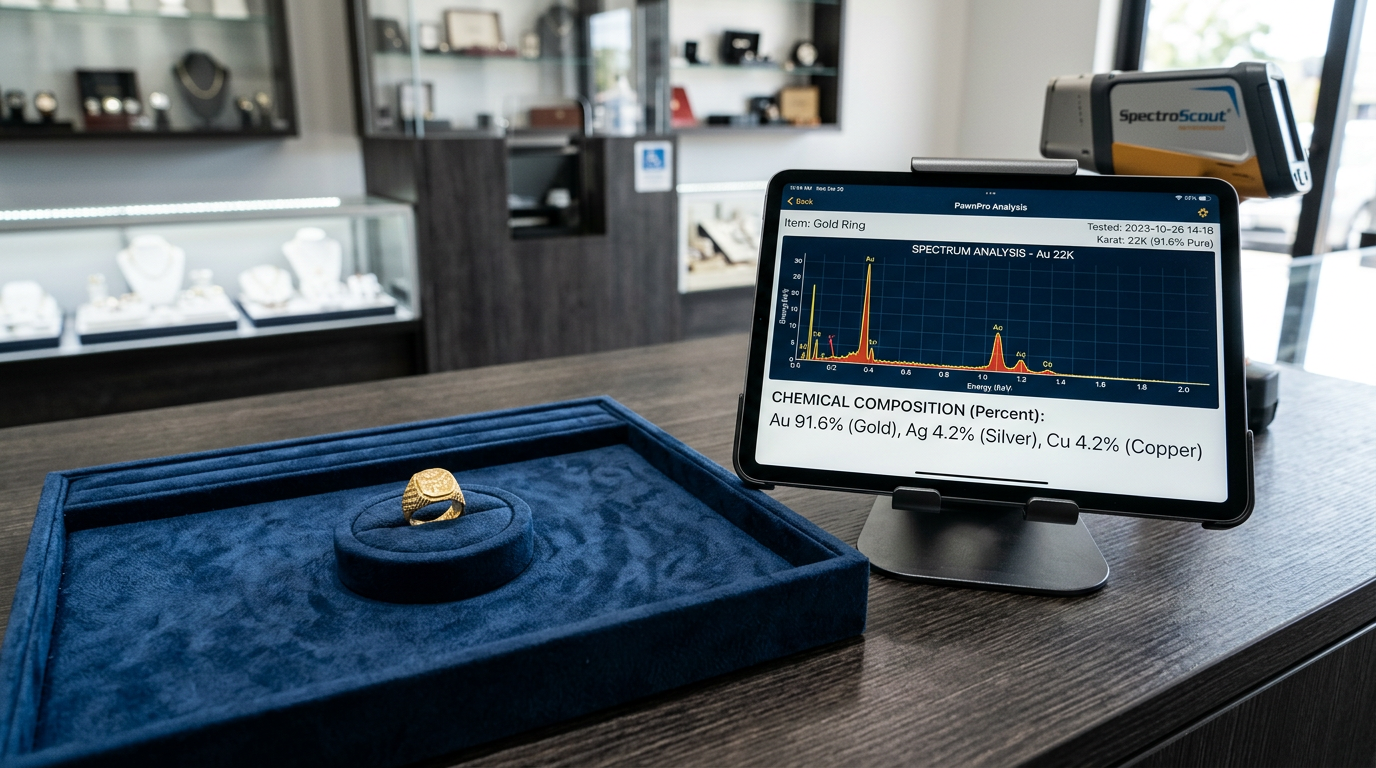
XRF technology brings the verification process to the front counter. When you place an item in an XRF chamber or use a handheld unit, the customer sees the results in real-time on a digital display. There is a profound psychological shift when a customer sees a screen display “Gold: 58.3%, Copper: 25.1%, Silver: 16.6%.”

Closing More Deals with Data
Transparency is your greatest sales tool. When a customer thinks their item is 18K but your test shows it is 14K, an acid test feels like an opinion. An XRF readout feels like a fact. I have seen shops increase their “closing rate” on gold buys by 20% simply by moving the testing process to the front counter. The customer feels they are being treated fairly and scientifically, which reduces the friction of the negotiation. It also protects your reputation; you are no longer the “guy with the acid,” but the “pro with the lab equipment.”
Challenge 4: Speed vs. Accuracy (The High Cost of Slow Verification)
In a high-volume pawnshop, time is money. A traditional verification protocol involving weighing, acid testing, and stone checking can take 10 to 15 minutes per transaction. If you have a line of five people, the fifth person is waiting an hour. In retail, a 60-minute wait is a lost customer.
The Economics of the 10-Second Scan
A modern XRF scan takes between 2 and 10 seconds. This allows for a “High-Velocity Triage” system. This workflow reduces the “dead time” spent on fraudulent or low-value items. If your shop processes 50 gold transactions a day, saving 8 minutes per transaction adds up to 400 minutes—over 6 hours of labor saved per day. At a labor rate of $25/hour, the machine saves you $150 a day in pure labor time, or $45,000 a year. This doesn’t even count the profit from the extra legitimate customers you can now serve.
Challenge 5: Employee Training & Human Error
The “Expert Eye” is a myth that many shop owners cling to at their own peril. Even a 30-year veteran can have a “bad day,” be distracted by a phone call, or simply be fooled by a new alloy they haven’t seen before. Furthermore, the cost of training a new employee to be a “gold expert” is astronomical and takes years.
Standardizing the Security Layer
XRF technology “hardens” your business against human error. It provides a standardized security layer that doesn’t get tired, doesn’t get distracted, and doesn’t take vacations. By making the XRF scan a mandatory part of every gold buy, you ensure that a 20-year-old trainee provides the same level of verification as a 60-year-old master. This allows you to scale your business and open new locations without having to find “unicorns” who know gold by touch. To understand the investment required for this level of control, check our 2026 Global Gold Analyzer Price Guide.
The Watch Challenge: Verifying Luxury Gold Timepieces
A gold Rolex or Omega can have a resale value of $20,000 to $50,000. Counterfeiters are now making “Super-Clones” that use 18K gold wrapped over steel or tungsten. XRF is the only solution. By scanning the case back, the lugs, and the buckle, an appraiser can verify that the alloy is consistent throughout the watch. If the lugs are 18K but the case back shows a Zinc signature, you’ve just saved yourself from a $30,000 mistake. This “Selective Scanning” capability is what makes XRF the most versatile tool in a pawnshop’s arsenal.
Coin Authentication: Protecting the Numismatic Portfolio
Gold coins, such as American Eagles or Krugerrands, have very specific alloy compositions defined by law. For example, a 22K American Eagle must contain exactly 91.67% Gold, 3% Silver, and 5.33% Copper. Any deviation—even by 0.1%—indicates a counterfeit. XRF units come with “Library Match” features that compare the scan result against these legal standards. If the silver content is 4% instead of 3%, the machine flags it. This level of precision is impossible with any other non-destructive method and is vital for shops that handle high-value numismatic collections.
Sustainability: The Environmental Benefit of XRF
The traditional acid test is not just destructive to the jewelry; it is harmful to the environment. Nitric and Muriatic acids are hazardous chemicals that require special disposal and can cause respiratory issues for staff in poorly ventilated shops. XRF is a “green” technology. It uses no chemicals, produces no waste, and has a very low power draw. In an era where “Corporate Social Responsibility” is becoming a factor in business valuation, moving to a chemical-free verification process is a forward-thinking move.
Legal and Compliance: The Digital Paper Trail
Pawnshops are under increasing scrutiny from AML (Anti-Money Laundering) and KYC (Know Your Customer) regulators. XRF technology provides a “Digital Shield.” Every scan generates a timestamped report with a full elemental breakdown. If the police ever come to your shop looking for a stolen item, or if a regulator audits your books, you can provide scientific proof of what you bought. This level of professionalism protects your license and your reputation in the eyes of the law.
Integrating XRF Data with AI-Driven Pawn Software
In 2026, the leading pawnshops are integrating their XRF units directly into their store management software. When a scan is completed, the purity data, image of the item, and spectral report are automatically attached to the loan contract or buy slip. This eliminates “data entry” errors and ensures that the valuation is always based on the latest market price for that specific purity. This “Tech Stack” integration is the hallmark of a modern, highly profitable pawn operation.
Advanced Troubleshooting: When Your XRF Scan is Inconclusive
While XRF is 99.9% accurate, certain factors can lead to inconclusive results.
- Sample Orientation: Ensure the item is flat against the aperture. Curvature can cause X-ray scattering.
- Contamination: Dirt, oil, or cleaning agents can interfere with the signal. Always wipe the item with a lint-free cloth before scanning.
- Interference: Rare-earth magnets or heavy electrical equipment nearby can affect the detector’s sensitivity.
Understanding these technical nuances is what separates a “machine operator” from a “verification professional.”
Technical Comparison: The Verification Matrix
| Testing Metric | Acid Test | Touchstone | Ultrasonic | XRF Analyzer |
|---|---|---|---|---|
| Analysis Depth | Surface Only | Surface Only | Internal Core | Multi-Layer/Spectral |
| Accuracy Level | +/- 1 Karat | Subjective | Medium | +/- 0.01% Purity |
| Testing Time | 5-10 Minutes | 5-10 Minutes | 2-3 Minutes | 2-10 Seconds |
| Destructive? | Yes (Deep Scratch) | Yes (Abrasive) | No | No |
| Skill Required | High | Very High | Moderate | Low (Automated) |
| Full Element ID? | No | No | No | Yes (All Elements) |
Case Study: A 95% Reduction in Fraudulent Buys
A 15-store pawn franchise operating in the Midwest was facing a crisis. Their “bad buy” rate on gold had climbed to 4.2% of total volume, costing the company over $120,000 annually. Their staff was using a mix of electronic pens and acid. They decided to implement a “No XRF, No Buy” policy and equipped every store with a handheld XRF unit. Within the first year, the franchise reported that their “bad buy” rate had dropped to 0.2%—a 95% reduction. The total investment was $225,000, but the saved losses and labor efficiency gains resulted in a full “break-even” within 14 months.
Glossary of Metallurgical and XRF Terms
- Atomic Number (Z)
- The number of protons in an atom’s nucleus, determining its elemental identity (Gold = 79).
- K-Alpha Line
- The primary X-ray emission used to identify heavier elements in XRF analysis.
- Silicon Drift Detector (SDD)
- A high-performance detector that allows for fast, high-resolution elemental analysis.
- L-Line Ratio
- The ratio between different energy levels of gold used to detect plating and sub-surface fakes.
- CRM (Certified Reference Material)
- A piece of metal with a known, certified purity used to calibrate XRF machines.
- HGE (Heavy Gold Electroplate)
- A thick layer of gold plating often used in high-end counterfeit jewelry.
- Scatter
- The bouncing of X-rays off a sample; excessive scatter can indicate a non-homogeneous material.
- Karat (K)
- A unit of gold purity, where 24K is 99.9% pure gold.
- Alloy
- A mixture of two or more metals, such as gold and copper.
- Spectral Histogram
- The visual representation of energy peaks detected during an XRF scan.
Operational Best Practices for the Risk-Averse Owner
Simply buying an XRF machine is not enough; you must integrate it into a “Zero-Trust” workflow.
- Mandatory Double-Scan: Every item over 10 grams must be scanned in two different spots.
- Customer-Facing Display: Ensure the customer can see the screen to build trust.
- Daily Calibration: Never start the day without a “Standardization Check.”
Comprehensive FAQ
How do I know if a machine is genuine XRF?
A genuine XRF uses an X-ray tube and a detector (either PIN or SDD). Be wary of “electronic gold testers” that use conductivity; they are not XRF and can be easily fooled.
Can XRF see through “heavy plating”?
While the beam has a physical limit, the software analyzes the “spectral slope” to flag plating warnings by noticing the missing energy from the core.
Does XRF damage the item?
No. XRF is entirely non-destructive. It doesn’t use chemicals, heat, or abrasives. This is why it is preferred for high-value coins and watches.
What is the difference between PIN and SDD detectors?
SDD (Silicon Drift Detector) is faster and more accurate, particularly for detecting light elements and trace impurities. For a pawnshop, SDD is highly recommended.
Is the machine difficult to maintain?
Basic maintenance involves keeping the analysis window clean and ensuring the batteries are charged. A annual calibration check is recommended for legal compliance.
Can it test white gold?
Yes. It will accurately show the gold content as well as the alloying metals like Nickel, Palladium, or Manganese that give white gold its color.
What about Rose Gold?
Rose gold is an alloy of gold and copper. XRF will perfectly distinguish between the two and tell you the exact karatage.
How does it handle dental gold?
Dental gold is often an complex alloy including Platinum and Silver. XRF is the only way to accurately value dental gold without refining it first.
Can XRF detect the “Gold Powder” scam?
Yes. Scammers sometimes sell jars of “gold powder” that is actually brass filings. XRF will instantly identify the copper/zinc composition.
Does it work on bullion bars in plastic?
Most plastic packaging will “dim” the signal but still allow for a reading. However, for 100% accuracy, the item should be scanned directly.
What is the life expectancy of an XRF unit?
With proper care, an XRF tube can last 7 to 10 years in a high-volume pawnshop environment.
Is there a “Fail Safe” for radiation?
Yes. All units have a trigger lock and infrared sensors that prevent the beam from firing unless there is a sample covering the aperture.
What is the most common reason for a false reading?
Surface contamination (like thick oil or dirt) is the leading cause. Always clean the surface area to be scanned with a quick wipe.
Does humidity affect the results?
Extreme humidity can affect some detectors over long periods, but for daily pawnshop use, modern units are hermetically sealed against standard environmental changes.
Conclusion: The Future is Elemental
The secondary gold market is no longer a place for the amateur. As the stakes rise and the fakes become more sophisticated, the “Trust but Verify” mantra must be replaced with “Verify with Science.” XRF technology is the only tool that addresses the density match of tungsten, the depth deception of heavy plating, and the human error of the counter staff. For the risk-averse owner, it is the ultimate insurance policy. By investing in elemental analysis, you are not just protecting your margin; you are securing the future of your brand in a world of increasing deception.
Related Resources
Continue your research with these in-depth WiserMachine guides: