
 Xrf Gold Analyzer
 Handheld Alloy Analyzer
 Handheld Mining Analyzer
 Other XRF Analyzer
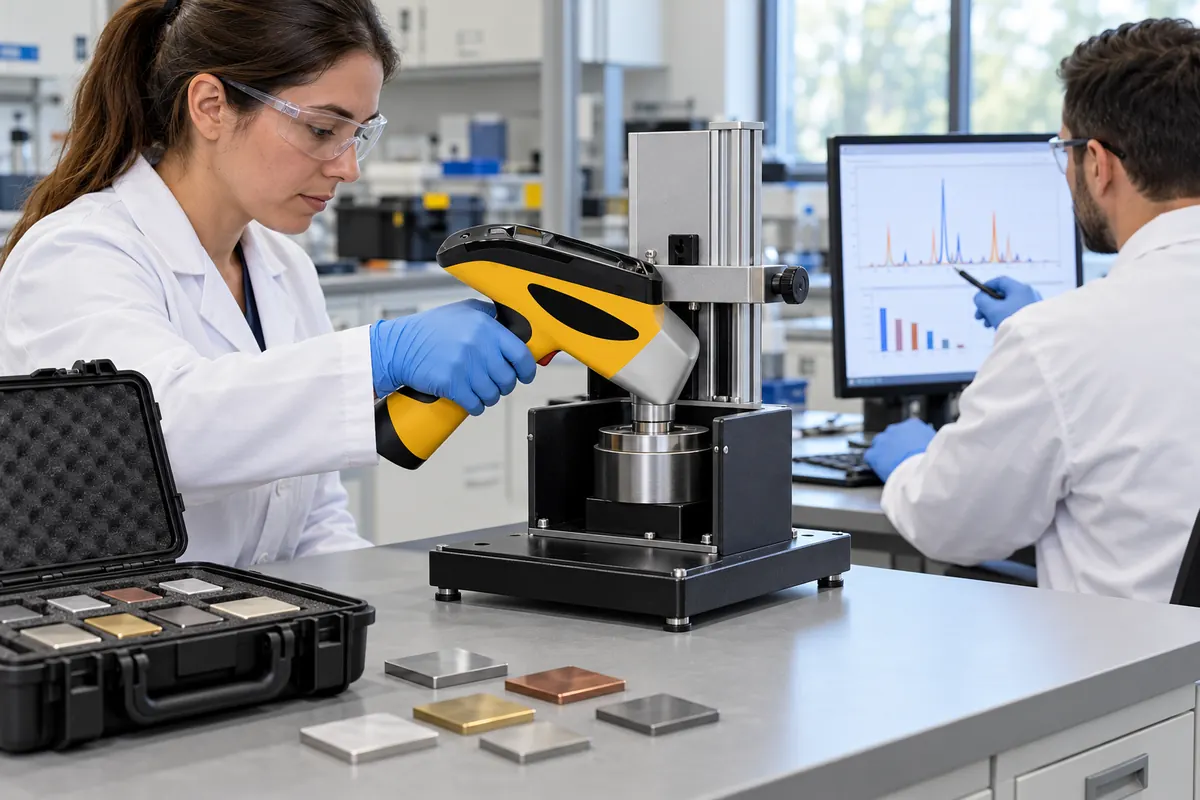
XRF proficiency testing compares a laboratory’s result with an assigned value or peer group under a structured scheme designed to evaluate participant performance. An interlaboratory comparison can also study a method or compare sites, but not every round robin is a formal proficiency test. Use sufficiently homogeneous and stable items, routine methods, predefined statistics and documented investigation of unsatisfactory results.
Quick answer
| Decision | xrf proficiency testing interlaboratory comparison |
| First check | Confirm sample construction, geometry, target elements and the exact business decision. |
| Before quotation | Send clear sample photos with dimensions, daily volume, destination, voltage and reporting needs. |
Choose the right comparison purpose
- Use a competent proficiency-testing scheme when the objective is independent evaluation of laboratory performance.
- Use another interlaboratory comparison when an appropriate PT scheme is unavailable or the goal is method/site comparability, while documenting its limitations.
- Define analytes, matrices, ranges and measurement procedures that represent routine work.
- Do not label an informal sample exchange as accredited proficiency testing without the required scheme controls.
Run the routine method without coaching
- Treat the item like a normal sample unless the provider gives special instructions.
- Use routine operators, equipment, preparation, calibration, reporting units and review workflow.
- Record method version, test time, atmosphere, sample position and uncertainty information where requested.
- Protect the assigned value and peer information until results are submitted to avoid bias.
Interpret and act on results
- Review the provider’s assigned value, uncertainty, standard deviation and performance statistic before judging the score.
- Investigate sample handling, transcription, units, calibration, drift, operator steps and matrix effects when performance is questionable.
- Document root cause, corrective action and effectiveness checks instead of only repeating the test.
- Trend multiple rounds because one acceptable score cannot prove continuous competence across all matrices and ranges.
Practical decision table
| Sample or condition | Action | Reason |
|---|---|---|
| Formal PT scheme | Evaluate laboratory performance | Use provider protocol/statistics |
| Small inter-site comparison | Compare branches or methods | Document limitations |
| Unsatisfactory score | Investigate and correct | Do not hide or simply retest |
| No suitable scheme | Plan justified alternative ILC | Match routine scope |
Evidence and method boundary
Use the model manual, an approved method and suitable reference materials before making purchase, release or compliance decisions. Technical references include the Eurachem proficiency-testing resources, Eurachem interlaboratory comparison guidance. These sources explain the method boundary; they do not replace model-specific configuration, laboratory confirmation or local legal advice.
Recommended WiserMachine path
Review WM5000 and compare WM9800T. The exact detector, collimator, calibration, software and reporting configuration must be confirmed against real samples before ordering. You can also browse the complete XRF product catalog.
Related guides
Continue with calibration transfer between analyzers, measurement uncertainty and guard bands, reference-standard verification, or use the support center for preparation, operation and service guidance.
Build external evidence for XRF laboratory performance
Send sample photos, dimensions, target elements, expected range, daily volume, reporting needs, voltage and destination. WiserMachine will confirm a suitable configuration and freight plan before quotation.
Frequently Asked Questions
Is every XRF round robin a proficiency test?
No. Proficiency testing has a specific performance-evaluation purpose and competent scheme design; other interlaboratory comparisons may serve different purposes.
Should a laboratory use a special method for the PT sample?
Normally use the routine method unless the provider instructs otherwise, because the purpose is to evaluate real laboratory performance.
What happens after an unsatisfactory result?
Investigate the cause, document corrective action, check effectiveness and review whether routine customer results may have been affected.