
 Xrf Gold Analyzer
 Handheld Alloy Analyzer
 Handheld Mining Analyzer
 Other XRF Analyzer
Copying an XRF method or calibration file to another analyzer does not prove equivalent results. First confirm compatible detector, tube, filters, collimator, geometry, software and method version. Then measure stable transfer standards and representative samples across the decision range, compare bias and repeatability against approved limits, document any permitted adjustment and verify again after service or updates.
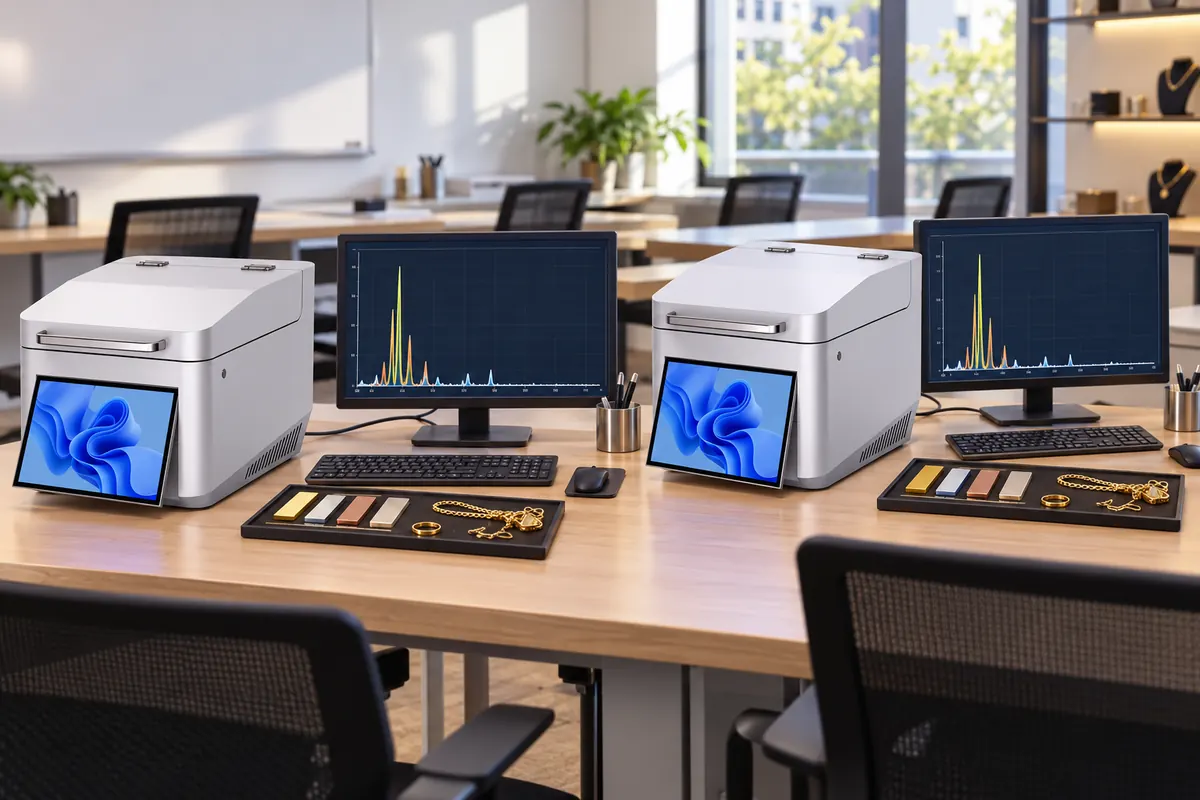
Quick answer
| Decision | xrf calibration transfer between analyzers |
| First check | Confirm sample construction, geometry, target elements and the exact business decision. |
| Before quotation | Send clear sample photos with dimensions, daily volume, destination, voltage and reporting needs. |
Confirm transfer compatibility
- Record source and destination model, serial number, detector, tube, filter, collimator, geometry and software version.
- Confirm the method was designed for the same matrices, elements, concentration ranges and reporting rules.
- Use controlled export and import procedures so coefficients, libraries and permissions are not lost or altered.
- Treat different hardware generations as a new validation question rather than an automatic file transfer.
Verify with transfer materials
- Select stable standards and representative samples that span low, middle, high and commercial decision points.
- Measure both analyzers with the same preparation, position, test time and sequence while controlling drift.
- Compare paired bias, repeatability, classification outcomes and any element-specific residual pattern.
- Define acceptance criteria before viewing the comparison and investigate failures instead of applying undocumented offsets.
Control the method after release
- Assign one approved method ID, version, owner and change history across all locations.
- Lock critical settings and train operators to use the same sample and review procedure.
- Run routine reference checks and inter-site comparisons at a risk-based frequency.
- Repeat verification after relevant hardware, software, calibration, service or environmental changes.
Practical decision table
| Sample or condition | Action | Reason |
|---|---|---|
| Identical model and configuration | Controlled transfer plus verification | Similarity reduces but does not remove risk |
| Different detector or filter | Evaluate as a changed method | Response can differ |
| Branch results disagree | Compare standards and versions | Separate drift, setup and method |
| After repair or update | Reverify affected range | Qualified state may have changed |
Evidence and method boundary
Use the model manual, an approved method and suitable reference materials before making purchase, release or compliance decisions. Technical references include the Eurachem method validation guide, Eurachem analytical equipment qualification guide. These sources explain the method boundary; they do not replace model-specific configuration, laboratory confirmation or local legal advice.
Recommended WiserMachine path
Review WMK6000 and compare WM5800T. The exact detector, collimator, calibration, software and reporting configuration must be confirmed against real samples before ordering. You can also browse the complete XRF product catalog.
Related guides
Continue with FP versus empirical calibration, reference-standard verification, multi-branch XRF SOP, or use the support center for preparation, operation and service guidance.
Standardize XRF methods across analyzers and branches
Send sample photos, dimensions, target elements, expected range, daily volume, reporting needs, voltage and destination. WiserMachine will confirm a suitable configuration and freight plan before quotation.
Frequently Asked Questions
Can I copy one XRF calibration file to every branch analyzer?
Only after confirming compatibility and completing documented verification on each destination analyzer.
What samples should be used for method transfer?
Use stable transfer standards and representative samples covering the matrices, concentration range and decision limits used in routine work.
Is one matching gold standard enough?
Usually not for a broad method. One point cannot show element-specific bias, range behavior or classification performance across varied alloys.