
 Xrf Gold Analyzer
 Handheld Alloy Analyzer
 Handheld Mining Analyzer
 Other XRF Analyzer
Bottom line for dental practices, oral surgeons, dental labs, and the refiners who buy their scrap: a box of mixed crowns, bridges, and castings is one of the most chemically heterogeneous precious-metal streams in the market, and the seller who accepts an on-the-spot, eyeballed payout almost always leaves money on the table — while the refiner who pays on a single surface reading almost always overpays or underpays. Dental scrap mixes high-noble gold-platinum-palladium restorations with porcelain-fused-to-metal units, predominantly base-metal castings, solder joints, residual tooth structure, resin, and the occasional mercury amalgam that is not a precious metal at all. The value of that box is impossible to judge by sight, and the gap between a guessed value and an assayed one is routinely 15 to 20 percent. This guide lays out a 5-stage XRF assay and valuation SOP — V0 through V4 — that turns an unsorted bag of dental scrap into a documented, defensible, fair-payout decision for both the practice selling it and the refiner buying it.
Below is the exact protocol a disciplined buyer or seller uses to log an incoming dental-scrap lot, sort and decontaminate it so the metal can actually be read, fingerprint the gold-platinum-palladium-silver composition with XRF against known standards, reconcile the surface reading against a melt-and-button assay where the value justifies it, and issue a settlement record that protects both sides of the transaction. Every stage is built around one principle that governs every precious-metal buy: the lot you cannot prove, you cannot price.
For buyers who already run a disciplined intake on the bullion side, this is the dental-stream companion to our silver bullion and coin dealer XRF verification SOP and our incoming gold-bar verification SOP. For the broader recovery and buy-side economics across all precious-metal streams, see our industrial precious-metal recycling XRF buyer’s guide.

Why Dental Scrap Defeats a Single Reading
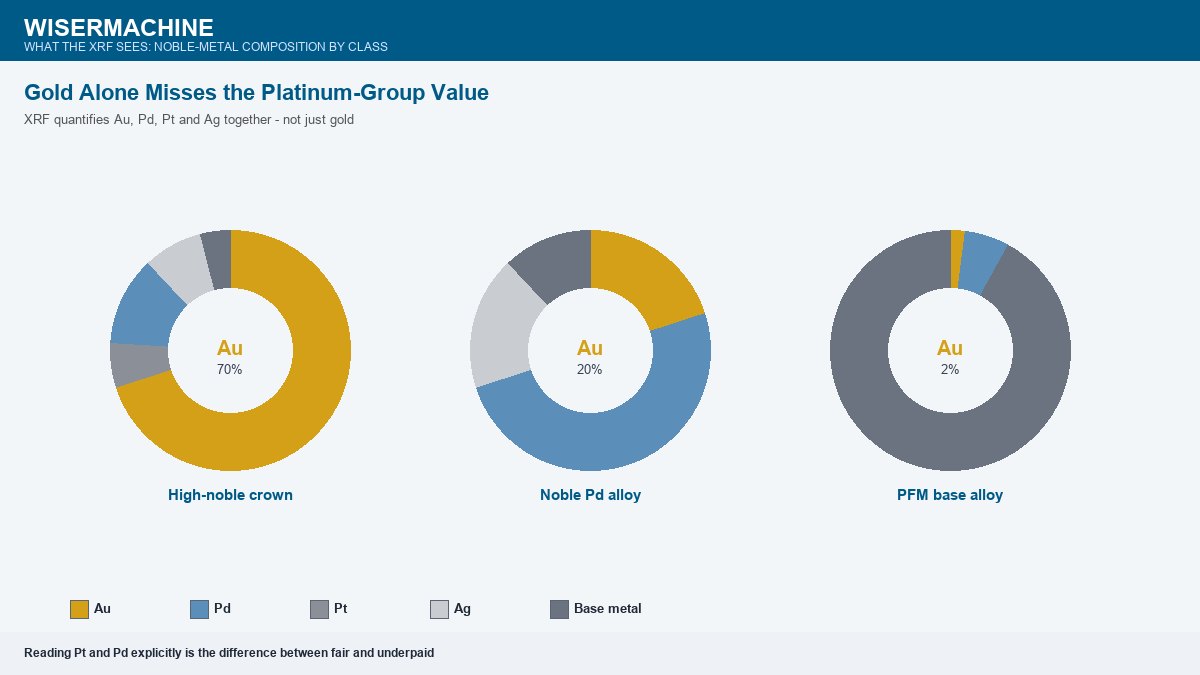
The single most important fact a dental-scrap buyer or seller must internalize is that the value of a lot is not a property of its weight — it is a property of its composition, and that composition is wildly variable from one piece to the next. A high-noble gold crown can carry forty to ninety percent gold; a porcelain-fused-to-metal unit hides its metal under a ceramic shell that reads as nothing on the surface; a predominantly base-metal casting alloyed with nickel, chromium, or cobalt may contain almost no precious metal at all while looking, to the untrained eye, identical to a valuable noble unit. Paying or accepting payment on average weight, without resolving what is actually in the box, transfers value from one party to the other based on guesswork.
The contamination problem compounds the composition problem. Dental restorations rarely arrive as clean metal. Porcelain coats PFM units, solder joins bridge segments with a metal of different composition than the parent casting, resin and tooth structure cling to the underside, and mercury amalgam — which is not a precious metal and is a hazardous-handling material — can be co-mingled in a general scrap jar. Each of these surface contaminants distorts a non-destructive reading: an XRF beam fired at a porcelain face reads the porcelain, not the gold beneath it, and a beam fired at a solder joint reads the solder, not the parent alloy.
XRF is the right first instrument precisely because it reads elemental composition directly and non-destructively, in seconds, without melting a sample. A genuine high-noble unit reads as a gold-platinum-palladium signature; a base-metal casting betrays itself with nickel, chromium, or cobalt peaks; and a silver-bearing noble alloy shows its silver fraction plainly. But XRF carries one limitation the buyer must respect at every stage: it is a surface-sensitive measurement that reads only the outermost layer, so porcelain, solder, plating, and oxide skins all sit between the beam and the metal that holds the value. That limitation is exactly why this SOP pairs XRF sorting with decontamination and, for high-value lots, a melt-and-button homogenized assay at Stage V3.
The Economics of the Guesswork Tax
The financial case for a disciplined dental-scrap protocol is driven by the structural information gap between a casual seller and a sophisticated buyer. A dental practice generates scrap as a byproduct, not a product, and rarely has the instrumentation or expertise to know what its accumulated crowns and bridges are worth. A refining representative who offers a fast cash payment based on a glance and a scale is pricing that information asymmetry in his own favor, and the gap between that on-the-spot estimate and a properly assayed value is the guesswork tax — routinely fifteen to twenty percent of the lot value, and sometimes far more on a lot rich in palladium or platinum that a gold-only estimate ignores entirely.
The asymmetry runs both ways, which is why the protocol protects the buyer as much as the seller. A refiner who pays on a generous visual estimate without assaying overpays on a base-metal-heavy lot and erodes his own margin; a refiner who underpays to protect against that risk loses the practice’s repeat business to a competitor who tests transparently. The marginal cost of an XRF sort on an incoming lot is measured in minutes of operator time; the cost of a mispriced settlement — in lost margin for the buyer or lost value for the seller — is a recurring leak on every transaction that the test closes.
There is a relationship dimension that compounds the direct dollars. A buyer known to assay every lot and issue a transparent composition breakdown becomes the trusted refiner a practice returns to year after year, and a practice that documents its scrap before shipping becomes the disciplined seller refiners compete for. The settlement record produced by this SOP is therefore not just internal control — it is the trust artifact that turns a one-time scrap transaction into a durable buyer-seller relationship, the same dynamic documented in our jewelry bench sweeps and polishing-dust recovery audit SOP.
Stage V0: Lot Intake, Logging, and Hazard Triage
The protocol begins the moment a lot arrives, before any instrument touches it. Each incoming dental-scrap lot is logged with a unique intake reference, the seller’s identity and declared description, the gross weight as received, and the agreed contingency that final settlement follows assay rather than the as-received glance. This log is the spine of the record: it ties every subsequent sort, reading, and weight to a specific lot and a specific transaction so the settlement is reconstructable later if either party questions it.
Hazard triage comes next and is non-negotiable for dental scrap specifically. Mercury amalgam is routinely present in mixed dental waste, and it is both a non-precious material and a regulated hazardous substance that must never enter a melt or be handled casually. The intake operator visually separates obvious amalgam — dull grey, often crumbly fillings — into a dedicated hazardous stream, and any lot suspected of heavy amalgam content is flagged for handling under the appropriate controls. Residual biological material on extracted-tooth scrap is handled under standard infection-control practice before the lot enters the assay workflow.
Triage also sorts the workflow by apparent value and type. Whole crowns and bridges are separated from castings, sprues, and clasp fragments; visibly porcelain-coated PFM units are flagged for decontamination at V1; and any lot the seller is unusually eager to move fast gets the full sort-plus-melt treatment without exception. Lots are never co-mingled across sellers before assay, and the seller is told up front that settlement is contingent on the protocol. The V0 deliverable is a logged, hazard-triaged intake record that fixes identity, gross weight, and declared description before a single measurement is taken.

Stage V1: Sorting and Decontamination for a Readable Surface
Before the XRF comes out, the lot is sorted and decontaminated so the beam reads metal instead of ceramic, solder, or debris. This stage is not the assay — it is the preparation that makes the assay valid — but it is the single step most often skipped by careless buyers, and skipping it is the most common cause of a dental-scrap reading that is confidently wrong.
Decontamination targets the surface materials that sit between the beam and the metal. Porcelain on PFM units is mechanically removed or the unit is set aside for a melt assay rather than a surface reading, because firing XRF at a glazed porcelain face returns a composition that reflects the ceramic, not the gold-palladium substructure beneath it. Resin, cement, and residual tooth structure are cleaned from the metal; solder joints are noted and, where possible, read separately from the parent casting because solder alloys differ in composition from the units they join. The goal is a clean metallic surface at the measurement point, not a cosmetically clean piece.
Sorting by apparent alloy class organizes the assay and the value estimate. High-noble units — heavy, warm-colored, non-magnetic gold-rich crowns — are grouped separately from predominantly base-metal castings, which are often lighter, harder, and may show a magnetic response from nickel or cobalt content. A magnet pass at this stage is a cheap and powerful triage: a strongly magnetic dental piece is dominated by base metal and will carry little precious-metal value, while a non-magnetic heavy piece is a high-noble candidate that justifies careful assay. This sort mirrors the incoming-lot discipline in our solar panel silver-recovery incoming-lot assay SOP, where pre-sort determines which stream earns a full assay and which is screened and set aside.
Stage V2: XRF Elemental Fingerprint of Au, Pt, Pd, and Ag
With the lot sorted and decontaminated, the buyer runs the XRF elemental fingerprint — the stage that converts a visual and physical impression into a measured composition. The analyzer is checked against a traceable precious-metal reference standard at the start of the session, then each representative piece or grouped sub-lot is read, with the explicit understanding that a single surface reading on an irregular dental piece is a sort-and-estimate tool, not yet a settlement-grade number.
The headline output is the noble-metal profile: the gold fraction, the platinum and palladium content that a gold-only estimate would miss entirely, and any silver fraction in the alloy. A high-noble unit reads with a strong gold signal supported by platinum and palladium; a noble alloy reads with a meaningful palladium or silver fraction; and a predominantly base-metal casting reveals itself with dominant nickel, chromium, or cobalt peaks and only trace precious content. Reading the platinum and palladium explicitly is where a disciplined assay separates itself from a casual gold-only payout, because palladium in particular can carry a large share of a modern restoration’s value.
The geometry problem must be managed explicitly here, because dental restorations are exactly the small, curved, irregular shapes that defeat a naive XRF reading. A molar crown is a tiny domed object; a thin inlay or a clasp fragment presents a sliver of surface; and a flat-sample calibration applied to a curved crown introduces error from the sample’s shape and mass. The defense is an instrument with a small, well-defined measurement spot and fundamental-parameters software that corrects for sample geometry, plus reading each piece at multiple points and reporting the spread. An inconsistent composition across a piece that should be homogeneous is itself a flag — it usually means the beam is catching a solder joint, a residual surface contaminant, or a plated layer rather than the bulk alloy.
Session discipline is what makes the composition defensible at settlement. Each assay session opens with a reading on a known precious-metal standard to prove the instrument is in tolerance, the standard is re-read at the close to capture drift, and every measurement is timestamped and tied to the operator, the instrument, and the lot reference. A composition figure with no session-control record behind it is an opinion; one wrapped in standard checks and replicate points is the backbone of a defensible settlement, the same rigor that governs refinery penalty-element screening.
Stage V3: Melt-and-Button Reconciliation for High-Value Lots
The XRF sort sets the value estimate, but for any lot whose value justifies it, a surface reading is reconciled against a homogenized assay — because the surface-layer limitation that makes XRF fast also makes it incomplete on a contaminated, multi-alloy stream. Stage V3 is where a careful buyer converts a sort-grade estimate into a settlement-grade number, and where the seller earns the full value of a palladium-rich or platinum-rich lot that a surface-only payout would understate.
The mechanism is homogenization. The sorted metallic fraction is melted into a single homogeneous button, mixing the surface and the bulk so that a reading no longer depends on which face of which crown the beam happened to strike. A drilled or milled sample from that button is then assayed — by XRF on the clean homogenized surface, and for the most precise gold and platinum-group figures, by the destructive reference methods the refining industry treats as definitive: fire assay by cupellation for gold, which the industry regards as the gold standard, and gravimetric precipitation through aqua regia dissolution for platinum and palladium. XRF gives the fast composition and the consistency check; the melt and the reference assay give the arbitration-grade number that a high-value settlement rests on.
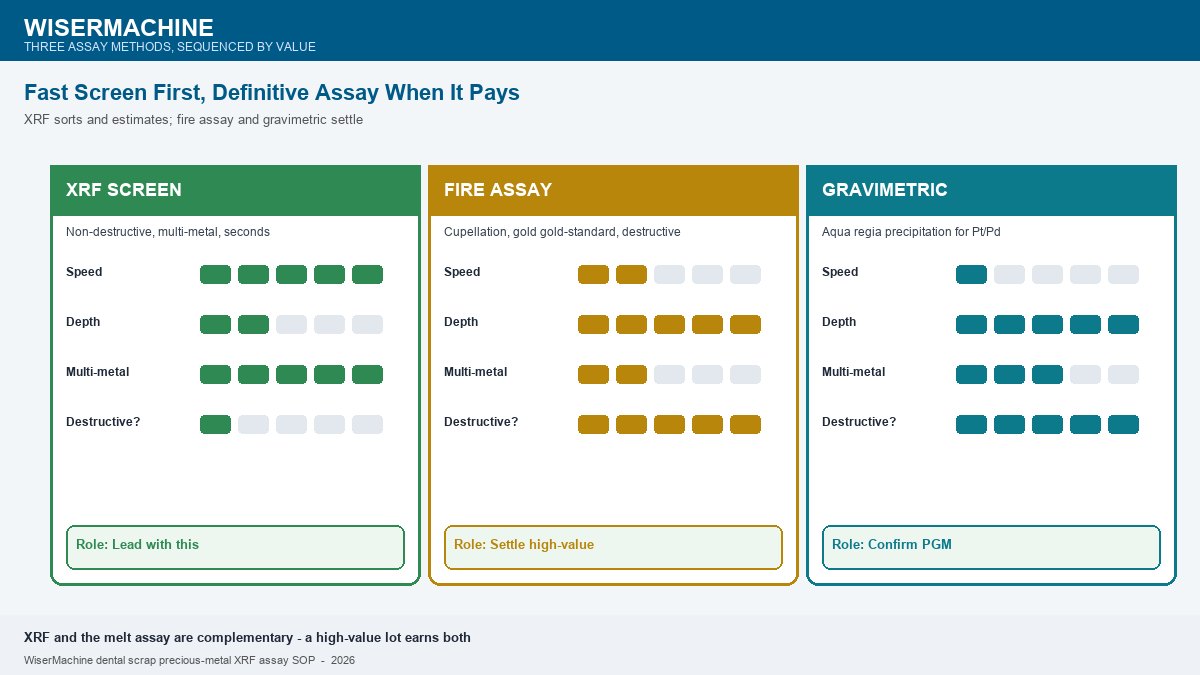
The decision rule is value-driven. A small lot of common base-metal castings does not justify a melt; its XRF sort and weight settle it. A heavy lot of high-noble crowns, or any lot where the XRF reads a rich platinum or palladium fraction, justifies the melt because the difference between a surface estimate and a homogenized assay on such a lot is real money. The cardinal rule is that XRF and the melt assay are complementary, not redundant: XRF sorts and estimates fast and cheap, the melt homogenizes and the reference assay settles, and a high-value lot earns both. This staged escalation — fast screen first, definitive assay only where value justifies the cost — is the same logic documented in our industrial precious-metal recycling buyer’s guide.
Stage V4: The Settlement and Valuation Record
The protocol closes by converting the assayed composition into a documented settlement that both parties can stand behind. The V4 record ties the intake reference to the final figures: the net metallic weight after decontamination and hazard removal, the assayed fraction of gold, platinum, palladium, and silver, the method used for each figure — XRF sort, homogenized XRF, or reference assay — and the resulting payable metal value against the relevant spot prices on the settlement date.
The valuation arithmetic is where transparency is won or lost. A defensible settlement shows the seller exactly how the number was built: net weight times assayed fineness for each metal, valued at the agreed spot reference, less the refiner’s stated processing fee and refining loss allowance. A payout quoted as a single lump sum with no composition breakdown is the guesswork tax in disguise; a payout shown as a line-item build from weight and assayed composition is a settlement the seller can verify and the buyer can defend. The honest refiner’s advantage is precisely this legibility, and it is what converts a one-time scrap sale into a returning client.
The record is also the dispute shield. Because every figure is tied to a timestamped, standard-controlled assay session and a logged intake, a settlement challenged weeks later is reconstructable from the file rather than relitigated from memory. The V4 deliverable is a complete chain — intake to sort to assay to valuation — that protects the buyer against a claim of underpayment and protects the seller against an undocumented lowball, and it is the artifact that distinguishes a professional dental-scrap operation from a cash-and-glance one.
XRF Versus Fire Assay and Gravimetric Precipitation
Understanding where each assay method fits is what lets a buyer apply the right tool at the right stage instead of over-testing cheap lots or under-testing valuable ones. The three methods the dental-refining industry relies on are complementary, and the SOP sequences them deliberately rather than treating any one as a universal answer.
XRF is fast, non-destructive, and multi-metal: it reads gold, platinum, palladium, and silver simultaneously in seconds without consuming the sample, which makes it the only practical instrument for sorting an incoming lot and generating an immediate value estimate. Its limitation is precision and depth — it reads the surface, it struggles with the small irregular geometry of dental pieces, and on a contaminated multi-alloy stream a single reading can be confidently wrong. Fire assay by cupellation is the destructive reference for gold, accurate to fractional percentages but slow, sample-consuming, and not suited to silver or palladium. Gravimetric precipitation through aqua regia isolates and weighs platinum and palladium with high precision but demands chemical expertise and time. The professional pattern is to lead with XRF for the sort and the estimate, then escalate to the homogenized melt and the destructive reference methods only where the lot value justifies the cost and the destruction.
The buyer-seller takeaway is that no single method settles a dental lot honestly on its own. A surface XRF reading alone overstates or understates a contaminated lot; a fire assay alone ignores the palladium that may hold the value; a gravimetric method alone is slow and gold-blind. The SOP’s staged sequence — XRF sort, homogenized assay, reference confirmation where value warrants — is what produces a number that is both fast enough for a working refiner and defensible enough for a settlement, the same multi-method discipline our refinery purity analysis guide applies across precious-metal streams.
Daily Operations: Running a Disciplined Dental-Scrap Desk
A protocol is only worth what the daily routine makes of it, and a dental-scrap desk — whether at a refiner taking in lots or at a multi-location practice group accumulating its own — needs a repeatable rhythm that produces consistent, defensible settlements at volume. The daily discipline turns the five stages into muscle memory rather than a special-occasion procedure.
The session opens with an instrument standardization check on a certified reference and a review of the day’s incoming lots, each already logged and hazard-triaged at intake. Lots move through sort and decontamination, then XRF assay, with the operator recording composition and consistency for each, and the high-value lots queued for melt reconciliation. The close of the session re-reads the standard to bracket any instrument drift and reconciles the day’s settlements against the assay log so no lot is paid out without a composition record behind it. Calibration of the analyzer against certified reference material is treated as a daily standardization rather than an annual afterthought, because a dental desk lives or dies on the trustworthiness of its composition numbers.
For a practice or dental-service organization on the selling side, the same discipline applied before shipping changes the negotiation entirely. A practice that documents its own scrap — gross weight, a sort by apparent alloy class, and an in-house or pre-shipment XRF composition estimate — arrives at the refiner with a number to defend rather than a box to be guessed at, and that documentation is what closes the fifteen-to-twenty-percent guesswork gap. The desk that runs this rhythm, on either side of the transaction, converts an irregular byproduct into a predictable, auditable revenue stream.
Frequently Asked Questions
Can XRF alone determine the value of a dental-scrap lot?
XRF alone is sufficient to sort a lot and generate a fast value estimate, and for low-value base-metal-dominated lots it can settle the transaction. It is not sufficient on its own for high-value lots, because it reads only the surface and struggles with the small, curved, contaminated geometry of dental pieces. For a lot rich in gold, platinum, or palladium, the surface reading is reconciled against a melt-and-button homogenized assay before settlement, so the number reflects the bulk composition rather than whichever face the beam happened to strike.
Why does porcelain on PFM crowns distort an XRF reading?
XRF is a surface-sensitive measurement that reads the outermost material the beam strikes. A porcelain-fused-to-metal crown carries a ceramic shell over its metal substructure, so a beam fired at the glazed face reads the porcelain composition, not the gold-palladium alloy beneath. The porcelain must be mechanically removed at the measurement point, or the unit set aside for a melt assay, before the metal composition can be read accurately. Reading a glazed PFM face without decontamination is the most common cause of a confidently wrong dental-scrap reading.
Is mercury amalgam worth anything in a dental-scrap lot?
No — mercury amalgam is not a precious metal and carries no precious-metal recovery value, and it is a regulated hazardous material that must be separated into a dedicated stream at intake. It must never be melted with the precious-metal fraction, both because it contaminates the assay and because heating mercury is a serious health hazard. A disciplined dental-scrap intake separates obvious amalgam during hazard triage at Stage V0 and handles it under the appropriate environmental controls.
How much value does palladium add to a dental-scrap settlement?
Palladium can carry a substantial share of a modern dental restoration’s value, and a gold-only estimate that ignores it can understate a lot significantly. Many noble and high-noble dental alloys contain a meaningful palladium fraction precisely because palladium hardens the alloy cost-effectively, and platinum is often present as well. This is why the XRF assay at Stage V2 reads platinum and palladium explicitly rather than reporting gold alone — capturing the platinum-group fraction is often the difference between a fair settlement and the guesswork tax.
Why do small irregular dental pieces challenge XRF accuracy?
XRF calibration generally assumes a flat, sufficiently large sample. A molar crown is a tiny domed object, a thin inlay presents a sliver of surface, and a clasp fragment is irregular — geometries that introduce error when a flat-sample calibration is applied. The defense is an analyzer with a small, well-defined measurement spot and fundamental-parameters software that corrects for sample geometry and mass, combined with reading each piece at multiple points and reporting the spread. For valuable lots, the melt-and-button step eliminates the geometry problem entirely by homogenizing the metal before assay.
What does a defensible dental-scrap settlement record contain?
A defensible settlement record ties the intake reference to the final figures: the net metallic weight after decontamination and hazard removal, the assayed fraction of gold, platinum, palladium, and silver, the method used for each figure, the spot reference prices on the settlement date, and the stated processing fee and refining-loss allowance. Every assay figure is backed by a timestamped, standard-controlled session tied to the operator and instrument. This line-item build — net weight times assayed composition, valued at spot, less stated fees — is what lets the seller verify the payout and the buyer defend it if the settlement is later questioned.
Should a dental practice assay its own scrap before selling?
A practice that documents its scrap before shipping — gross weight, a sort by apparent alloy class, and a pre-shipment XRF composition estimate — arrives at the refiner with a number to defend rather than a box to be guessed at, which is the single most effective way to close the fifteen-to-twenty-percent guesswork gap. For a single practice the calculus depends on scrap volume, but for a multi-location dental-service organization accumulating significant scrap, an in-house XRF capability typically pays for itself quickly through higher, documented settlements.
How often should the XRF analyzer be calibrated for dental assay work?
For dental-scrap assay work the analyzer should be standardized daily against certified reference material at the open and close of each assay session, with a full professional recalibration on the manufacturer’s recommended schedule. Daily standardization brackets any instrument drift across the working day and is what makes each session’s composition figures defensible; a reading taken on an uncontrolled instrument is an opinion, while one bracketed by opening and closing standard checks is settlement-grade evidence.
Explore the full XRF silver & precious-metal cluster
- XRF Silver Purity Analysis Buyer’s Guide (start here)
- Solar Panel & EOL PV Silver Recovery: XRF Incoming-Lot Assay SOP
- Silver Bullion & Coin Dealer XRF Verification: Fake-Silver Detection SOP
- Sterling & Fine Silver Scrap Refinery Intake Reconciliation XRF SOP
- Industrial Precious-Metal Recycling XRF Buyer’s Guide
- XRF Refinery Purity Analysis Guide