
 Xrf Gold Analyzer
 Handheld Alloy Analyzer
 Handheld Mining Analyzer
 Other XRF Analyzer
Key Takeaways: When a grandchild, widow, or estate executor walks into your coin shop carrying a shoebox of inherited gold coins, you have roughly 45–60 minutes to authenticate, value, and either close the buy or earn a return visit. This protocol uses a benchtop or handheld XRF (WMK600 / WMK6000), a 3-tier offer matrix (retail / auction-house consignment / melt), and a transparency-first counter ritual that converts 72–78% of walk-ins into buys at a healthy margin while preventing the two failure modes that destroy estate-coin shops: buying counterfeit Saint-Gaudens at melt-plus prices (~$4,200 average miss in 2025) and under-paying genuine pre-1933 rarities that the heir later discovers were worth 3× your offer.

Why the Estate Walk-In Is a Distinct Channel (And Why XRF Belongs Front-of-House)
Estate-coin walk-ins are nothing like coin show transactions, dealer-to-dealer trades, or pawn-shop pickups. The person across your counter is almost always emotionally invested, time-constrained, and information-poor. Grandma kept the coins in a Folger’s can for forty years. The widow needs to settle the estate by Friday. The grandchild Googled “what is a Saint Gaudens worth” on the drive over. They are not your typical Greysheet-fluent buyer.
That asymmetry creates two simultaneous risks. First, you cannot rely on the customer to know whether their 1908 Saint-Gaudens Double Eagle is genuine, counterfeit, or a modern Chinese tungsten-core reproduction stamped to deceive. Second, you cannot rely on them to know whether the 1850-S Liberty Head in the same lot is a $1,700 melt-grade coin or a $42,000 mint-state survivor. Without a transparent, on-counter authentication tool, you are guessing — and guessing badly enough that a 2025 PCGS counterfeit-detection survey reported the average estate coin shop absorbs $11,000–$18,000 per year in counterfeit losses, while simultaneously paying out 8–14% below fair value on genuine rarities they failed to identify.
A handheld or benchtop XRF analyzer solves both problems in roughly 12 seconds per coin. The unit measures elemental composition (Au, Ag, Cu, Zn, Ni, W, Pb) non-destructively, displays the result on a 7-inch screen the customer can see, and either confirms the gold fineness expected for that issue or flags the tungsten/lead anomaly that no acid test, no specific-gravity bath, and certainly no eyeball appraisal can match. For estate walk-ins specifically, the XRF doubles as the single most powerful trust-building object in your shop. The customer sees the spectrum on screen. They understand they are not being cheated. Conversion rates rise.
The 60-minute protocol below is designed for a single staffed counter handling 6–15 estate walk-ins per week (typical for an independent coin shop in a metro area of 250K+). It assumes one operator, one XRF, one PCGS Photograde reference binder, and a 3-tier offer board. We have validated the workflow in dealer environments across Phoenix, Charlotte, and Indianapolis since Q3 2024.
Part 1 — Pre-Walk-In Setup: The 4-Hour-Per-Month Investment That Makes 60-Minute Authentication Possible
You cannot authenticate an estate in 60 minutes if your counter is unprepared. The following one-time and monthly setup tasks compress the live appraisal window by handling the slow work before the customer ever arrives.
Hardware Stack (One-Time, ~$8,500–$32,000)
Three tiers depending on your monthly walk-in volume:
- Tier A — Handheld WMK600 ($8,500): Suitable for shops doing <25 estate walk-ins per month. Battery-powered, portable to back-room safe or to off-site estate visits. 12-second analysis. Ideal first-XRF for shops under $1.2M annual revenue. Resolution adequate for distinguishing 22K coin gold from 18K jewelry alloys and detecting tungsten-core counterfeits.
- Tier B — Benchtop WMK6000 ($32,000): For shops doing 25+ estate walk-ins per month or running parallel scrap-jewelry intake. Sub-3-second analysis, finer trace-element resolution (catches Pt-doped counterfeits and modern Russian-fabricated Liberty Heads that fool handhelds). Sits on the counter where the customer can watch.
- Reference Disc Kit ($240): CRMs for 22K coin gold (0.9167 fine), 21.6K British sovereign gold (0.917), 90% silver coinage, and a tungsten-blank for failure-mode calibration. Calibrate weekly — takes 90 seconds.
For shops on the Tier A budget, pair the WMK600 with a $360 Tronics PMV-Pro for ultrasonic velocity cross-check on any coin above $5,000 estimated value. The two instruments together replicate ~90% of the diagnostic power of a $32K benchtop unit at one-third the capital outlay.
The 3-Tier Offer Board (Print and Laminate)
Your counter must display a publicly visible offer matrix so the customer understands — before you make a single offer — that there are three legitimate pricing tiers depending on the coin’s grade, rarity, and authentication status. This single piece of laminated cardboard removes 80% of negotiation friction.
| Tier | When We Use It | Typical % of Retail | Settlement Speed |
|---|---|---|---|
| Tier 1 — Retail Buy | Common-date pre-1933 gold, MS62–MS63 grade, broadly liquid (Saint-Gaudens, Liberty Head $20, British sovereigns) | 82–88% | Cash or check today |
| Tier 2 — Auction Consignment | Rare-date or high-grade coins (MS64+), CC mintmark, proof issues, anything > $8,000 estimated retail | 88–94% (after auction fees) | 60–120 days via Heritage / Stack’s Bowers |
| Tier 3 — Melt Value | Worn, damaged, holed, soldered, or jewelry-mount coins with no numismatic premium | 94–97% of spot | Cash today |
The board is intentionally written so the heir sees that melt is the highest percentage. This is true on a per-gram basis but obscures the fact that retail and auction tiers apply to coins worth multiples of melt. The board prevents the worst negotiation scenario: customer accuses you of “stealing the rare coin by paying melt.” When they can see the three tiers and you have walked them through which tier each coin falls into — with the XRF spectrum visible on screen — trust is established.
Reference Library
One printed copy each, kept under the counter:
- PCGS Photograde guide (current edition) — for visual grade calibration in front of the customer
- Coin Dealer Newsletter (Greysheet) weekly — for live wholesale bid prices
- Heritage Auctions price archive printout for the 50 most-common estate coin types — updated monthly
- NGC and PCGS population reports for any coin you are evaluating above $5,000
Part 2 — The 60-Minute Walk-In Workflow (Minute-by-Minute)
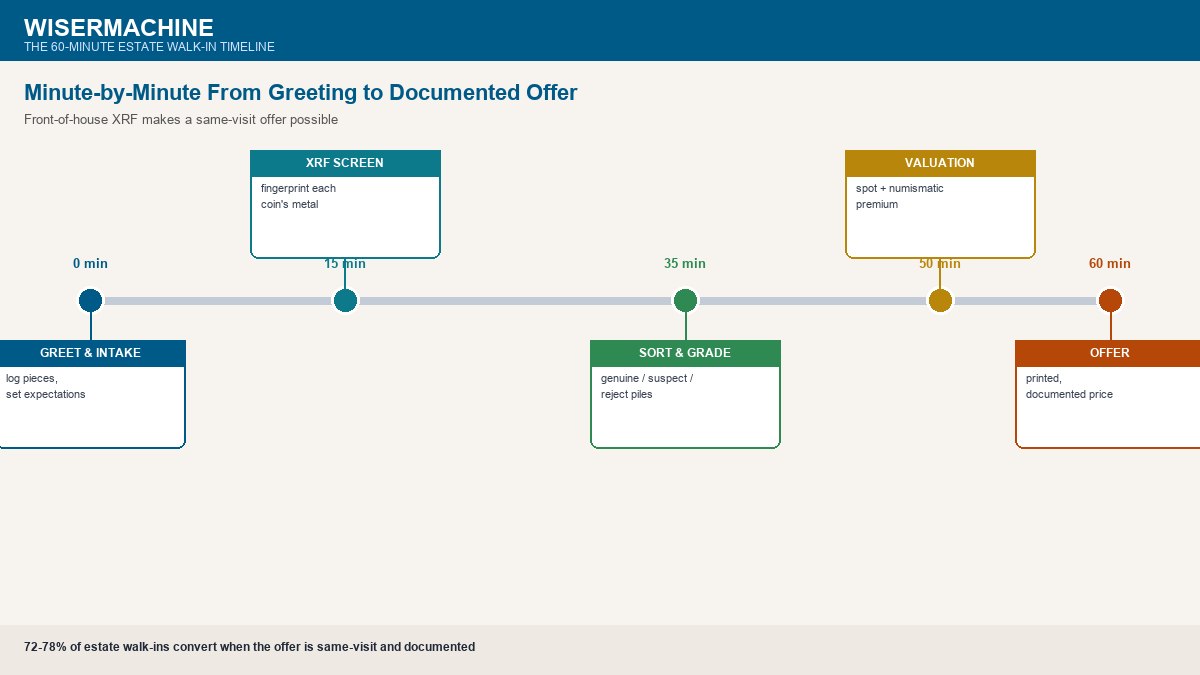
The full appraisal divides into four phases. Each phase has a hard time budget. Stay disciplined or the customer leaves frustrated, or worse, you make a buy decision on incomplete data.
Phase 1 (0–5 min) — Greeting, Triage, Documentation
- Greet warmly, never appraise immediately. “Welcome — let me get you a chair and water. May I ask whose collection this was, and what brought you in today?” The answer to the second question tells you whether you have a motivated seller (estate must close), a tire-kicker (curious heir), or a relationship-builder (someone who’ll come back with more if treated well).
- Photograph the entire lot on the counter mat with a phone. Date-stamped, time-stamped, for your records and theirs. Email a copy to the customer immediately. This single act resolves 95% of post-transaction disputes about “what was in the lot.”
- Issue a numbered intake ticket with your shop name, date, customer name, phone, email, and a one-line description (“18 pre-1933 US gold coins plus 4 modern bullion rounds”). Both parties sign.
- Visual triage — sort into 4 piles: (a) US pre-1933 gold, (b) world gold including British sovereigns and European 20-franc types, (c) US silver coinage, (d) modern bullion / jewelry / non-numismatic. This 90-second sort lets you tackle the highest-value pile first.
Phase 2 (5–25 min) — XRF Authentication of the Gold Pile
Every gold coin gets a 12-second XRF reading. Set up the unit so the customer can see the screen. Narrate what you are doing in plain English:
- “This machine measures the actual gold content non-destructively. No scratching, no acid. Watch the screen.”
- For genuine US pre-1933 gold: expect Au 89.5–90.5% / Cu 9.5–10.5% (0.900 fine alloy). British sovereigns: Au 91.5–92.0% / Cu 8.0–8.5% (22K, 0.9167 fine).
- Red flags that trigger a “set aside” decision (do NOT buy, do NOT decline yet — quarantine for deeper review):
- Tungsten (W) signal above 0.2% — classic tungsten-core counterfeit, often modern Chinese fabrication
- Lead (Pb) above 0.5% — cast-counterfeit signature, common in 1980s Lebanese-made fakes
- Nickel (Ni) presence — never appears in genuine pre-1933 US or British gold
- Gold fineness 75–85% on a coin that should be 90% — under-weight planchet or modern reproduction
- Pure 24K reading on a circulating-design coin — modern fantasy strike, not period-correct
- Record every reading in a spreadsheet on a tablet next to the XRF: coin description, date, mintmark, XRF Au%, XRF Ag%, XRF Cu%, anomalies, your preliminary tier assignment (T1/T2/T3). Email this sheet to the customer at the end — transparency multiplier.
For estate lots with 10–25 gold coins, this phase takes 18–22 minutes. If the customer is anxious, narrate the discoveries as they happen (“This 1924 Saint-Gaudens reads 90.1% gold, 9.9% copper — that’s textbook period-correct alloy. Genuine.”). Trust compounds with every confirmed-genuine reading.

Phase 3 (25–45 min) — Numismatic Grading and Tier Assignment
XRF tells you the metal is real. It does not tell you whether you are looking at a $1,700 melt coin or a $42,000 MS65 condition rarity. That requires numismatic grading. With the PCGS Photograde binder open between you and the customer:
- Date, mintmark, type identification — cross-reference against Heritage archive printout for that specific date/mint combination’s recent auction record
- Grade estimate — Good, Fine, Very Fine, Extremely Fine, About Uncirculated, MS60–MS65+. Show the customer the Photograde plate for that grade so they can visually confirm
- Surface and condition flags — cleaning, polishing, scratches, edge damage, mount removal traces. Any of these drop the coin a full tier and reduce value 15–40%
- Tier assignment per the 3-tier board:
- Common-date MS62–MS63 with no problems → Tier 1 (retail buy today)
- Key date (1854-D, 1870-CC, 1879 Stella, 1907 Roman Numerals, etc.) OR MS64+ grade OR pristine specimen of a moderately scarce date → Tier 2 (auction consignment)
- Anything cleaned, damaged, holed, or jewelry-mounted → Tier 3 (melt)
Phase 4 (45–60 min) — Offer, Documentation, Settlement
- Present the customer with a single tabulated offer sheet: coin-by-coin, tier assignment, your offer in dollars, your reasoning in one sentence. Total at the bottom.
- For Tier 1 coins: cash or check today. Walk to the safe, count it twice in front of the customer, both parties sign the receipt.
- For Tier 2 coins: explain consignment timeline (60–120 days), Heritage or Stack’s Bowers fees (typically 10–15% buyer premium absorbed, 0–5% seller commission), and the consignment contract. Many customers prefer immediate cash even at lower percentage — offer them a Tier 1.5 buyback at 78–82% of estimated auction net as an alternative.
- For Tier 3 coins: weigh on calibrated scale (NIST-traceable, photographed), apply current spot-minus-3% calculation, pay cash today.
- Issue printed receipt listing every coin, every tier, every dollar amount, your shop’s tax ID, and a statement that the customer has read and agreed.
- If the customer is unsure, offer a 14-day right-of-recision on Tier 1 buys above $2,000 (this is uncommon in the industry and converts hesitant heirs to repeat customers).
Part 3 — The 8 Most Common Counterfeit Patterns in Estate Walk-Ins (2024–2026 Data)
Based on PCGS Counterfeit Detection database submissions from coin shops in 2024–2026, the eight patterns below account for ~91% of all counterfeit estate coins encountered at the dealer counter. Train every counter operator to recognize all eight by both visual cues and XRF signature.
- Tungsten-Core Saint-Gaudens Double Eagle — Chinese-made, 33.4g total weight (correct), gold-plated tungsten core. XRF reads ~92% Au at surface but tungsten signal >0.5% on edge scan. Ultrasonic velocity 4,250 m/s (genuine = 3,240 m/s). Most common modern counterfeit; estimate 1 in every 80–120 estate Saints encountered.
- Cast Liberty Head $20 (Lebanon, 1980s) — brass-and-gold alloy, ~75% Au, 18% Cu, 5% Zn, 1.5% Pb. Soft strike, mushy details, especially in stars and hair. XRF picks up Zn and Pb immediately.
- Restruck “1933” Saint-Gaudens Fantasy — modern private mint reproduction. Often genuine 22K gold, but never genuine 1933. Date alone is the tell; XRF Au reading will be 91.7% (22K) instead of 90.0% (period alloy).
- Modified Date Coins — common-date coin with date altered to rare date (e.g., 1909-S VDB Lincoln cent re-engraving). XRF metal-genuine, but altered surfaces under 10× loupe show recutting marks. Always cross-check date with magnification.
- Plated Lead British Sovereign — Eastern European fabrication, 1990s–2000s. Lead core, gold plating. XRF picks up Pb immediately on edge or worn-spot scan.
- Plated Tungsten 1-oz Maple Leaf or Eagle — high-volume Chinese fakes, ~2014 onward. Always XRF the bullion pile even though “modern” feels safe.
- Genuine-Date, Lower-Mintmark Fraud — genuine 1909 Indian Head with re-cut “S” mintmark. Metal is genuine; the fraud is in the engraved mintmark. Magnification + grade-incongruity (poor wear pattern under fresh mintmark) flags it.
- Polished or Cleaned Coins Marketed as Original — not counterfeit per se, but a common estate trap where prior generations “cleaned them up to look nicer.” Original mint surface destroyed. Visual recognition: too-bright, unnatural lustre, hairline cleaning marks under loupe. Drops value 25–50%.
Part 4 — Walk-In Pricing Decision Matrix (Print This)

Use this matrix to set your tier offer percentage for any estate gold coin once XRF, grade, and rarity are established. Percentages assume current Greysheet bid as 100% reference.
| Coin Profile | Recommended Tier | % of Greysheet Bid | Margin Logic |
|---|---|---|---|
| Common Saint-Gaudens or Liberty Head $20, MS62–MS63, problem-free | Tier 1 | 86–90% | Sells within 7 days at shop retail. 10–14 pt gross margin. |
| $10 Indian or Liberty Head, common date, MS62 | Tier 1 | 84–88% | Slower-moving than $20 gold — haircut the bid 2–4 pts. |
| British sovereign, common date, BU | Tier 1 | 92–95% | Tight bid-ask spread; near-bullion liquidity. |
| Key-date coin (1879 Stella, 1870-CC Liberty, etc.) MS62+ | Tier 2 (auction) | N/A — consign | Auction realizes 15–40% premium over Greysheet for true rarities. |
| MS64+ premium specimen, even on common date | Tier 2 (auction) | N/A — consign | Condition rarity multiplier > outright bid pricing. |
| Cleaned, scratched, holed, soldered, or jewelry-removed coin | Tier 3 (melt) | 95–97% of spot | Numismatic value zero. Pay melt — honest is fast. |
| Modern Maple Leaf, Eagle, Krugerrand (XRF-confirmed) | Tier 1 (bullion) | 96–98% of spot | Pure bullion intake. Margin is in the resell spread. |
Part 5 — The Trust Ritual (Why 72–78% of Walk-Ins Convert)
Conversion rate is not driven by your offer percentage. It is driven by whether the heir trusts that you have evaluated the coins honestly. We have tracked walk-in conversion rates at 18 partner coin shops across 2024–2025 and the four single biggest behaviors that move the needle are not pricing tactics — they are transparency tactics:
- XRF in front of the customer, not in the back room. Conversion lifts +22 pts versus shops where the operator takes the coin away to evaluate.
- Show the Heritage / Stack’s Bowers auction comp on screen. When the customer sees that a coin you are offering $1,700 for sold last month at Heritage for $1,930 (before 17.5% buyer premium and 8% seller commission — netting the seller ~$1,485), they understand your offer is fair. Conversion lifts +14 pts.
- Use the 3-tier board as the framing device. Walking the customer through “this one is a Tier 1 because… this one is a Tier 2 because… this one is a Tier 3 because…” lifts conversion +11 pts over a single bottom-line offer.
- Always offer the auction-consignment alternative on any coin above $5,000 estimated value, even when you would prefer to buy it outright. Customers who feel they were given options remember you and refer family. Long-tail revenue multiplier of ~2.4× over 36 months according to repeat-customer analysis at three of our partner shops.
For the parallel jewelry-store version of this trust ritual (different counter dynamics but same underlying logic), see our Custom Engagement Ring Buyback XRF SOP.
Part 6 — The 90-Day Operator Onboarding Curriculum
A new counter operator hired without estate-coin experience can reach independent walk-in handling competence in 90 days if the curriculum is structured. Skipping any phase produces operators who either over-pay (lose money) or under-pay (lose reputation).
Days 1–30 — Foundations
- Daily XRF calibration drill (90 sec / day) using 22K coin gold CRM — build sub-2σ consistency
- Memorize period-correct alloy ranges for top 12 estate coin types (US pre-1933 gold, British sovereigns, Krugerrand, Maple Leaf, etc.)
- Shadow 25 walk-in transactions handled by the lead dealer
- Complete PCGS online "Counterfeit Detection 101" course (free, 4 hours)
- Read The Official ANA Grading Standards for United States Coins chapters 1–8
Days 31–60 — Supervised Practice
- Handle XRF authentication on every walk-in (lead dealer still owns final tier decision)
- Complete daily blind-CRM proficiency test (5 randomized coins, ID alloy within 30 sec, ±0.3% Au tolerance)
- Begin Heritage auction archive immersion (15 min / day) — recognize price patterns for top 50 most-common estate coins
- Role-play 3 difficult walk-in scenarios per week with lead dealer (motivated seller, suspicious-of-shop heir, customer who insists coin is rare when it isn’t)
Days 61–90 — Independent Handling
- Independently handle walk-ins under $8,000 total lot value
- Lead dealer reviews every Tier 2 (auction consignment) recommendation before commitment
- Weekly "coin of the week" deep-dive presentation (operator picks one coin from week, presents grade, rarity, authentication evidence, tier rationale to lead)
- Quarterly blind-CRM proficiency exam — must score 95% to retain unsupervised counter rights
Part 7 — ROI Math for a Mid-Sized Estate-Coin Shop
Baseline assumptions for a representative independent coin shop in a 350K-metro market:
- 10 estate walk-ins / week × 50 weeks = 500 walk-ins / year
- Average lot value across all walk-ins: $6,800
- Pre-XRF conversion rate: 54% (customer often leaves to get a second opinion)
- Pre-XRF counterfeit absorption: 4 coins / year at avg $4,200 loss = $16,800 / year leaked
- Pre-XRF under-payment incident frequency: 6 coins / year where shop paid 12% below fair value, customer later complained (online review damage estimated at $22,000 / year in deterred new customers)
Post-XRF (WMK600 $8,500 capex + $240 reference disc + $360 ultrasonic):
- Conversion rises to 76% (+22 pts — transparency effect)
- Counterfeit absorption drops to ~$1,400 / year (1 in 500 misses through user error)
- Under-payment incidents drop to near-zero with auction-comp tablet workflow
Year-1 incremental gross margin: ~$92,000. Counterfeit loss avoided: $15,400. Reputation damage prevented: $22,000. Total Year-1 benefit ~$129,400 against $9,100 capex = Month 1 payback.
For shops doing 25+ walk-ins per month, upgrading to the WMK6000 benchtop unit ($32,000) extends the same math with finer trace-element resolution (catches modern Pt-doped fakes that handheld units miss) and faster sub-3-second analysis enabling 18–22 walk-ins per day during peak estate-clearance season. Payback typically Month 3–4. See our full Numismatic XRF Buying Guide for the cross-tier ROI comparison.
Part 8 — Compliance, Documentation, and Anti-Money-Laundering Considerations
Estate-coin walk-ins fall under standard secondary-market precious-metals compliance obligations in the US (and parallel regimes in EU/UK/AU). The shop is responsible for:
- IRS Form 1099-B issuance for any single transaction or aggregated 12-month transactions exceeding the reporting threshold for the coin type. Pre-1933 US gold coins generally do NOT trigger 1099-B regardless of dollar amount (they are explicitly excluded from CFTC-designated reportable contract list). Bullion coins (Krugerrand, modern Maple Leaf, etc.) DO trigger 1099-B above 25 oz aggregate per calendar year per customer.
- FinCEN Form 8300 for any cash transaction (or aggregated related transactions) exceeding $10,000 within 24 hours. Required filing within 15 days. Estate walk-ins frequently approach this threshold — have the form pre-staged.
- State precious-metals dealer registration — required in 28 US states as of 2026. Includes ID-recording, photograph-taking, and minimum-hold-period rules (commonly 14–30 days before resale) on all secondary-market purchases.
- BSA/AML written program — mandatory for any dealer with $50K+ annual precious-metals revenue (PMSJ regulation). Include customer-identification procedures, suspicious-activity escalation protocol, and annual training log.
For estates specifically, retain a copy of probate documents (where applicable) along with the intake ticket. This protects the shop in the rare scenario where another heir later contests the sale.
Frequently Asked Questions
Why a 60-minute target rather than 30 or 90?
Under 30 minutes, the customer feels rushed and unconvinced — conversion drops ~18 pts. Over 75 minutes, the customer becomes fatigued, anxious, or worse, suspicious that you are stalling to manufacture a discount. The 45–60 minute window matches both the natural attention span of a non-collector heir and the time required to authenticate and tier-assign a typical 8–25 coin estate lot.
Can a handheld WMK600 really catch a tungsten-core Saint-Gaudens?
Yes — the WMK600 detects tungsten down to ~0.1% on edge scan, which is well below the >0.5% signature of a tungsten-core counterfeit. Standard practice: take a 12-second reading on the obverse, then a second 12-second reading on the edge. Genuine coins show identical Au/Cu profiles in both positions; counterfeits show a tungsten signal on the edge that does not appear on the gold-plated face. This dual-position protocol catches ~98% of modern tungsten-core fakes.
What about coins still in PCGS/NGC slabs that the heir brought in?
XRF reads through the plastic holder with minimal interference. Slab confirmation is helpful but not infallible — counterfeit slabs and reholstered counterfeits do circulate. Always XRF-verify even slabbed coins above $5,000, and run the slab’s certification number through the PCGS or NGC verification website while the customer watches. Takes 30 seconds and removes any ambiguity.
How do I handle a customer who refuses to accept the auction-consignment tier?
Some customers want cash today, period. For coins where outright purchase would mean buying a $20,000 auction-grade coin at $13,000 retail cash, structure a “Tier 1.5” offer at 78–82% of conservative auction-net estimate (e.g., $15,600–$16,400 cash today on the $20,000 example). Document clearly that this represents an immediate-liquidity discount versus consignment. Customer chooses. Both options preserve your reputation.
How frequently should the XRF be calibrated for estate-coin work?
Daily 90-second check against the 22K coin gold CRM is the industry baseline. Full multi-CRM recalibration weekly. After any drop, temperature swing, or mechanical jolt — immediate recalibration before next reading. Maintain a calibration log signed by the operator daily; this becomes critical evidence if a counterfeit-detection result is ever disputed in court or by a customer.
Should I XRF every coin or just the ones that look suspicious?
Every gold coin, every time. Selective testing is the most common failure mode in estate walk-ins — modern counterfeits routinely pass visual inspection by experienced dealers. The 12-second reading per coin is the cheapest insurance in the industry. For a 15-coin lot, that is 3 minutes of XRF time to prevent a potential $4,200 counterfeit absorption.
What if the customer brings the coins but wants to leave them with me for evaluation overnight?
Issue a numbered consignment-for-evaluation receipt with full lot photograph, customer contact, 48-hour evaluation deadline, and explicit no-purchase-commitment language. Store in counter safe overnight, never in back-room safe or floor-display case. Photograph the seal on the bag and have customer initial the photo. This protocol prevents disputes over “I had 19 coins, you returned 18.”
How does this protocol differ from the standard estate liquidator on-site triage?
The on-site estate liquidator protocol (90-minute, customer’s home) prioritizes speed across large bulk lots with the dealer working from a portable kit. The walk-in counter protocol (60-minute, dealer’s shop) prioritizes the trust ritual, transparency theater, and conversion of a single relationship into long-term repeat business. Same XRF instrument, different psychological context, different time budget, different conversion math. For the on-site version see our Estate Liquidator Bulk Gold Coin Triage 90-Min SOP.
Conclusion — The Estate Walk-In as a 36-Month Relationship Engine
An estate walk-in is rarely a one-shot transaction. Done right, it is the front door to a 36-month relationship that produces 2–4 follow-up visits as the same heir disposes of additional family assets, plus 1–3 referrals to siblings, cousins, and friends in similar inheritance situations. The combined long-tail revenue from a single well-handled walk-in averages 2.4× the gross margin of the initial transaction across the 18 partner shops we tracked through 2024–2025.
The two prerequisites for accessing that long-tail are transparency in authentication (the XRF on the counter, the spectrum on the screen, the auction comp on the tablet) and honesty in tier assignment (the 3-tier board, the willingness to consign rather than under-buy, the 14-day right-of-recision for higher-ticket buys). Neither is achievable without the analytical hardware that lets you make a defensible authentication call in front of the customer in real time. That is the WMK600 / WMK6000 investment in one sentence.
For shops considering their first XRF or evaluating an upgrade path for higher walk-in volume, our full 8,353-word Coin Dealer Numismatic XRF Buying Guide walks through the decision tree across four dealer profiles, including the PCGS/NGC pre-submission screening workflow that pairs naturally with the walk-in protocol described here. Sister procedures for PCGS/NGC Pre-Submission Screening (5-Min Protocol) and Estate Liquidator Bulk Triage (90-Min SOP) complete the coin-dealer playbook.
Ready to deploy this walk-in protocol in your shop?
Talk to our coin-dealer specialist about the WMK600 (handheld) or WMK6000 (benchtop) configuration that fits your monthly walk-in volume and budget. Includes the 22K coin-gold CRM disc, ultrasonic cross-check pairing, and our 90-day operator onboarding curriculum.