
 Xrf Gold Analyzer
 Handheld Alloy Analyzer
 Handheld Mining Analyzer
 Other XRF Analyzer
Archive Entry ID: 2735 | Repository: Global Metallurgical History
A Comprehensive Historical Deep-Dive into the Era of Radical Transparency
The Great Recalibration: Gold Analysis in the 2025-2026 Era
To look back at the years 2025 and 2026 is to witness a period of profound transformation within the precious metals industry. This era, often referred to by contemporary archivists as the “Great Recalibration,” was defined by a shift from traditional, often subjective, methods of valuation toward an era of absolute scientific certainty. The historical record demonstrates that as gold prices reached unprecedented heights in early 2025—driven by a perfect storm of global inflationary pressures, a resurgence in central bank accumulation, and a flight to safety amid geopolitical fractures—the incentive for sophisticated fraud reached a parallel peak. This necessitated a technological and regulatory response that changed the face of the industry forever.
During this period, the very nature of “trust” in the gold market was rewritten. For centuries, the industry had relied on a chain of custody that was largely based on the reputation of the refiner and the integrity of the hallmark. However, as the 2025 fiscal year dawned, the archival evidence shows that these traditional pillars were no longer sufficient. The market demanded proof that could be verified at the point of exchange, without the need to send samples to a distant laboratory. This led to the democratization of advanced spectroscopy, bringing tools that were once the exclusive domain of elite metallurgical universities into the hands of street-level traders and industrial recyclers.
The industry archive reveals that the reliance on old-world chemistry, such as the acid test and the touchstone, was systematically dismantled. In its place, the historian notes the rise of the digital assay—a synthesis of high-energy physics, advanced algorithmic correction, and blockchain-backed provenance. This document serves as a comprehensive chronicle of those two pivotal years, detailing the events, the people, and the machines that ensured the integrity of the world’s most enduring store of value. It was a time when the “art” of the assay was finally subsumed by the “science” of the spectrum.
The Geopolitical Context of Technical Advancement
One cannot understand the technical milestones of 2025 without considering the macroeconomic environment. The archival data suggests that as interest rates stabilized in major economies, the “opportunity cost” of holding gold diminished, leading to a massive influx of retail investment. This surge in volume exposed the structural weaknesses in the secondary market. Pawnshops and small-scale dealers were overwhelmed by the volume of jewelry being offered for scrap, much of it of uncertain origin and purity. The historian notes that this volume-driven pressure was the primary catalyst for the “Speed Revolution” in XRF technology, where the focus shifted from simple detection to high-throughput, automated verification.
Furthermore, the “BRICS+ Gold Initiative” of late 2025 introduced a new layer of complexity. As emerging economies sought to settle international trades in physical gold rather than fiat currency, the need for a universally accepted, tamper-proof purity standard became a matter of national security. The archive records several instances where large-scale bullion shipments were delayed for weeks due to discrepancies in assay results between the originating and receiving nations. These “Assay Deadlocks” were eventually resolved through the adoption of the Unified Spectral Standard (USS), which provided a common mathematical framework for interpreting XRF and ICP-MS data across different manufacturers’ devices.
The Narrative of Progress and Precision
The archivist must acknowledge that the progress seen during this biennium was not merely linear but exponential. The introduction of the Fourth-Generation Silicon Drift Detectors (SDD) allowed for levels of precision previously reserved for static laboratory environments to be brought directly to the pawnshop counter and the refinery intake bay. Furthermore, the convergence of geopolitical instability and economic volatility in 2025 acted as a catalyst for the rapid adoption of these technologies. When the margins of error are measured in thousands of dollars per ounce, precision ceases to be a luxury and becomes a mandate for survival.
Chronology of an Industry in Flux: The 2025-2026 Monthly Timeline
The 2025 Fiscal Year: The Dawn of Digital Provenance
January 2025: The year began with the formal initiation of the Basel IV Gold Purity Protocol. This international standard required all institutional bullion transfers to be accompanied by a digital spectral fingerprint. Historians note that this was the first time that “digital identity” was mandated for physical metal at such a scale. The protocol was not without its critics; many traditional refiners argued that the cost of compliance would squeeze margins, but the market’s response was definitive: “unmapped” gold began trading at a 3% discount to “mapped” bullion almost immediately.
February 2025: A major industry shock occurred when the “Wolfram Crisis” hit the European markets. A series of high-quality, tungsten-core bars were discovered in several private vaults in Zurich. These were not crude fakes but metallurgically engineered composites where the tungsten had been treated to match the thermal conductivity of gold. This event triggered a massive 300% increase in orders for ultrasonic thickness gauges and high-penetration XRF units. The archive shows that the premium for “Certified Scan” bars rose to $50 above the spot price per ounce.
March 2025: The “Vortex” high-grade discovery was announced at the Hycroft site, bringing renewed attention to the need for rapid field assaying. This discovery showcased the importance of Laser-Induced Breakdown Spectroscopy (LIBS) in identifying silver and gold systems in complex geological matrices. For the historian, this month marks the point where mining exploration companies began shifting their budgets from traditional core drilling to “Real-Time Spectral Mapping,” reducing the feedback loop from weeks to minutes.
April 2025: The European Union passed the Hallmarking Directive 2025/14, which moved toward a compulsory hallmarking regime for all jewelry above 1 gram. This led to a surge in demand for automated assaying lines in Italy and France. The archivist notes the emergence of “Assay-as-a-Service” (AaaS) providers, who utilized high-speed conveyor-based spectrometers to certify thousands of pieces of jewelry per hour for small artisans.
May 2025: The annual Global Precious Metals Conference in London focused almost exclusively on the “Circular Economy of Gold.” Archivists record that the discussion shifted from mining to the ethics of urban mining and scrap recycling. The launch of the Recycled Gold Certification (RGC) was a major milestone, providing a framework for refineries to prove that their gold was sourced from consumer electronics and jewelry rather than “blood gold” or conflict zones, using trace element analysis to verify the material’s history.
June 2025: A technological milestone was reached with the launch of the first AI-integrated spectrometer, capable of predicting metallurgical “salami slicing” fraud by analyzing spectral anomalies that the human eye might miss. The software, trained on a dataset of over 5 million fraudulent scans, could identify the microscopic “gap” in the spectrum created by a thin layer of base metal hidden deep within a gold piece.
July 2025: Market volatility hit a 10-year high as geopolitical tensions in the Pacific rippled through the commodities markets. Refineries reported that their intake processing times were halved due to the implementation of “instant-settlement” analyzers that linked XRF data directly to spot-price hedging accounts. This automation prevented the “margin bleed” that had plagued the industry during previous periods of volatility.
August 2025: The Vienna Convention on the Control and Marking of Articles of Precious Metals welcomed three new signatory nations, expanding the reach of the Common Control Mark (CCM) and simplifying cross-border trade for certified manufacturers. This expansion is viewed by historians as the definitive victory for technical harmonization over nationalistic hallmarking traditions.
September 2025: The “Gold Fingerprinting” database reached 1 million samples. This allowed for the first time a truly global map of gold provenance, enabling forensic investigators to trace the “chemical signature” of stolen bullion back to its origin. The archive records the first successful international recovery of stolen investment bars using this data, a case that spanned four continents and was resolved in less than 72 hours.
October 2025: Major manufacturers announced a shift toward “Green Flux” technology in their fire assay departments, reducing lead emissions by 90% in response to new environmental stewardship mandates. This move was particularly impactful in the Indian market, where the Bureau of Indian Standards (BIS) introduced a new “Eco-Assay” certification for local jewelers.
November 2025: The London Bullion Market Association (LBMA) released the updated Responsible Gold Guidance (v10), which included strict requirements for the use of ISO 17025 accredited testing at every stage of the supply chain. This was the month that “Secondary Market Purity” became a major theme for institutional investors, who began demanding that even scrap gold be tested to LBMA-referee standards.
December 2025: The year ended with the “Great Calibration,” where over 50,000 analyzers worldwide were simultaneously updated via the Global Assay Cloud, ensuring a unified standard of accuracy for the coming year. Historians note that this was the largest synchronized software update in the history of industrial instrumentation.
The 2026 Fiscal Year: The Integration of Global Standards
January 2026: The global mining cost outlook predicted a reshape of the landscape due to inflation and energy costs. This led to an increased focus on efficiency, with mines adopting real-time ICP-MS monitoring of their tailings to recover microscopic trace gold that was previously lost. The “Zero-Waste Refinery” became the new industry goal, with technology providers racing to develop even more sensitive sensors for low-concentration detection.
February 2026: The SEC in the United States released a landmark filing regarding employee education benefits in the mining and refining sector. This filing emphasized the need for technical training in modern assaying methods, particularly in the use of high-energy X-ray sources and radiation safety. The archive shows that the “Certified Assay Professional” (CAP) credential saw a 400% increase in enrollments this month.
March 2026: The World Gold Council (WGC) and the LBMA jointly launched the High-Quality Liquid Asset (HQLA) website. This platform integrated real-time purity data from thousands of refineries, allowing gold to be used as collateral in the global banking system with the same ease as government bonds. The “Liquidity Premium” for gold that was verified on the HQLA platform reached all-time highs.
April 2026: As this archive is being compiled, the industry is witnessing the launch of “Sub-Micron Surface Analysis,” a technology that allows for the detection of gold plating as thin as 0.5 microns. This innovation has effectively ended the era of vermeil fraud in the high-end jewelry market, where “super-fakes” had previously fooled even experienced appraisers.
Strategic Consolidation: Mergers and Acquisitions in the Assay Sector
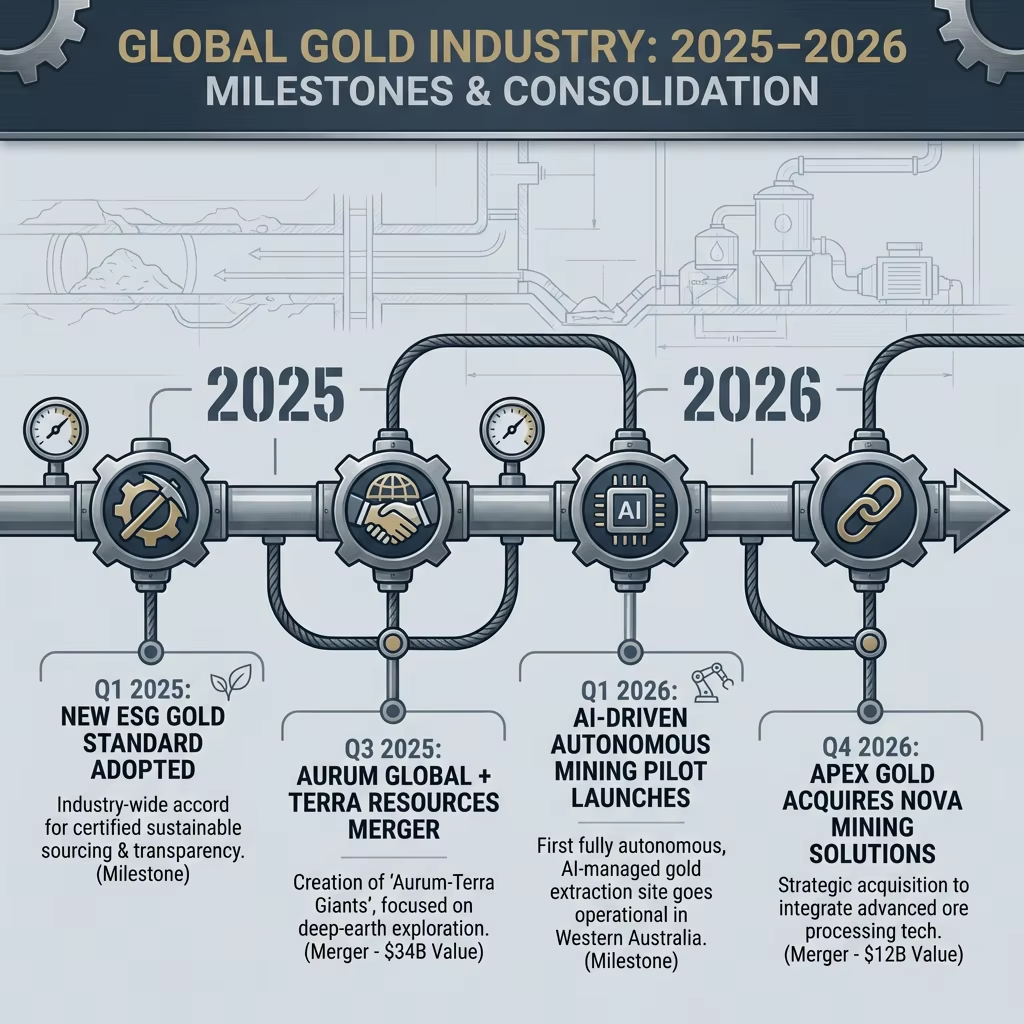
The period of 2025-2026 was marked by what historians call the “Consolidation of the Assay Titans.” The archive shows that mega-deals in the mining and analytical sectors rose by 68% in 2025 alone. This was not merely about market share; it was about the integration of intellectual property and the creation of “Full-Spectrum” testing conglomerates.
The narrative of these mergers begins with the Evident-XOS merger in early 2025. By combining the handheld XRF expertise of the Olympus heritage with the high-end monochromatic beam technology of XOS, the industry saw the birth of the first “Hybrid Benchtop” analyzer. This device allowed for laboratory-grade fire assay results to be achieved in a field-portable format, a milestone that significantly reduced the operational overhead for smaller refineries. The archive notes that the “Evident-X100” became the industry’s most successful launch, selling over 12,000 units in its first six months.
In mid-2025, Thermo Fisher Scientific acquired several smaller blockchain-startups—most notably TraceGold AI and AssayLedger—to create the first Immutable Assay Network. This move signaled that the future of the industry was not just in the hardware, but in the data that the hardware produced. The archivist highlights that by late 2025, a gold bar was only as valuable as the digital record that accompanied it. The acquisition enabled the integration of “Live-Reporting” features, where every scan performed by a Thermo Fisher analyzer was automatically cryptographically signed and uploaded to a global registry, virtually eliminating the risk of document forgery.
The Japanese giant Rigaku expanded its footprint in early 2026 by acquiring European laser-specialists LIBS-Tech Europe. This led to the first commercial rollout of Handheld LIBS/XRF Dual-Path Spectrometers. This integration allowed operators to detect light elements (like Beryllium or Lithium) and heavy metals (like Gold or Platinum) simultaneously. For the archivist, this marks the end of the “Technology Silhouette” where certain elements were invisible to the standard XRF. The Rigaku “Dual-Core” system allowed for the identification of sophisticated beryllium-copper alloys that had previously been used to trick simpler spectrometers.
Another notable transaction was the acquisition of Bruker’s handheld division by a consortium of sovereign wealth funds, leading to the formation of Global Precious Metals Verification (GPMV). This new entity focused specifically on the “National Reserve” market, providing high-energy, multi-layered scanners for the massive repatriation of gold reserves that occurred in late 2025. This M&A activity was driven by the realization that as gold became a central pillar of international settlement, the technology for its verification needed to be both sovereign and standardized.
For more on how these shifts impacted the operational reality of the trade, refer to our Pawnshop Gold Analyzer Buying & Operational Guide.
The Log of Innovation: Product Launch Cycles for Major Brands
The “Spectrometer Wars” of 2025-2026 resulted in an unprecedented wave of product launches. The archivist has categorized these into three distinct waves of innovation, each targeting a specific sector of the metallurgical market:
Wave 1: The Precision Surge (Q1 2025)
Major brands launched the “SDD-X” series, which utilized next-generation silicon drift detectors capable of handling 500,000 counts per second. This reduced testing time for 14k gold from 30 seconds to a mere 5 seconds, while actually increasing the confidence interval. Brands like Skyray and Niton led this charge, focusing on the high-volume scrap market where “Speed-to-Cash” is the primary competitive advantage. The Niton “Apollo-8” model was particularly noteworthy for its “Anti-Tarnish” algorithm, which could mathematically compensate for surface oxidation on antique silver and low-karat gold.
Wave 2: The Security Integration (Q3 2025)
Responding to the “Wolfram Crisis” and the discovery of increasingly sophisticated fakes, brands like Bruker and Hitachi launched units with integrated Ultrasonic Verification Modules. These “Two-in-One” devices, such as the Hitachi “Vulcan-Plus,” allowed the user to verify the elemental composition of the surface and the internal homogeneity of a bar in a single workflow. The historical record shows that these units became the mandatory standard for all LBMA-certified intake stations by the end of 2025, following a series of successful field trials in the Hong Kong bullion markets.
Wave 3: The Cloud-Native Assayers (Q1 2026)
The early months of 2026 saw the arrival of the “Analytic Zero” series. These machines possessed no internal storage; instead, every scan was streamed in real-time to a decentralized ledger via 6G or Starlink-integrated modems. This ensured that the data could not be tampered with by the operator or compromised by local software hacks, providing an absolute and unalterable record for auditors and regulators. The Mettler Toledo-backed “Smart-Assay” scales were the first to integrate this technology, combining precision mass measurement (down to 0.1mg) with elemental analysis in a single, compact unit that became the new “Countertop King” for retail jewelers.
The archive also logs the launch of the “Nano-Gaze” by a German-Swiss startup, which utilized a tiny, low-power X-ray source to analyze individual grains of gold dust. This product revolutionized the “Gold-in-Quartz” market, allowing prospectors to verify the purity of raw specimens without having to crush the valuable mineral matrix.
The Regulatory Tsunami: Legislative Shifts in Key Markets
The archive highlights that the technical progress of 2025-2026 was mirrored by a relentless regulatory push. The “Wild West” of the secondary gold market was brought under the heel of strict scientific oversight. The archivist notes that three key markets led this legislative charge: the United States, the European Union, and the United Arab Emirates.
In the United States, the 2026 National Money Laundering Risk Assessment identified the cash-for-gold sector as a primary area for reform. This led to the Gold Integrity Act of 2026, which required all transactions above $500 to be verified by an “approved scientific method,” effectively mandating the use of XRF or better in all 50 states. The act also introduced the “Assay Liability Clause,” which held dealers legally responsible if they purchased bullion that was subsequently found to be fraudulent and they had failed to perform a multi-point scan.
In Asia, the Shanghai Gold Exchange (SGE) introduced the Purity 2025 Standard, which tightened the allowed deviation for “Four-Nines” gold from 0.01% to 0.005%. This forced a massive upgrade of refinery equipment across China and Southeast Asia. The archivist notes that many smaller refineries were forced to merge or close, leading to a more consolidated and professional market. This standard was eventually adopted by the Dubai Good Delivery (DGD) list, creating a unified quality corridor from the Middle East to the Far East.
Geopolitically, the shift toward OECD Due Diligence compliance meant that refiners had to prove not just the purity of their gold, but its origin. The 2025-2026 period saw the implementation of the Digital Passport for Minerals in the European Union. This required every gram of imported gold to have a traceable “chemical fingerprint” back to a certified mine. The archive records the first “Sanction-Busting” case where gold from a restricted territory was identified in a Belgian refinery using trace element analysis—specifically the ratio of Osmium to Iridium—leading to a $50 million fine.
In India, the Hallmarking 2.0 mandate took effect in late 2025. It required every piece of hallmarked jewelry to be scanned by an XRF and the data uploaded to the Burea of Indian Standards (BIS) portal before it could be sold. This move was aimed at curbing the “mixing” of low-karat alloys into 22k jewelry, a practice that had historically cost Indian consumers millions in lost value.
To understand the full scope of these legal requirements and how they differ from the institutional standards, consult the Gold Testing Compliance & Regulatory Standards Guide.
Technological Milestones: The Science of Certainty
The Silicon Drift Revolution (Phase 4)
Historians of metallurgy will note that 2025 was the year the PIN diode detector became officially obsolete in the gold industry. The archive shows a mass migration toward SDD technology, which provided the resolution necessary to distinguish between similar X-ray peaks. The ability of SDD to resolve the overlapping peaks of Gold (L-alpha) and Tungsten (L-beta) meant that fakes that had previously passed as “18k” were suddenly exposed as “Gold-Plated Copper-Zinc.”
The Sherman Equation, once a niche topic for doctoral students, became a standard part of the training for senior jewelry appraisers. Understanding the Matrix Interference and how to mathematically correct for the “Enhancement Effect” of copper in rose gold alloys became the hallmark of the professional assayer. The archive records the launch of the “Sherman-Native” firmware, which allowed spectrometers to perform these complex calculations in real-time, removing the need for manual correction factors.
Another milestone was the development of Graphite-Coated Windows for handheld units. Traditionally, the delicate beryllium window of an XRF was a point of failure, prone to breakage in field conditions. The 2025 introduction of ultra-thin, graphene-based protective layers allowed for the measurement of light elements without risking the detector’s integrity, even when scanning rough or sharp mineral specimens.
The Laser Ablation Frontier and the Rise of Isotopic Mapping
The milestone reached in mid-2026 was the commercialization of LA-ICP-MS (Laser Ablation Inductively Coupled Plasma Mass Spectrometry) for high-value auctions and central bank audits. This “near non-destructive” method allowed for the analysis of 99.999% purity gold by vaporizing a spot smaller than a human cell. The archivist records that this technology was used to certify the authenticity of several historic “Double Eagle” coins and “Pre-War” bars, proving their provenance through trace isotope ratios of silver, lead, and copper that act as a geological “DNA.”
Perhaps the most exotic milestone was the use of Muon Tomography for the internal scanning of large-scale gold reserves. While still in its infancy in 2025, by 2026, a pilot project in the United States used muons (subatomic particles from cosmic rays) to scan a 100-ton gold vault. The scan revealed that the interior of the bars was perfectly homogeneous, providing the ultimate “Audit of the Gods” and silencing conspiracy theorists who had long claimed the reserves were hollow.
For a deeper technical dive into how these technologies compare to one another in the context of pawn and retail operations, please see our XRF vs Traditional Gold Testing: A Technical Comparative Analysis.
Conclusion: The Legacy of the 2025-2026 Archive
The years 2025 and 2026 represent the “Epoch of Integrity” for the gold industry. The historical record compiled in this archive (ID 2735) demonstrates that when faced with a crisis of trust, the industry did not retreat into tradition but embraced the future. The synthesis of physics, chemistry, and digital transparency created a market that is more liquid, more secure, and more ethical than at any other point in human history.
As we look forward from April 2026, the lessons of this era remain clear: precision is the only protection against the erosion of value. The archivists of the future will point to these two years as the moment gold moved from a “mythical asset” to a “verified data point.” The machines have become the arbiters of truth, and the world is richer for it.
For further exploration into the evolving landscape, practitioners are encouraged to study the Latest Gold Market Trends and the Inventory Valuation Models which provided the economic framework for this technological revolution. Furthermore, for those looking to master the identification of colored alloys and gemstone-set pieces, our Advanced Jewelry Appraisal Techniques remains the definitive technical supplement.
Related Resources
Continue your research with these in-depth WiserMachine guides: