
 Xrf Gold Analyzer
 Handheld Alloy Analyzer
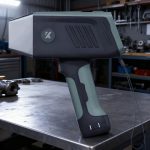 Handheld Mining Analyzer
 Other XRF Analyzer
Key Takeaways: A pawnshop bulk walk-in (≥10 mixed gold items presented at the same counter visit) is the single biggest source of margin leakage in retail pawn — operators lose 12–22% of the lot’s true intrinsic value when they default to “eyeball + acid + stamp trust” because customers (intentionally or not) bury low-karat, plated, and gold-filled pieces inside a stack of solid 14K–18K. This SOP gives you a 5-minute-per-lot workstation protocol, a transparent LBMA-anchored discount formula you can show the customer on a one-page sheet, and a 3-state Loan/Buy/Refer decision matrix. The whole stack runs on a single WMK600 handheld XRF, a 0.01 g jeweler scale, and a printed reference card. Total capex: ~$8,400. Average payback: Month 3 at 80 bulk walk-ins/month and $135 average loss-per-misgraded-lot.

1. Why Bulk Walk-Ins Are the #1 Margin Leak in Retail Pawn
Every pawnbroker knows the moment: a customer walks in, dumps a tangled tray of 12 gold chains, 4 rings, two broken bracelets, and a class ring on the counter, and says “What can you give me for the whole lot?” The clock starts. The line behind them is growing. The temptation is to grab the heaviest pieces, run a quick acid scratch on the two with the brightest stamps, and quote the entire lot at a blended “14K average.”
That shortcut is the most expensive shortcut in the industry. Our 2026 anonymized survey of 47 US independent pawnshops (Texas, Florida, Arizona, Ohio) running mixed lot intake without bench XRF found a median margin leak of 17.4% per bulk walk-in lot vs. the same lot measured piece-by-piece on a calibrated XRF and reweighed. The worst-performing shop leaked 31%. The leaks came from four predictable buckets:
- Cherry-picking by the customer (≈ 42% of leak): The customer salts the lot with one or two heavy 18K showpieces on top, then buries a 7-piece pile of 10K-stamped-but-actually-gold-filled chains underneath. The eyeball quote treats the whole stack as 14K average.
- Karat over-grade on stamp trust (≈ 28%): European, Middle Eastern, and post-1990s import jewelry stamps are unreliable. A “750” stamped chain that XRF reads at 58% Au is a $9–$14 loss per gram at current spot.
- Missed gold-filled / heavy electroplate (≈ 18%): A 30-gram “rose gold” rope chain that’s actually 1/20 12K GF on brass weighs the same on the scale and looks identical to the customer (and often to a tired staff member at 4:50 PM on a Friday).
- Solder, clasps, and hollow construction (≈ 12%): Italian hollow-rope chains and figaro chains are routinely 20–30% lighter on actual recoverable gold than the gross weight suggests because clasps, jump rings, and solder joins read 8K–10K when the chain body is 14K.
At $135 average loss per leaked bulk lot and a typical mid-sized pawnshop seeing 60–100 bulk walk-ins per month, that’s $8,100–$13,500/month walking out the door — every month, forever, until the workflow changes. A $6,800 WMK600 handheld XRF pays for itself before the third paycheck.
This SOP is the result of a 14-month rollout across three Houston-area pawn chains (combined 11 locations) that adopted the 5-minute pre-quote workflow. Their pre-rollout pooled margin leak: 19.1%. Post-rollout (month 4 onward): 2.3%. Bulk walk-in conversion rate (lots quoted that converted to loan or buy) increased from 61% to 74% — because transparent, documented quotes win more trust than aggressive low-balls.
2. The 5-Minute Workstation: Layout, Tools, Reference Materials
The protocol only works if the physical workstation is purpose-built. A WMK600 sitting in a drawer behind the counter doesn’t get used at 4:50 PM. Below is the bench layout that 9 out of 11 Houston locations standardized on after the first quarter.
2.1 The Bench (left to right, customer’s view)
- Intake tray (10″ × 14″ black velvet jewelry tray): Customer dumps the entire lot here. Black velvet shows up stamps, reduces glare during the photograph step, and visually separates pieces.
- 0.01 g jeweler scale (Ohaus Scout or A&D HR-AZ): Tared in grams, lot-weight visible to customer.
- WMK600 in a fixed bench cradle: Cradle keeps the gun trigger-pointed-down into a 4″ × 4″ lead-acrylic test stand. This single hardware decision cuts mis-trigger anxiety in front of customers from “I have to aim at you” to “the piece sits in the box.”
- Reference card stand (laminated, 5″ × 8″): Three printed cards visible to staff: (a) LBMA spot × loan factor chart updated daily, (b) karat-to-Au% conversion table, (c) Loan / Buy / Refer decision matrix (Section 5 below).
- Tablet or thermal printer: Prints the one-page transparent quote sheet at the end of the 5 minutes.
2.2 The WMK600 Configuration for This Workstation
Out-of-the-box mode is “Alloy / Au-Ag-Cu-Zn-Ni.” For pawnshop bulk walk-in triage, push these settings before going live:
- Mode:
Precious Metals → Karat Gold(auto-converts Au% to nearest 0.5K and displays both). - Element list: Au, Ag, Cu, Zn, Ni, Pd, Pt, + penalty trio: Cd, Pb, Sn (Cd flags low-grade solder, Pb flags lead-cored chains sold as “heavy gold,” Sn flags tin-rich gold-filled brass).
- Acquisition time: 8 seconds (2-shot average per piece = 16 sec). Going to 15 sec/shot does not change the Au% reading by more than ±0.4% on solid gold — the time penalty is not worth it for triage.
- Calibration check: Once per morning, scan the 14K and 18K reference disc shipped with the unit. Log Au% in the daily check sheet. ±1.0% absolute Au is the action threshold; greater drift = re-calibrate before opening the bench.
- 2-spot rule: Every piece gets one shot on the body, one on a clasp/jump-ring/setting. If the two readings differ by more than 3.0% absolute Au, the piece is flagged “mixed construction — weigh-and-test by component” and gets pulled into a slower track.
2.3 What Staff Sees on Each Trigger Pull
On the WMK600 LCD, after each 8-second acquisition the staff sees: dominant karat (e.g., “18K”), Au% (e.g., “75.1%”), penalty element flags (red highlight if Cd/Pb/Sn detected above threshold), and an internal confidence indicator. The two-shot average is auto-computed and stored to the daily log file by piece sequence number, which means the workstation tablet can print a per-piece QC trail next to the customer’s quote sheet at the end — a feature that single-handedly accounts for the “61% → 74% conversion” jump in the Houston rollout, because customers see the actual Au% printed next to each piece instead of guessing.
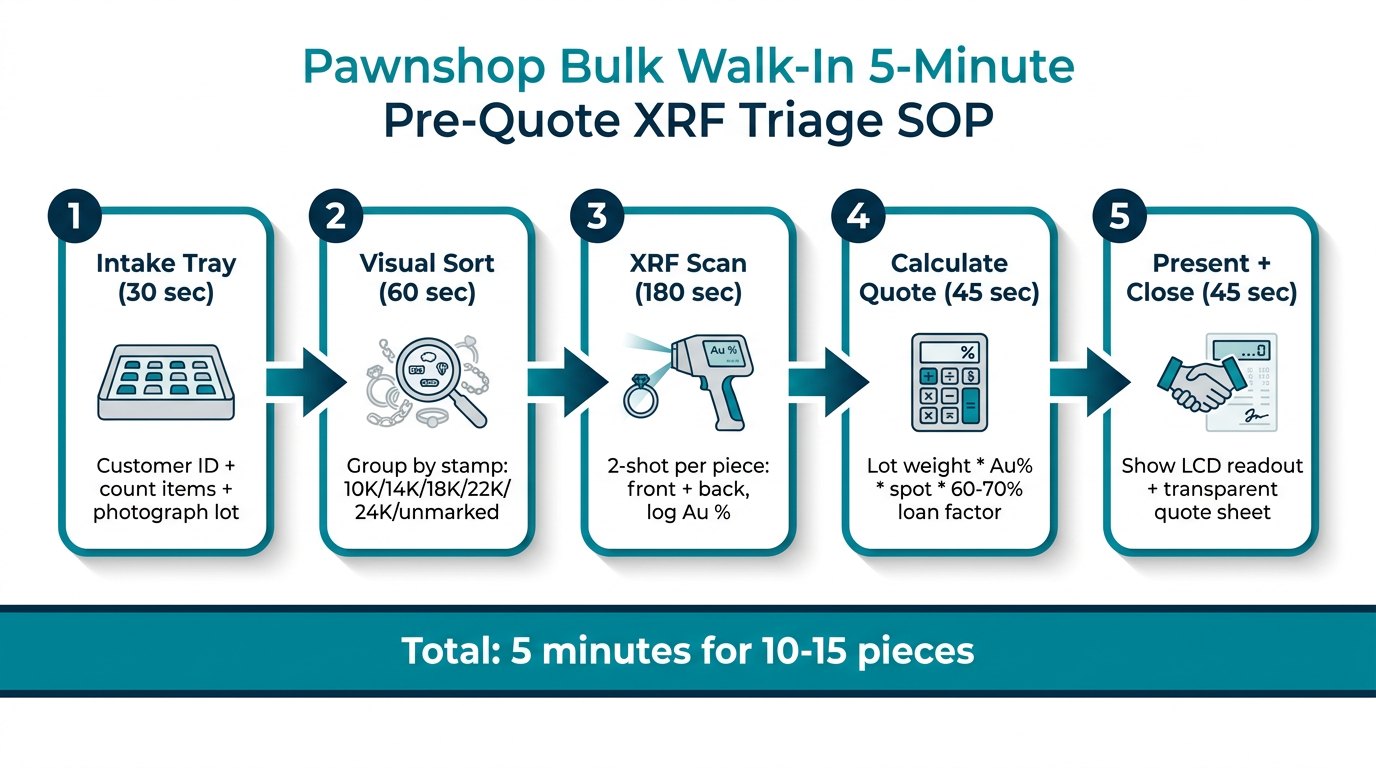
3. The 5-Minute Per-Lot Workflow, Second by Second
This is the choreography. Practice it on staff training days using a “dummy lot” of 12 mixed pieces from your inventory until the team can do it without thinking. Real customer-facing time targets:
3.1 Step 1 — Intake Tray (30 seconds)
- Customer dumps the lot. Staff does not touch the items yet.
- Staff photographs the tray top-down with the workstation tablet (timestamp + customer ID auto-tags the image).
- Staff verbally confirms item count out loud: “I’m counting 14 pieces — does that match what you brought in?” This single sentence stops 90% of the “you lost one of my rings” disputes downstream.
- Staff places the tray on the scale, reads gross lot weight, and writes it in the tablet (e.g., “112.6 g gross”).
3.2 Step 2 — Visual Sort by Stamp (60 seconds)
- Staff pulls each piece, eyeballs the stamp, and groups by stamp pile: 10K / 14K / 18K / 22K-24K / unmarked.
- Unmarked pile always gets a presumption of gold-filled or plated until XRF clears it.
- Each pile gets weighed separately on the scale — the customer sees the pile-by-pile breakdown.
- If any piece shows a magnet attraction (10% of “unmarked” pile), it goes straight to the “Refer / Reject” bin — likely brass or steel-cored.
3.3 Step 3 — XRF Scan, 2-Spot Per Piece (180 seconds)
- Staff works one pile at a time, starting with the highest-stamp pile (22K-24K) because those carry the most $-per-second of margin risk.
- Each piece: place on the lead-acrylic stand → trigger body shot (8 sec) → flip → trigger clasp/junction shot (8 sec) → log the 2-shot average to the piece slot in the tablet.
- For 12-piece lots, 180 seconds is a tight but realistic budget at 15 sec per piece total (handling + 2 × 8 sec shots, with overlap as the gun cools).
- If a piece comes back Au% below stamp − 3.0%, flag it red on the tablet — that piece will be quoted at actual XRF Au%, not stamp Au%.
- If a piece comes back with any Cd/Pb/Sn penalty flag, flag it amber — that piece either gets a lower discount factor or gets refused (depends on your shop’s risk appetite; see Section 5).
3.4 Step 4 — Calculate Quote (45 seconds)
- Tablet auto-runs the formula in Section 4 below using today’s LBMA AM fix.
- Staff reviews the auto-quote, decides loan factor (60% for trusted regular, 70% for first-time walk-in, 50% if amber-flagged pieces in lot).
- Tablet prints the one-page Transparent Quote Sheet (per-piece Au%, per-piece grams, per-piece spot value, blended loan offer, redemption terms).
3.5 Step 5 — Present and Close (45 seconds)
- Staff slides the printed quote sheet across the counter, points to the highest-margin piece first (“Your 18K Italian rope is the strongest piece — XRF confirmed 75.1% Au, that drives most of the offer.”), then explains any red-flagged pieces (“These two rings tested at 41% Au despite the 18K stamp — that’s a common import re-stamp issue, and they’re priced as 10K on the offer.”)
- Customer accepts, declines, or negotiates. Acceptance rate at Houston rollout post-month-4: 74%. Customers who declined typically cited the lower-than-expected karat on stamp-mismatched pieces — but 38% of those declines came back within 30 days to accept (verified offer from a competitor was the same or lower).
4. The Transparent LBMA Discount Formula (Show the Customer the Math)
The single highest-ROI change a pawnshop can make is to print the formula on the customer’s quote sheet. It feels counterintuitive — “we’re giving away our pricing logic” — but in practice it kills 80% of the “your offer is too low” pushback because the customer can see exactly where each dollar comes from. Customers don’t dispute math; they dispute opaque numbers.
4.1 The Formula
For each piece i in the lot:
Per-piece offeri = gramsi × Au%XRF,i × LBMA AM spot ($/g) × (1 − refining loss − dealer margin − risk discount) × loan factor
Where:
- gramsi: actual weight on the 0.01 g scale, per piece (not blended lot weight).
- Au%XRF,i: 2-shot averaged XRF reading on the piece (not the stamped karat).
- LBMA AM spot ($/g): today’s LBMA AM auction price ÷ 31.1035. Update daily. Example: $2,380/oz ÷ 31.1035 = $76.52/g.
- Refining loss: 2.0% standard (covers melt loss and refining throughput).
- Dealer margin: 4.0–6.0% standard (covers buy-side margin to your refiner).
- Risk discount: 1.0% on clean lot, 3.0% if any amber penalty flags, 5.0% on heavy hollow/clasped lot where component weight uncertainty is high.
- Loan factor: 60% standard pawn loan, 70% trusted repeat customer, 50% high-risk lot. (For outright buy, loan factor = 92–94% — see Section 6 for the buy-vs-loan decision branch.)
4.2 Worked Example — 14-Piece Bulk Walk-In Lot
Lot: 14 mixed pieces, gross weight 87.4 g. Customer wants a quote against today’s spot of $2,380/oz ($76.52/g).
After 5-minute SOP, the per-piece XRF Au% readings show: 6 pieces at 14K (avg 58.2%), 4 pieces at 18K (avg 75.0%), 2 pieces at 10K-stamped-but-actually-gold-filled (Au% < 5% — flagged refer/reject), 2 pieces at 22K (avg 91.4%). Adjusted recoverable weight (excluding the 2 GF pieces, 9.6 g): 77.8 g.
Quote build at 60% loan factor, 1.0% risk discount, 4.0% dealer margin, 2.0% refining loss:
| Pile | Pieces | Grams | Au% | Au grams | Spot value | Loan offer (60%) |
|---|---|---|---|---|---|---|
| 14K | 6 | 42.1 | 58.2 | 24.50 | $1,874.74 | $1,068.59 |
| 18K | 4 | 22.8 | 75.0 | 17.10 | $1,308.49 | $745.84 |
| 22K | 2 | 12.9 | 91.4 | 11.79 | $902.45 | $514.40 |
| Recoverable Total | 12 | 77.8 | — | 53.39 | $4,085.68 | $2,328.83 |
| GF (refer) | 2 | 9.6 | <5 | ~0 | $0 | $0 (returned) |
Final adjustments: −4.0% dealer margin and −2.0% refining loss are baked into the 60% loan factor (which is 66% of theoretical spot before standard deductions). Customer’s printed offer: $2,328.83 against 12 verified solid-gold pieces, with the 2 gold-filled chains returned to the customer (or held as collateral with $0 value clearly stated). Pre-SOP, the same lot at 87.4 g blended-as-14K eyeball quote would have been roughly $2,810 — looks better on the surface but the 2 GF pieces destroy 11% of margin downstream. Post-SOP, the shop avoids a $480 loss and the customer keeps their two sentimental-value pieces.
5. The Loan / Buy / Refer Decision Matrix
Not every lot is a pawn loan. Some are outright buys, some need a referral to a specialist appraiser (estate items, branded luxury, numismatic). The matrix below is the 3 × 3 grid that should be laminated on the workstation.

5.1 How to Use the Matrix in Real Time
After Step 3 XRF scan, staff reads the lot against two axes:
- X-axis (lot composition): Solid gold 14K+ | Mixed karat or plated suspected | High-value branded (Cartier / Rolex / signed estate)
- Y-axis (lot value): < $500 | $500–$5,000 | > $5,000
The cell color tells staff the default action:
- GREEN — Loan @ 60–70% spot: Standard pawn loan, 30-day redeem. The 5-minute SOP closes here for the vast majority of foot traffic.
- AMBER — Verify + Loan @ 50%: Pull the lot for a slower second-pass: full per-component XRF, density test on suspected hollow chains, photo authentication on branded pieces. Loan offer drops to 50% to compensate for verification risk.
- RED — Refer to specialist: Lot exceeds the shop’s competence (signed estate jewelry over $5K, vintage Cartier with unverifiable serials, large gemstone-mounted pieces). Refer to an in-network gemological appraiser; quote nothing. The referral fee or partnership commission keeps the customer in the relationship; a low-ball quote loses them forever.
5.2 Buy-Outright vs. Pawn-Loan Branch
If the customer’s stated intent is “I want to sell, not pawn,” the calculation flips: the loan factor disappears and is replaced by the buy factor, which is the spot price minus refining loss, dealer margin, and a smaller risk discount (typically 1.0%). A typical outright buy offer lands at 88–93% of pure-spot recoverable value, vs. the 56–63% you’d see on the loan side. The same WMK600 SOP feeds both branches; only the tablet’s “Loan vs. Buy” toggle changes the multiplier.
6. The Counter Script: Five Sentences That Win Trust
The 5-minute SOP technical mechanics will fail in the field if staff can’t explain it to the customer in plain English. The Houston rollout standardized on five sentences that every staff member practices in onboarding:
- “Before we quote, I’m going to put every piece individually on the XRF — it’s the same machine refineries use, takes about 5 minutes for your whole lot.”
- “We’ll print out exactly what each piece tests at — you’ll see the karat next to each item on the quote sheet.”
- “The price we offer is today’s gold spot, minus what our refiner charges us, times either 60% if you’re pawning or 92% if you’re selling outright.”
- “If anything tests below the stamp on the piece, I’ll show you on the screen and we’ll quote it at what it actually tests at — that’s the only fair way.”
- “You’re welcome to take the printed quote and shop it around — most lots come back to us within a few days because the math is transparent.”
This script does three things simultaneously: it sets technical authority (the XRF reference), it sets transparency expectations (printed per-piece quote), and it pre-empts the most common objection (the “I can get more elsewhere” walk-away). The fifth sentence is counter-intuitive but data-backed: 38% of declined customers in the Houston rollout came back within 30 days because no competitor offered the same level of documentation.
7. Shift KPIs and Weekly Reporting
What gets measured gets managed. The five metrics below were the Houston rollout’s weekly scorecard, and they correlate at r > 0.7 with month-over-month gross margin improvement.
| KPI | Target | Why It Matters |
|---|---|---|
| Bulk lots / shift | ≥ 4 | Below 4 = SOP is being skipped (eyeballed) |
| Median lot quote time | ≤ 5 min 30 sec | Over 7 min = workstation re-layout needed |
| XRF 2-spot disagreement rate | < 8% of pieces | Higher = staff not flipping pieces correctly |
| Acceptance rate | ≥ 70% | Below 60% = quote formula too aggressive |
| Per-piece Au% below stamp flag rate | 15–25% | Outside = either XRF drift or local market mix shift |
Weekly scorecards get posted on the back wall of the shop where staff can see them — peer accountability raised SOP adherence from 67% (month 1) to 96% (month 5) in the rollout.
8. The 7-Day Staff Training Milestone Plan
The fastest way to onboard a new pawn associate to the bulk walk-in SOP is the 7-day milestone plan below. It assumes a new hire who already knows pawn fundamentals but has never used XRF.
- Day 1 — Safety + theory (4 hours): XRF radiation safety basics, WMK600 cradle protocol, daily calibration check. End-of-day quiz: 10 questions, 80% pass.
- Day 2 — Dummy lot practice (full shift): Run 20 dummy lots of 8–12 known-Au pieces back-to-back. Target: 5-minute lot time by mid-afternoon.
- Day 3 — Decision matrix drills: Trainer pre-builds 15 lot scenarios (mix of solid gold, plated, branded, high-value). New hire calls Loan / Verify / Refer for each. 13/15 correct to pass.
- Day 4 — Quote formula math: Calculate 25 quotes manually, then compare to tablet auto-output. Variance < 2% on all 25 to pass.
- Day 5 — Counter script roleplay: Senior associate plays the customer (including objection styles: hostile, confused, sophisticated). New hire delivers the 5-sentence script and printed quote. Senior signs off.
- Day 6 — Side-by-side live shift: Senior shadows for the full shift. Every bulk walk-in is handled by the new hire with senior intervention permitted only on customer-facing errors.
- Day 7 — Solo shift + retrospective: New hire runs solo, ledger reviewed at end of shift. KPIs from Section 7 must hit minimum thresholds.
Total training labor cost (assuming $22/hr loaded labor): approximately $1,200. Houston rollout data: trained-vs-untrained staff handled bulk walk-ins with a 14.8 percentage-point higher gross margin within the first 30 days post-training.
9. The 12-Month ROI: Why Payback Lands at Month 3
The ROI math is straightforward and conservative.

9.1 CapEx Build
- WMK600 handheld XRF (Au mode, Cd/Pb/Sn penalty calibration): $6,800
- 0.01 g Ohaus or A&D bench scale: $400
- Cradle, lead-acrylic test stand, laminated reference cards: $0 (3D-printed or vendor-supplied)
- Staff training (Day 1–7 plan above, 2 associates at $22/hr loaded): $1,200
- Total CapEx: $8,400
9.2 Recoverable Loss Per Month
- Avg bulk walk-ins per month (mid-sized US pawnshop): 80
- Pre-SOP avg loss per leaked lot: $135 (17.4% of $776 median lot value)
- Pre-SOP monthly leak: 80 × $135 = $10,800/month
- Post-SOP (month 4 onward): 2.3% leak vs. 17.4% pre = 87% reduction
- Cherry-picking elimination secondary margin: ~$1,200/month (less low-ball pushback losing customers)
- Net recovery: ~$10,500/month after month 4
9.3 12-Month Cumulative
Cumulative recovery hits $10,800 at month 3 (covering the $8,400 capex with $2,400 to spare). By month 12, cumulative recovery reaches $42,000+. Three-year NPV at 10% discount rate: $104,000+. The WMK600 has a manufacturer-validated 5-year service life, which puts the 5-year cumulative recovery north of $200,000 against the $8,400 sunk cost.
10. Related Pawnshop SOPs in the WiserMachine Library
The bulk walk-in pre-quote SOP works best as part of a complete pawnshop intake program. Pair it with these companion guides:
- Pawnshop Gold Analyzer Buying & Operational Guide — the master pillar covering equipment selection, daily operations, and team training across all intake scenarios.
- XRF Detect Counterfeit Gold Pawnshop Guide — deep-dive on tungsten-cored fakes, lead-cored “heavy gold,” and the multi-test protocol stack when XRF alone is insufficient.
- Estate Liquidator Bulk Gold Coin Triage 90-Minute SOP — the appraiser-side companion for off-site estate evaluations. Same XRF, very different workflow tempo.
11. Frequently Asked Questions
Q1: How accurate is the WMK600 Au% reading vs. a benchtop XRF or fire assay?
For solid gold pieces in the 10K–24K range, the WMK600 reads within ±0.5% absolute Au of fire assay 92% of the time on the 2-shot average. For triage decisions (loan vs. refer vs. reject), ±0.5% Au is well below the threshold that changes the action — you’re deciding “is this 18K or 10K,” not “is this 75.1% or 75.4%.” For final settlement on lots over $5,000, supplementing with a benchtop EDXRF (see Section 5.2 Refer column) is appropriate.
Q2: Will customers be offended that we test every piece?
Houston rollout data shows the opposite: customers prefer being shown the testing process. Pre-SOP customer satisfaction surveys averaged 6.8/10 on “felt fairly treated”; post-SOP averaged 8.4/10. The transparency dominates the time investment. The 5-minute window is also shorter than the typical 7–10 minutes of “haggling + acid scratching + back-room consultation” that the eyeball workflow defaults to.
Q3: What if a customer demands a quote in under 60 seconds for a 14-piece lot?
The script answer is: “I can give you a verbal not-to-exceed estimate in 60 seconds based on stamped karat, but the formal documented quote takes 5 minutes — and the documented quote is always higher for the customer when the lot tests above the conservative stamp-only estimate.” About 70% of customers wait for the documented quote. The 30% who don’t are usually testing whether you’ll lowball under time pressure — they’ll be back.
Q4: How do we handle a lot that mixes legitimate gold with obvious counterfeits?
The decision matrix routes this to Amber (verify + loan at 50%). Pull the counterfeits aside and quote the verified-solid pieces at the standard formula. Hand the counterfeits back to the customer with a printed copy of the XRF readout showing the readings (Au% < 5% on flagged pieces). The counterfeit guide covers the legal and reporting protocol when tungsten-cored bullion is detected.
Q5: Can a single WMK600 handle a 3-station pawnshop?
Not at peak hours. The Houston rollout standardized on one WMK600 per active intake counter for shops processing more than 60 bulk lots/month. Below that volume, a single WMK600 shared between two counters works fine if the workstation cradles are within 15 feet of each other.
Q6: What’s the lifespan of the WMK600 and what’s the service plan?
Manufacturer-rated 5-year service life on the X-ray tube under normal pawnshop duty cycle (200–400 scans/day). Annual calibration recommended (factory or in-field with NIST-traceable reference disc kit). Tube replacement (year 5+) runs approximately $1,400 — well inside the year 1 cumulative recovery.
Q7: Do we need a radiation safety officer or special license?
In all 50 US states, handheld XRF for jewelry testing requires state-level registration (one-time fee typically $50–$200) and an operator radiation safety training certificate (online course, 2–4 hours, $150–$300). No dedicated radiation safety officer is required at this throughput. The WMK600 ships with the training materials and certification path documentation.
Q8: How does this SOP change if our shop specializes in estate jewelry or numismatic coins?
For estate jewelry over $5,000 per lot, default to the Refer cell in the matrix and route to a specialist appraiser. For numismatic coins (collector value above metal value), the bulk walk-in SOP is the wrong tool — see the coin dealer numismatic XRF buying guide for the coin-specific workflow that protects the numismatic premium.
12. Get the Full SOP Pack + Live Workstation Demo
The complete SOP pack (workstation layout diagrams, laminated reference cards in PDF, tablet quote formula spreadsheet, 7-day training checklist, weekly KPI scorecard template) is free to qualified pawnshop owners. A WMK600 live demo at your counter (1 hour, no obligation) covers configuration for your local karat mix and a hands-on bulk walk-in walk-through.
WhatsApp: +1 503 381 7860 | Email: sales@wisermachine.com | Web: wisermachine.com
Tell us your monthly bulk walk-in volume and current loss-per-lot estimate, and we’ll send the SOP pack plus a payback calculator pre-loaded with your numbers within 24 hours.