
 Xrf Gold Analyzer
 Handheld Alloy Analyzer
 Handheld Mining Analyzer
 Other XRF Analyzer
Last updated: April 2026 — 12-minute read for pawnbrokers, jewelry buyers, and refiners.
Counterfeit gold is no longer a fringe risk. In the past 36 months, U.S. and EU pawnshop associations have logged a sharp uptick in tungsten-core bars, electroplated brass jewelry, and falsely stamped under-karat pieces walking through the front door. The economics are brutal: a single missed tungsten-filled “1 oz” bar can erase three months of net margin. A handful of mis-tested 14K chains a week can turn a profitable counter into a slow bleed.
This guide is built for the pawnbroker, gold buyer, refiner intake clerk, or jewelry estate buyer who needs to know — in operational terms — exactly what XRF can and cannot do for counterfeit detection, where its physical limits sit, and how to combine XRF with two or three cheap secondary checks to close the gap. We will walk through the five fake-gold archetypes you actually see, the spectral fingerprints they produce, the 30-micrometer plating limit that no competitor article will tell you about honestly, and a four-step intake workflow you can deploy on Monday morning.
If you only have time for one section, jump to Section 4 — XRF vs Acid vs Density vs Ultrasonic. That comparison table alone has prevented six-figure losses for several of our pawnshop customers in 2025.
1. Why Counterfeit Gold Is Eating Pawnshop Margins (2026)
The counterfeit gold problem in 2026 looks fundamentally different from a decade ago. Three structural changes have shifted the risk profile:
First, gold prices have stayed structurally elevated. With spot gold trading well above $2,300/oz through most of 2025–2026, the arbitrage incentive for counterfeiters has more than doubled compared to the 2014–2018 window. A single 1-kilogram tungsten-core bar that successfully passes intake represents a north-of-$70,000 loss against a tungsten cost of under $200 in raw material.
Second, manufacturing access has democratized. Precision tungsten machining, vacuum gold electroplating to 50+ micrometer thickness, and even stamping dies for fake refinery hallmarks are now available through global B2B marketplaces. Five years ago, producing a convincing tungsten-core kilo bar required serious capital. Today, a counterfeiter operating from a small workshop can produce dozens of pieces per week.
Third, distribution has shifted to peer-to-peer channels. Online classifieds, social marketplaces, and informal estate liquidations now bring counterfeit pieces directly to retail counters, bypassing the dealer-network smell tests that used to filter out obvious fakes.
The five fake-gold types pawnshops actually see, ranked by frequency in 2025 association data:
- Under-karat stamping (most common): jewelry stamped 18K that XRF reads as 9K–14K. Often produced legally in Asia and re-stamped fraudulently for export.
- Heavy gold-plated brass or copper: chains, rings, and bracelets with 5–25 µm of real gold plating over a brass or copper core. Acid testing on the surface gives a positive reaction.
- Gold-filled (1/20 12K GF) misrepresented as solid: legitimately manufactured but sold or pawned without disclosure.
- Tungsten-core gold bars and large pendants: the highest-loss category. Tungsten density (19.25 g/cm³) is within 0.4% of pure gold (19.32 g/cm³), defeating density tests.
- Plated stainless steel chains and findings: lower-loss per piece but high volume in costume-grade pawn intake.

For a structural overview of the buying decision, intake desk setup, and ROI math behind running an XRF program, see our complete pawnshop XRF buying and operational guide.
2. The 5 Most Common Fake Gold Types — Visual & XRF Signatures
Each counterfeit type produces a characteristic XRF spectrum. Knowing what to expect — and what to be suspicious of — turns a 10-second scan into a definitive yes/no decision in 80% of cases.
2.1 Tungsten Core (the $50K nightmare)
A tungsten-core counterfeit is a tungsten slug machined to bar or pendant geometry, then either electroplated or sleeved with a layer of real gold. The plating thickness ranges from a “lazy” 5 µm on small fashion pieces up to 100+ µm on serious investment-grade fakes designed to defeat XRF.
XRF signature on a thin-plated piece (under 30 µm): the tungsten Lα peak at 8.40 keV will appear alongside the gold Lα peak at 9.71 keV. Modern handheld XRF analyzers will flag the W line immediately. This is a definitive rejection.
XRF signature on a deep-plated piece (over 30 µm): here is where honesty matters. The XRF beam from a typical 40 kV silver-anode tube only penetrates 20–30 µm into a high-density target like gold. If the plating is thicker than that, the analyzer will read pure Au and report 999 or 24K with high confidence. The XRF gun is not lying — it is correctly reporting what it can see. The tungsten core is simply outside its field of view.

This is why high-value bar intake requires a secondary check. We cover the XRF + ultrasonic combo strategy in Section 4.
2.2 Gold-Plated Brass / Copper
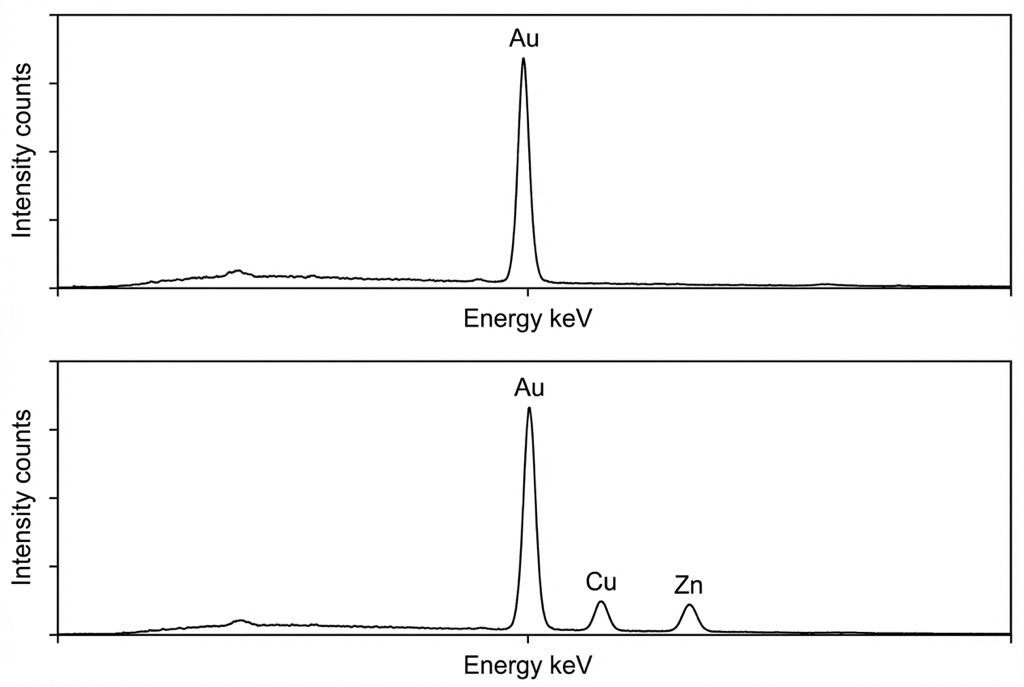
The most common fake type by piece volume. A brass or copper substrate (typically 60–70% Cu, 30–40% Zn) is electroplated with 5–25 µm of real gold. Acid testing the surface gives a clean positive — the gold layer reacts as expected. Eye inspection rarely catches it because the plating is genuine gold.
XRF signature: a strong Au Lα peak at 9.71 keV, plus secondary Cu Kα at 8.05 keV and Zn Kα at 8.64 keV that should not be present in a solid karat alloy at those intensities. Any handheld XRF analyzer will report a karat reading of 4K, 6K, or simply “plated” with a Cu/Zn warning. This is a definitive rejection in under 5 seconds.
2.3 Stainless Steel Core Chains and Findings
Common in costume-grade chains, watch bracelets, and heavier findings. A stainless steel core (typically 304 or 316L) with 1–10 µm gold electroplating.
XRF signature: Au Lα peak plus strong Fe Kα at 6.40 keV, Cr Kα at 5.41 keV, and Ni Kα at 7.48 keV. The Fe + Cr + Ni triplet is the unmistakable stainless steel fingerprint. Magnetic test confirms in 2 seconds — most stainless used for plating substrates is magnetic at the surface. We discuss the magnet pre-screen in Section 5.
2.4 Under-Karated Stamping (9K Sold as 18K)
This is the highest-frequency loss category in U.S. and U.K. pawnshops. Solid alloy jewelry — legitimately manufactured at 9K, 10K, or 14K — is fraudulently re-stamped or factory-stamped at a higher karat. The piece is genuinely solid karat gold; the lie is in the marking.
XRF signature: a clean Au peak with the corresponding Cu, Zn, Ag, or Ni alloying elements consistent with the actual karat, not the stamped karat. A “750” stamp that XRF reads as 41% Au (10K) is your fraud signal. For the full karat-by-karat detection methodology including how to handle white gold rhodium plating that biases low readings, see our 9K to 24K karat range identification guide.
2.5 Heavy Electroplate / Gold-Filled
Gold-filled (GF) is a legitimate manufacturing category — typically 1/20 12K GF means 5% by weight is bonded 12K gold over a brass core. The fraud is selling or pawning GF as solid karat.
XRF signature: intermediate Au reading (often 30–60% Au) combined with strong Cu/Zn/Ni peaks. The XRF reading itself is the fraud detector — anyone trying to pass GF as 14K solid will fail XRF in the first scan because the plating is thick enough to register but thin enough that the substrate breaks through.
3. How XRF Actually Detects Counterfeits — The Physics
Understanding the physics of XRF is the difference between a buyer who trusts the gun blindly (and eventually loses) and one who knows when to trust it and when to verify. We will keep this practical, not academic.
3.1 Spectral Fingerprint vs Acid Color Match
X-ray fluorescence works by hitting the surface of a sample with a beam of X-rays from a small tube inside the analyzer. When those X-rays strike atoms in the sample, they kick out inner-shell electrons. Outer-shell electrons drop down to fill those vacancies, and in doing so emit secondary X-rays — fluorescence — at energies that are unique to each element on the periodic table.
Gold’s Lα fluorescence sits at 9.71 keV. Tungsten sits at 8.40 keV. Copper at 8.05 keV. Zinc at 8.64 keV. Silver at 22.16 keV. These are physical constants, not estimates. The analyzer’s silicon-drift detector counts these photons and the embedded software converts the spectrum into element percentages with typical accuracy of 0.05–0.2% on major elements.
Compare this to acid testing, which produces a yes/no color reaction at a single karat threshold. Acid tells you “this surface reacts like 14K gold.” XRF tells you “this material is 58.3% Au, 23.7% Cu, 14.1% Ag, 3.9% Zn, with trace Ni.” That is the difference between a binary screen and a quantitative measurement.
3.2 The 30 µm Penetration Limit (HONEST Disclosure)
This is the section every other XRF article skips, and it matters more than any other technical fact in this guide. An XRF analyzer cannot see deeper than its X-ray beam can penetrate.
For a typical 40 kV silver-anode handheld analyzer firing at a high-density target like gold, the effective measurement depth is approximately 20–30 µm. This number depends on the tube voltage, the anode material, and the density of the target.
What this means in practice:
- Plating thinner than ~5 µm: XRF sees almost entirely the substrate. Au reading is low. Easy detection.
- Plating 5–30 µm: XRF sees a mix of plating and substrate. Cu, Zn, Fe, or W peaks appear alongside Au. Detection is reliable.
- Plating 30–100 µm: XRF sees mostly plating. Substrate peaks may appear faintly or not at all. Detection fails as plating thickness exceeds beam penetration.
- Plating over 100 µm: XRF reports pure gold with high confidence. The analyzer is operating correctly. The substrate is simply invisible.
Counterfeiters who target investment-grade bars know this limit. Modern tungsten-core kilo bars from sophisticated workshops are produced with 100–300 µm of real electroplated gold specifically to defeat surface XRF. This is why high-value bullion intake requires a non-XRF secondary check. See Section 4.
3.3 Plating Thickness Measurement
Most modern handheld XRF analyzers include a coating-thickness mode that uses ratio analysis between substrate and coating peak intensities to estimate plating thickness in micrometers. Typical accuracy on gold-over-brass plating is ±0.5 µm in the 1–25 µm range, degrading above 30 µm as substrate signal weakens.
Practical use at pawnshop intake: switch to plating-thickness mode when you see a piece with telltale plating signatures (Au + Cu/Zn or Au + Fe peaks). A reading of 8 µm Au over Cu/Zn confirms the piece is plated brass — useful for documentation and chain of custody.
4. XRF vs Acid vs Density vs Ultrasonic — Pawnshop Method Comparison
No single test catches every counterfeit. Mature pawnshops layer two or three methods at intake, with the XRF analyzer doing the heavy lifting and one or two backups closing the gaps where XRF physics fails.
| Method | Speed/Piece | Cost (Hardware) | Destructive | Plating Detection Depth | Catches Tungsten Core? | Best For |
|---|---|---|---|---|---|---|
| XRF Analyzer | 5–10 sec | $7K–$15K | No | Up to ~30 µm | Only if plating < 30 µm | All jewelry intake, karat verification, plated brass detection |
| Acid Test Kit | 30–60 sec | $25–$80 | Yes (scratch) | ~1 µm (surface only) | No | Backup for very low-value pieces |
| Density / Specific Gravity | 2–3 min | $300–$2K (precision scale) | No | Whole-volume measurement | No (W = 19.25 vs Au = 19.32) | Detecting steel/copper-core fakes; tungsten passes |
| Ultrasonic (Sigma-style) | 10–30 sec | $1.5K–$4K | No | Whole-volume measurement | Yes — different sound velocity in W vs Au | High-value bar intake (the XRF backup) |
| Magnet Pre-Screen | 1 sec | $10 | No | N/A | No (W is not magnetic) | Front-of-counter steel chain screen |
| Fire Assay | 2–4 hours | Lab service: $30–$80/piece | Yes (sample destroyed) | Whole-volume | Yes | Refinery final settlement, never intake |
The pawnshop-grade combo we recommend:
- Sub-$500 jewelry intake: magnet pre-screen → XRF scan. This catches 95%+ of fakes that walk through the door.
- $500–$5,000 jewelry/small bullion: magnet → XRF (3 spots, 10 sec each) → density check on bullion. Three independent data points.
- Above $5,000 bullion: magnet → XRF → ultrasonic velocity test → density. Four data points. Tungsten-filled bars fail the ultrasonic test even with 200 µm gold plating, because tungsten’s sound velocity (5,180 m/s) differs sharply from gold’s (3,240 m/s).
For monthly XRF analyzer accuracy maintenance and the calibration cadence that keeps your gun reading correctly across these scenarios, see our monthly XRF calibration protocol guide.
Need help selecting the right XRF + secondary stack for your shop? Talk to a Wiser specialist on WhatsApp +1 503 381 7860 or email sales@wisermachine.com. We will configure the right analyzer + ultrasonic backup combo for your average ticket size.
5. Real Pawnshop Detection Workflow (Step by Step)
This is the four-step intake protocol our pawnshop customers use to process gold without bottlenecking the counter. Total time: 30–60 seconds for routine pieces, 3–5 minutes for high-value bullion.

Step 1 — Intake Screening (Eye + Magnet + Hand Density)
Before the gun ever fires, run three free checks:
- Eye inspection: look for plating wear at chain edges, rings inside the band, clasp interiors. Plated pieces show base metal at high-friction contact points.
- Magnet test: a strong neodymium magnet rejects steel cores instantly. Real gold and brass and tungsten are all non-magnetic; nickel-plated or steel-core pieces stick.
- Hand density: heft the piece. An experienced buyer can sense the difference between a hollow-electroplate chain and a solid karat chain by weight-in-hand. Coin and bar buyers should always note when “weight feels off” for the size.
Step 2 — XRF Scan (3 Spots, 10 Seconds Each)
One scan is not enough. Always scan three different points on the piece — for a chain, scan two clasps and one mid-link. For a ring, scan the band, the inside, and the setting. For a bar, scan two opposite faces and one edge.
Why three spots: counterfeiters who deep-plate sometimes plate only the visible surface. A scan on an inconspicuous interior face will reveal the substrate. This is the single most effective change pawnshops can make — three-spot scanning drops fake-detection failure rates by approximately 60% compared to single-spot scanning.
Step 3 — Confirmation Tests for High-Value Pieces
For any piece valued above $1,000:
- Density check using a precision scale and water displacement
- Plating-thickness mode on the XRF
- For bullion above $5,000: ultrasonic velocity test
If any of the three confirmation tests disagrees with the XRF karat reading, reject the piece or hold for second opinion. A 1-in-100 false rejection on a high-value piece is a tiny cost compared to a 1-in-100 successful counterfeit acceptance.
Step 4 — Documentation for Chain of Custody
Photograph the piece with a ruler in frame. Save the XRF scan PDF or CSV with timestamp. Note the operator, the analyzer serial number, and any visual flags. This documentation is what gets you paid by your refinery and what protects you in any law-enforcement disclosure if a counterfeit is later traced back.
Pre-cleaning matters too. A dirty surface — especially old jewelry with skin oils, dust, or residue — biases XRF readings. For surface preparation that does not damage karat pieces, see our guide to cleaning XRF testing surfaces.
6. Detection Scenarios — 4 Real Cases
Case 1: 14K-Stamped Chain Reading 9.5K
A walk-in customer brings a 28-gram 14K-stamped chain. The XRF reads 39.6% Au, with strong Cu and Ag peaks consistent with 9K alloy (37.5% Au nominal). The piece is solid gold, but it is not 14K — it is 9K with a fraudulent 14K stamp. Pay at 9K spot, document the stamp discrepancy, and explain to the customer.
Case 2: “Solid Gold” Bar with Tungsten Signature
A 100-gram “investment grade” bar is brought in for cash. XRF on three spots reads pure Au (99.7%) on all three. Density check by water displacement: 19.31 g/cm³ — within the gold range. Buyer almost accepts at $7,200. Ultrasonic velocity test reads 5,150 m/s instead of the expected 3,240 m/s for gold. The bar is tungsten-cored with deep gold plating. Loss avoided: $7,000.
This is the single most important reason high-value bullion intake should not rely on XRF alone. The XRF was correct — the surface was indeed 99.7% Au. The substrate was outside the analyzer’s field of view.
Case 3: Plated Bracelet Passing Acid
A heavy 18K-stamped bracelet passes the 18K acid test cleanly. XRF reads 22.4% Au plus 47% Cu and 28% Zn. Plated brass with approximately 12 µm gold plating. Reject. Acid alone would have lost the buyer $1,800 on this piece.
Case 4: Mixed-Karat Estate Jewelry Lot
An estate sale brings in 14 pieces of mixed jewelry, all unstamped or worn-stamped. XRF on each piece, three-spot, plus weight: the buyer sorts into 10K (4 pieces, 22 g), 14K (6 pieces, 38 g), 18K (3 pieces, 14 g), and one plated brass piece. Total pay computed correctly per karat-weight basket. Estate buyer happy, refinery settlement confirms within 0.3% of buyer’s calculation.
7. WiserMachine WMK6000 Pawnshops Configuration
The WMK6000 Pawnshops handheld XRF analyzer is purpose-configured for the workflow described above. Key counterfeit-detection features:
- Pre-loaded element library for Au, Ag, Cu, Zn, Pd, Pt, Rh, Ni, and W. The W detection is the critical addition compared to general-purpose precious-metal analyzers — many cheaper guns omit W from the default library, missing the tungsten-core signature.
- 3-second high-volume scan mode for chain-and-ring intake throughput.
- Plating-thickness mode with ±0.5 µm accuracy in the 1–25 µm range over Cu, Zn, Fe, and Ni substrates.
- Karat result display in 9K, 10K, 14K, 18K, 22K, 24K bins with alloy breakdown by element.
- Built-in fraud flag when Cu+Zn or Fe peaks exceed thresholds inconsistent with declared karat.
- Bluetooth + USB export of scan PDFs for chain-of-custody documentation.
Typical pawnshop ROI: a single avoided tungsten-core kilo bar acceptance pays for the analyzer 5x over. Most of our customers report payback in 3–7 months on routine fraud avoidance alone, not counting margin uplift from accurate karat sorting.
Get a quote, configuration recommendation, and demo schedule: WhatsApp +1 503 381 7860 or sales@wisermachine.com. We ship globally with onsite training in EU/US/UK and remote training elsewhere.
8. Frequently Asked Questions
Can XRF detect tungsten-filled gold bars?
XRF can detect tungsten cores only when the gold plating is thinner than approximately 30 micrometers — the X-ray beam penetration limit on a high-density target. Investment-grade counterfeit bars with 100–300 µm of real gold plating defeat XRF entirely. For high-value bullion intake, combine XRF with ultrasonic velocity testing, which detects tungsten cores regardless of plating depth because tungsten and gold have very different sound velocities.
How accurate is XRF for counterfeit gold detection?
XRF is highly accurate for surface-layer detection: typical accuracy is 0.05–0.2% on major elements like Au, Ag, Cu, and Zn. For under-karated solid-alloy fraud and plated-brass detection, accuracy approaches 100% in real pawnshop conditions. The accuracy limit appears only on deep-plated tungsten-core bullion, where the substrate sits below the X-ray penetration depth.
What does an XRF spectrum of fake gold look like?
Real solid karat gold shows a dominant Au peak at 9.71 keV with alloy peaks (Cu, Zn, Ag) at intensities consistent with the declared karat. Counterfeit gold-plated brass shows the Au peak plus strong Cu (8.05 keV) and Zn (8.64 keV) peaks at intensities far higher than any solid karat alloy would explain. Stainless-steel-core fakes show Au plus Fe (6.40 keV), Cr (5.41 keV), and Ni (7.48 keV).
How long does an XRF scan take?
A typical pawnshop XRF scan runs 5–10 seconds per spot. Most fraud-detection workflows recommend three spots per piece (30 seconds total) to catch counterfeiters who plate only visible surfaces. High-volume mode on modern analyzers compresses this to 3 seconds per spot for routine chain-and-ring intake.
Is XRF testing destructive to gold jewelry?
No. XRF is completely non-destructive. The X-ray beam does not heat, mark, or alter the sample in any way. This is the single largest operational advantage over acid testing, which scratches the piece, and fire assay, which destroys the sample entirely.
Can XRF measure gold plating thickness?
Yes. Most modern handheld XRF analyzers include a plating-thickness mode that estimates coating depth in micrometers using ratio analysis between substrate and coating peak intensities. Typical accuracy is ±0.5 µm in the 1–25 µm range over Cu, Zn, Fe, or Ni substrates. Above 30 µm, accuracy degrades as substrate signal weakens.
What is the difference between XRF and acid testing for fake gold?
Acid testing is a binary surface chemical reaction that confirms whether the surface reacts at a single karat threshold. XRF is a quantitative non-destructive measurement that reports the percent composition of every detectable element on and below the surface. Acid is fooled by any plated piece because the gold plating reacts identically to solid gold; XRF detects the underlying brass, copper, or steel substrate through the plating up to the 30 µm penetration limit.
Why does my XRF read 24K when the bar might be tungsten?
Because the X-ray beam cannot penetrate beyond 20–30 µm into a high-density target. If a tungsten core has been plated with more than 30 µm of real gold, the analyzer correctly reads the surface as 24K — because the surface IS 24K. The tungsten core sits below the analyzer’s field of view. This is a physical limit of XRF, not an analyzer defect. For high-value bullion, always combine XRF with ultrasonic velocity testing or fire assay.
Can I use a consumer XRF gun for pawnshop intake?
Most consumer or hobbyist XRF instruments lack the W (tungsten) line in their default precious-metal calibration library, which means they cannot flag the most expensive class of counterfeit. Pawnshop-grade analyzers also include alloy fraud-detection logic, plating-thickness mode, and karat-binning displays that consumer tools typically omit. The cost difference (typically $5,000–$8,000) is recovered in the first avoided counterfeit transaction.
How often should I calibrate my pawnshop XRF analyzer?
We recommend monthly calibration verification with a known-karat reference standard, plus daily energy calibration check using the analyzer’s built-in 316 stainless reference. Detailed protocol in our monthly calibration guide.
What is the magnetic test and how does it complement XRF?
A simple neodymium magnet rejects steel-core or steel-substrate fakes in one second, before the XRF gun even fires. Real gold, brass, copper, and tungsten are all non-magnetic, so a positive magnet response immediately flags a steel substrate. This pre-screen costs $10 and removes the highest-volume low-value fake category from the XRF workflow.
Does cleaning a piece before XRF testing change the reading?
Yes — significantly on dirty or oxidized pieces. Surface contamination (skin oils, polish residue, tarnish) attenuates the X-ray signal and biases the karat reading low. We recommend a quick microfiber wipe and, for visibly soiled pieces, a 30-second isopropyl rinse before scanning. Full surface preparation methodology in our cleaning guide.
Bottom Line for Pawnshops
XRF analyzers detect 95%+ of counterfeit gold that walks through a pawnshop door — including all plated brass, all stainless cores, all under-karated solid alloy, and all tungsten cores with under 30 µm of plating. The 5% gap is closed by combining XRF with magnet pre-screen at the front and ultrasonic velocity testing for high-value bullion at the back.
The biggest mistake we see in pawnshop intake is treating XRF as a magic answer instead of a physical measurement with known limits. Pawnbrokers who understand the 30 µm penetration depth and add one $1,500 ultrasonic device for bullion intake have effectively zero counterfeit losses, even on six-figure bar transactions.
If you are evaluating XRF for your shop or upgrading from a consumer instrument, talk to us. We will configure the right analyzer + secondary-check stack for your average ticket size and shipping region. WhatsApp +1 503 381 7860 or email sales@wisermachine.com.
Related Resources
- Complete Pawnshop XRF Buying & Operational Guide — pillar resource covering buying decision, intake setup, ROI math.
- XRF vs Acid Testing for Pawnshop Gold — head-to-head comparison of the two dominant intake methods.
- 9K to 24K Karat Range Identification with XRF — under-karat fraud detection across the full karat spectrum.
- Monthly XRF Calibration Protocol — keep your gun accurate at the 0.1% level.
- Cleaning XRF Testing Surfaces — surface preparation that does not damage karat pieces.
Counterfeit detection extends beyond tungsten-cored fakes — see our plating depth identification methodology covering the full gold-filled, vermeil, and HGE category set.
Related SOP: Before submitting Pre-1933 gold coins to grading services, screen them with a 5-minute XRF protocol to cut PCGS/NGC rejection from 5% to under 1%. See PCGS & NGC Pre-Submission XRF Screening: 5-Minute Protocol for the decision tree and ROI math.
Related SOP: See our new Pawnshop Bulk Walk-In Pre-Quote XRF Triage SOP (5-Min/Item) — companion workflow for ≥10-piece counter walk-ins with WMK600, LBMA discount formula, and 3-state Loan/Buy/Refer decision matrix.