
 Xrf Gold Analyzer
 Handheld Alloy Analyzer
 Handheld Mining Analyzer
 Other XRF Analyzer
The complete buyer’s reference for XRF silver purity analysis across every silver stream: bullion and coin, jewelry and sterling scrap, photovoltaic and electronic recovery, dental alloy, and refinery intake. Silver is valued on one number above all others — its fineness — and that number cannot be judged by eye, weight, or stamp alone. A .999 fine bar, a .925 sterling offcut, a silver-plated base-metal slug, and a low-grade casting can look identical across a counter or in a drum, yet they carry wildly different recoverable value. X-ray fluorescence is the instrument that turns a silver stamp into a measured composition in seconds, non-destructively, and this guide is the central reference that ties together how XRF reads silver fineness, what it can and cannot do, and how each silver buying scenario applies it. It is the pillar that connects our silver-stream playbooks for bullion and coin verification, photovoltaic silver recovery, dental scrap valuation, and refinery intake reconciliation.
Whether you buy silver across a retail counter, recover it from end-of-life industrial streams, or reconcile supplier consignments at a refinery, the principle is the same: the silver you cannot prove, you cannot price. This guide lays out the silver fineness landscape, the physics and limits of XRF silver analysis, the buying scenarios where it matters, and how to choose and run an analyzer so every silver decision rests on a measured number rather than a stamp. For the parallel gold and precious-metal frameworks, see our industrial precious-metal recycling XRF buyer’s guide and our refinery purity analysis guide.

The Silver Fineness Landscape Every Buyer Must Know
Silver value begins with fineness, the ratio of pure silver to total alloy weight expressed in parts per thousand. The grade a piece carries determines both what it is worth and how it should be assayed, and a buyer who cannot place a piece on the fineness spectrum cannot price it correctly. The market runs on a handful of recognized standards, each with its own applications and its own assay implications.
Fine silver at .999 — sometimes pushed to .9999, four-nines — is 99.9 percent pure and is the standard for investment bullion, rounds, and coins where elemental purity is the whole point. Its softness makes it unsuitable for daily-wear products, which is why the alloyed grades exist. Britannia silver at .958 is 95.8 percent silver, a historic high-grade standard. Sterling at .925 is 92.5 percent silver with the balance typically copper, the workhorse alloy of jewelry and flatware because the copper hardens the metal for durability. Coin silver at .900 is 90 percent, and lower grades down to .800 appear in older European silverware and some industrial alloys. Modern tarnish-resistant alloys such as Argentium replace part of the copper with germanium at grades like .935 and .960.
Each grade carries a different recoverable-value and assay profile. A .999 piece recovers near its weight and reads cleanly on XRF; a .925 piece carries a copper fraction that both lowers recoverable silver and must be quantified, not ignored; and a piece declared simply as “silver” without a grade is a pricing dispute until an analyzer resolves it. This is why the first job of any silver intake — whether a coin shop counter or a refinery dock — is to fingerprint fineness against the claimed standard before a weight-based value is struck.
Why Silver Purity Verification Is a Growing Buyer Priority
Silver sits at an unusual intersection of monetary metal and industrial commodity, and that dual role is exactly why purity verification has moved from a nice-to-have to a core competency for anyone buying it. On the monetary side, silver bullion and coins trade on fineness as the basis of value, and the same liquidity that makes silver attractive to investors makes it attractive to counterfeiters who plate base metal to bullion dimensions. On the industrial side, silver is consumed in photovoltaics, electronics, brazing alloys, catalysts, and contacts, which means a steadily growing stream of end-of-life material flows back into recovery and refining channels where its fineness is unknown until it is measured.
The recovery side is where the verification imperative is sharpest. A retiring solar installation, a pallet of obsolete electronics, a box of dental restorations, or a drum of mixed jewelry scrap all contain silver at fineness levels that no stamp reliably declares, and the buyer who prices that material is exposed on every lot to the gap between what is claimed and what is recoverable. Unlike a freshly minted coin, recovered silver carries oxide, plating, contamination, and blended grades, so a non-destructive fineness measurement at intake is the only way to convert an ambiguous stream into a priced one. This is the same buy-side logic that drives our industrial precious-metal recycling guide, applied to the silver streams that are growing fastest.
The economic stakes scale with both volume and the spread between grades. The difference between .999 and .925 is roughly the copper fraction plus refining loss on every kilogram, and across a high-throughput counter or refinery that difference compounds into the margin that separates a profitable operation from a leaking one. Verification is not an overhead cost on these operations — it is the control that protects the margin, and the analyzer that performs it pays for itself in the mispriced lots it prevents.
How XRF Reads Silver: The Physics and Its Limits
X-ray fluorescence works by exciting the atoms in a sample with high-energy X-rays so they emit secondary X-rays at energies characteristic of each element. The analyzer reads those characteristic energies and computes the elemental composition, reporting silver fineness alongside copper, lead, zinc, and other constituents in seconds. For silver buying it is the only practical instrument that is fast, non-destructive, and multi-element at once: a modern analyzer covers a wide composition range, resolves high-purity silver to a fraction of a percent, and completes a reading in well under a minute without marking or consuming the piece.
The single most important limit a silver buyer must respect is that XRF is a surface-sensitive measurement. The exciting X-rays and the fluorescent response only penetrate and escape from the outermost layer of the sample, so XRF reports the composition of the surface, not the bulk beneath it. On a homogeneous .999 bar this does not matter — surface equals bulk — but on a silver-plated base-metal core, a sufficiently thick silver skin returns a near-pure silver reading that masks the copper, lead, or iron underneath. This is precisely why XRF detects thin plating over base metal and prevents overvaluation, yet can be defeated by a thick enough plate, and why disciplined silver buying never lets a clean surface reading stand alone on a high-value or suspicious piece.
The defense against the surface limit is to pair XRF with complementary checks matched to the stakes. Density and specific-gravity measurement probe the whole volume and catch base-metal substitutions a surface reading misses; reading multiple points and reporting the spread exposes uneven plating and inhomogeneity; and for high-value or heterogeneous lots, melting to a homogeneous button before assay eliminates the surface-versus-bulk problem entirely. The professional pattern across every silver scenario is the same: XRF first for fast non-destructive fineness, then density or a melt-and-assay confirmation where the value or the risk justifies it.
Why Silver Counterfeits and Misdeclarations Differ from Gold
A buyer moving from gold to silver must recalibrate the threat model, because the fraud and misdeclaration patterns are different. The tungsten-core trick that defines high-value gold fraud — tungsten’s density sits almost exactly on gold’s — does not transfer to silver, because tungsten is nearly twice as dense as silver and a tungsten-cored silver piece would fail a density check immediately. Silver’s real threats are subtler and cheaper: silver-plated copper, lead, iron, or zinc cores; low-fineness alloy passed off as a higher grade; and cast reproductions that copy the look without the metal.
On the supply side, the dominant problem is not always deliberate fraud but misdeclaration and ambiguity. A drum declared as “silver scrap” may blend .999 offcuts with .925 sterling, plated pieces, and non-metallic carry, and its declared gross weight overstates recoverable silver by the copper fraction plus loss. Sterling at .925 is, by definition, only 92.5 percent silver, so a lot settled as if it were fine silver overpays substantially. XRF resolves both the fraud and the misdeclaration problem the same way — by reading fineness directly against the claim — but the buyer must know which threat a given stream carries to apply the right confirmation. Our silver bullion verification SOP details the counter-side fraud playbook, while the refinery intake reconciliation SOP handles the declared-versus-assayed weight problem.

The Six Silver Buying Scenarios and How Each Applies XRF
Silver crosses a buyer’s hands in distinct streams, and while the analyzer is the same, the protocol around it changes with the material, the threat, and the economics. Understanding the six core scenarios is what lets a buyer apply XRF correctly rather than treating every silver transaction identically.
Bullion and Coin Counter Verification
At a coin shop or bullion counter, the threat is the plated or under-fineness counterfeit at the correct diameter and weight. XRF fingerprints fineness against the claimed .999 or .925 standard and screens for the copper, lead, and iron signatures of a plated core, paired with a magnet and specific-gravity check because a surface reading alone cannot clear a high-value piece. The full counter protocol is in our silver bullion and coin XRF verification SOP.
Photovoltaic and Electronic Silver Recovery
End-of-life solar panels and electronic scrap carry silver in pastes, contacts, and plated connectors, and the recovery buyer needs to grade an incoming lot to price it. XRF screens the silver content of a heterogeneous recovery stream so a lot can be sorted and valued before processing, with the protocol detailed in our solar panel silver recovery incoming-lot assay SOP.
Dental and Mixed Precious-Metal Scrap
Dental scrap mixes silver-bearing noble alloys with gold, platinum, and palladium, and the silver fraction is one part of a multi-metal valuation. XRF reads the full noble-metal profile including silver, with porcelain and contamination removed first so the beam reads metal, as covered in our dental scrap precious-metal assay SOP.
Refinery Intake Reconciliation
At a refinery dock, the job is to reconcile a supplier’s declared weight and fineness against the assayed reality and account for melt loss in settlement. XRF fingerprints .925 versus .999 at intake, then a melt-and-sample fire assay settles the recoverable content, as laid out in our silver scrap refinery intake reconciliation SOP.
Jewelry and Sterling Scrap Trade
Jewelry buyers and sterling scrap dealers face mixed-grade lots where .925, .900, and plated costume pieces co-mingle. XRF separates genuine sterling from plated and low-grade pieces and quantifies the copper fraction so a lot is priced on assayed fineness rather than on optimistic stamps, the same recovery and audit discipline our jewelry bench sweeps recovery audit SOP applies on the gold side.
Industrial and Toll Refining Streams
Industrial silver — brazing alloys, contacts, catalysts, and process residues — arrives with variable fineness and base-metal load, and the buyer or toll refiner needs both fineness and penalty-element screening. XRF quantifies silver alongside the lead, zinc, and other elements that affect routing and value, consistent with the compliance screening in our refinery penalty-element screening guide.

What XRF Can and Cannot Tell You About Silver
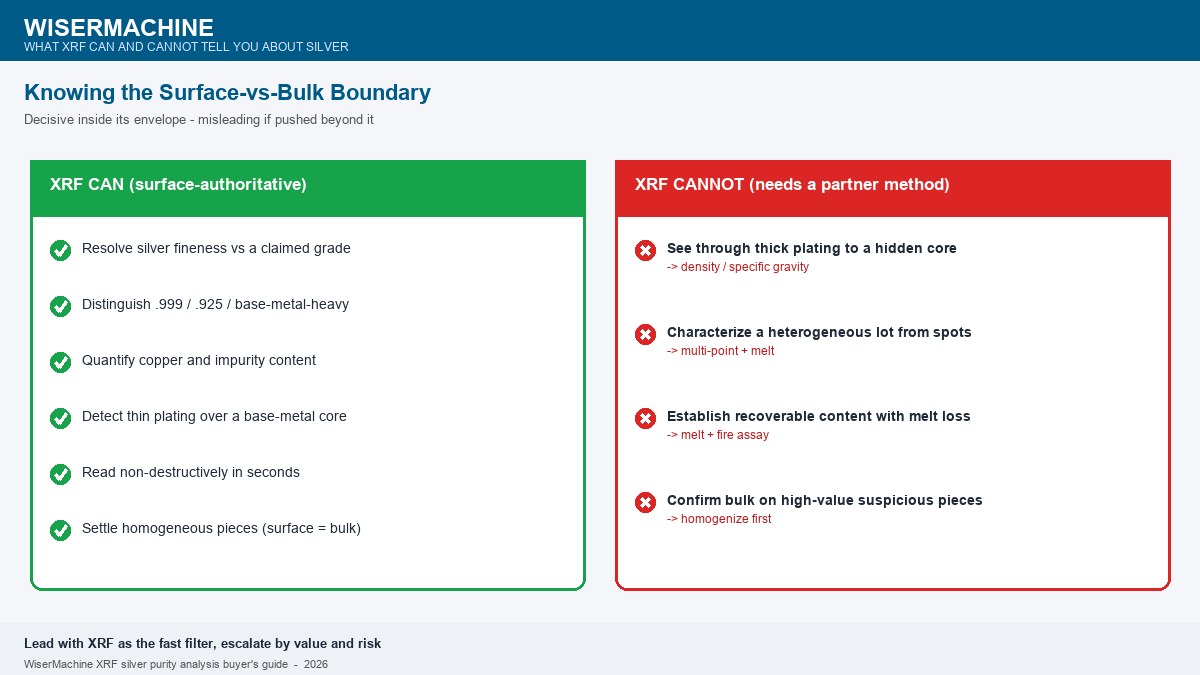
Buying silver on XRF means knowing exactly where the instrument is authoritative and where it must be backed by another method. Used inside its envelope, XRF is decisive; pushed beyond it, a clean reading can be dangerously misleading, and the difference is the surface-versus-bulk boundary.
XRF is authoritative for the surface elemental composition: it resolves silver fineness against a claimed grade, distinguishes .999 from .925 from base-metal-heavy material, quantifies copper and impurity content, and detects thin plating over a base-metal core — all non-destructively in seconds. For a homogeneous piece, the surface reading is the bulk composition, and the fineness number is settlement-grade when wrapped in proper calibration and replicate points. This is the daily workhorse function across every silver scenario.
XRF cannot, on its own, see through a thick plating layer to a hidden base-metal core, cannot measure the bulk of a heterogeneous lot from a few spot reads, and cannot establish the recoverable content of a scrap lot that loses metal in refining. Those questions belong to complementary methods: density and specific gravity for whole-volume substitution, multi-point reading for inhomogeneity, and melting to a homogeneous button followed by fire assay for the definitive recoverable content and the melt loss. A buyer who treats XRF as the fast first filter and escalates to these methods by value and risk gets both the speed of a non-destructive screen and the certainty of a settlement-grade assay.
Choosing and Running an XRF Analyzer for Silver
The right analyzer and the discipline around it determine whether silver fineness numbers are trustworthy enough to buy on. Selecting an instrument is a matter of matching its capabilities to the silver streams a buyer actually handles, and running it is a matter of session control that turns readings into defensible evidence.
For instrument selection, the buyer weighs the composition range and the accuracy on high-purity silver, the measurement-spot size and geometry handling for small or irregular pieces, the speed per reading for high-volume counter or intake work, and the form factor — benchtop for fixed assay stations, handheld for on-floor and field screening. A benchtop analyzer with a small well-defined spot and fundamental-parameters software suits a fixed assay desk reading coins, dental pieces, and reconciliation samples; a handheld suits a scrap floor or a field buy where the material comes to no fixed station. The same analyzer that serves the gold side typically covers silver, which is why a single capable instrument anchors a whole precious-metal operation.
Running the analyzer to a defensible standard means session control on every shift. Each assay session opens with a reading on a traceable silver reference to prove the instrument is in tolerance, the standard is re-read at the close to capture drift, and every measurement is timestamped and tied to the operator, the instrument, and the lot or piece reference. Daily standardization against certified reference material, multiple reads per piece with the spread reported, and a documented chain from reading to decision are what separate a fineness number you can settle on from an opinion. This rigor — the same that governs refinery penalty-element screening — is what makes XRF the backbone of silver buying rather than a quick guess with a gadget.
From Stamp to Settlement: The Complete Silver Decision Chain
Every silver scenario in this guide follows the same underlying decision chain, and seeing that chain whole is what lets a buyer move confidently between streams rather than relearning the discipline each time. The chain runs from the claim a piece or lot arrives with, through measurement and confirmation, to a priced and documented decision, and each link exists to close a specific gap between what is claimed and what is true.
The chain begins with the claim and the receipt: a stamp, a manifest, a declared grade, logged against the physical reality received. It moves to the fast non-destructive screen, where XRF fingerprints fineness against the claim and screens impurities in seconds, sorting clean confirmations from flags. Flagged or high-value material escalates to confirmation — density and specific gravity for whole-volume substitution, multi-point reading for inhomogeneity, or a melt-and-fire-assay for the definitive recoverable content and the loss. The chain closes with a priced decision tied to a documented record: fineness, impurities, method, and value against the silver reference, reconstructable later if questioned.
What changes between scenarios is not the chain but where the weight falls. A counter buy leans hard on the fast screen plus a density check because speed and counterfeit defense dominate; a refinery intake leans on the melt-and-assay confirmation because recoverable content and melt loss dominate; a recovery stream leans on sorting and grading because heterogeneity dominates. A buyer who internalizes the single chain and learns to shift its emphasis by stream is equipped for any silver transaction, and each dedicated SOP in this cluster is that chain tuned for one material. The shared backbone is why a single capable analyzer and one set of session-control habits serve an entire precious-metal operation, silver and gold alike.
The discipline that holds the chain together is documentation. A fineness reading, a density result, or an assay figure is only as valuable as the record that ties it to a specific piece or lot, a calibrated instrument, a timestamped session, and an operator. That record is simultaneously the pricing basis, the dispute shield, and the audit trail, and it is the artifact that distinguishes a professional silver operation from one that buys on stamps and hopes. Across bullion, recovery, dental, refining, jewelry, and industrial streams, the operation that documents its silver decisions is the one that protects its margin and earns the repeat business of suppliers who trust its numbers.
Frequently Asked Questions
What silver fineness grades does XRF distinguish?
XRF resolves the full silver fineness spectrum: .999 fine silver at 99.9 percent, .958 Britannia at 95.8 percent, .925 sterling at 92.5 percent, .900 coin silver at 90 percent, lower grades down to .800, and tarnish-resistant alloys such as Argentium at .935 and .960. It reports silver as a measured percentage against the claimed standard and quantifies the alloying metals — chiefly copper in sterling — so a piece declared at one grade that reads at another is flagged before a value is struck. Fineness is the parts-per-thousand ratio of pure silver to total alloy weight.
Why is XRF only a surface measurement, and why does it matter for silver?
XRF excites atoms with X-rays and reads the characteristic energies they emit, but both the exciting and emitted X-rays only penetrate and escape the outermost layer of the sample, so XRF reports the surface composition, not the bulk. For a homogeneous .999 bar this is fine because surface equals bulk, but for a silver-plated base-metal core a thick enough silver skin returns a near-pure reading that hides the copper or lead beneath. This is why XRF detects thin plating and prevents overvaluation yet must be paired with density or a melt assay on high-value or suspicious silver pieces.
Can XRF detect silver-plated counterfeits?
Yes, within limits. XRF readily flags plating that is thin enough for the base-metal signature to show through, and reading edges, rims, and wear points where coverage is thinnest exposes most plated fakes. A sufficiently thick silver plating, however, can mask a base-metal core to a surface reading alone, which is why a plated-counterfeit screen pairs XRF with a specific-gravity or density check that probes the whole volume. A genuine silver piece reads clean fineness and the expected density together; a plated fake fails one or the other.
How does XRF silver analysis compare to fire assay?
XRF is fast, non-destructive, and multi-element, ideal for fingerprinting fineness and screening impurities in seconds without consuming the piece, which makes it the right instrument for intake sorting and counter verification. Fire assay by cupellation is destructive and slower but is the definitive reference for recoverable precious-metal content on a homogenized sample. The professional pattern is to lead with XRF for fast fineness and escalate to a melt-and-fire-assay for settlement on high-value or heterogeneous lots, so the buyer gets both speed and settlement-grade certainty.
Is sterling silver scrap worth less than its weight suggests?
Yes. Sterling at .925 is only 92.5 percent silver with the balance about 7.5 percent copper, so a sterling lot contains materially less recoverable silver than its gross weight implies, and refining loss reduces the recovered amount further. A lot declared simply as “silver” and settled as if it were fine silver overpays by roughly the copper fraction plus loss. XRF resolves the actual fineness at intake so the lot is priced on assayed silver content rather than on an optimistic declaration, which is the core of the refinery intake reconciliation discipline.
Which XRF analyzer is right for buying silver?
The right analyzer matches the silver streams handled: a benchtop with a small well-defined measurement spot and fundamental-parameters software suits a fixed assay desk reading coins, dental pieces, and reconciliation samples, while a handheld suits a scrap floor or field buying where the material does not come to a fixed station. Key selection factors are composition range, accuracy on high-purity silver, spot size and geometry handling for small irregular pieces, speed per reading for volume work, and the certified reference standards available. A single capable analyzer typically covers both gold and silver, anchoring a whole precious-metal operation.
How often should a silver XRF analyzer be calibrated?
For silver buying the analyzer should be standardized against certified silver reference material at the open and close of every assay session, with a full professional recalibration on the manufacturer’s recommended schedule. Daily standardization brackets instrument drift across the working day, and combined with multiple reads per piece, reported spreads, and a timestamped chain tying each reading to the operator and lot, it is what makes a fineness number defensible. A reading on an uncontrolled instrument is an opinion; one bracketed by opening and closing standard checks is settlement-grade evidence.
How do the silver buying scenarios relate to each other?
Bullion and coin verification, photovoltaic and electronic recovery, dental scrap, refinery intake reconciliation, jewelry and sterling scrap, and industrial streams all rest on the same XRF fineness foundation but differ in threat and economics. Counter buying defends against plated counterfeits; recovery streams grade heterogeneous material; refinery intake reconciles declared against assayed weight with melt loss; and industrial streams add penalty-element screening. This guide is the central reference, and each scenario links to its dedicated step-by-step SOP for the full protocol, so a buyer can move from the principle here to the practice there.