
 Xrf Gold Analyzer
 Handheld Alloy Analyzer
 Handheld Mining Analyzer
 Other XRF Analyzer
Bottom line for silver refiners, electrolytic-cell operators, and the quality teams that certify cathode: a Moebius cell turns an impure silver anode into .9999 fine cathode and a gold-and-platinum-group-bearing anode slime, but neither output is worth its potential unless the cathode purity is verified and the slime value is captured. A cathode that quietly drifts below specification because lead, bismuth, or copper crept into the electrolyte downgrades a premium product to commodity silver; an anode slime sold or processed without assaying its gold and platinum-group content gives away the highest-value byproduct of the whole operation. This guide lays out a 5-stage XRF audit SOP — E0 through E4 — that verifies cathode fineness, controls electrolyte impurity drift, and quantifies the slime value so a silver electrorefining operation certifies its cathode and captures every gram of contained precious metal.
Below is the exact protocol a disciplined silver electrolytic refinery uses to audit anode composition at charge-in, monitor and balance the silver-nitrate electrolyte so base-metal impurities do not co-deposit, verify harvested cathode against the .999 or .9999 commercial standard, assay the anode slime for its gold and platinum-group recovery value, and document a certification and reconciliation record. Every stage rests on one principle of electrorefining: the cell only upgrades purity if impurities are controlled at the anode and in the electrolyte, and the value is only realized if both the cathode and the slime are assayed.
Silver electrorefining is the high-purity end of the silver value chain, and it connects directly to the streams that feed it. For the incoming material that becomes anodes see our silver scrap refinery intake reconciliation SOP; for the full fineness reference see our XRF silver purity analysis buyer’s guide; and for the gold-side electrolytic parallel see our electrolytic refining cathode purity audit SOP.

Why a Silver Cell Can Quietly Drift Off Specification
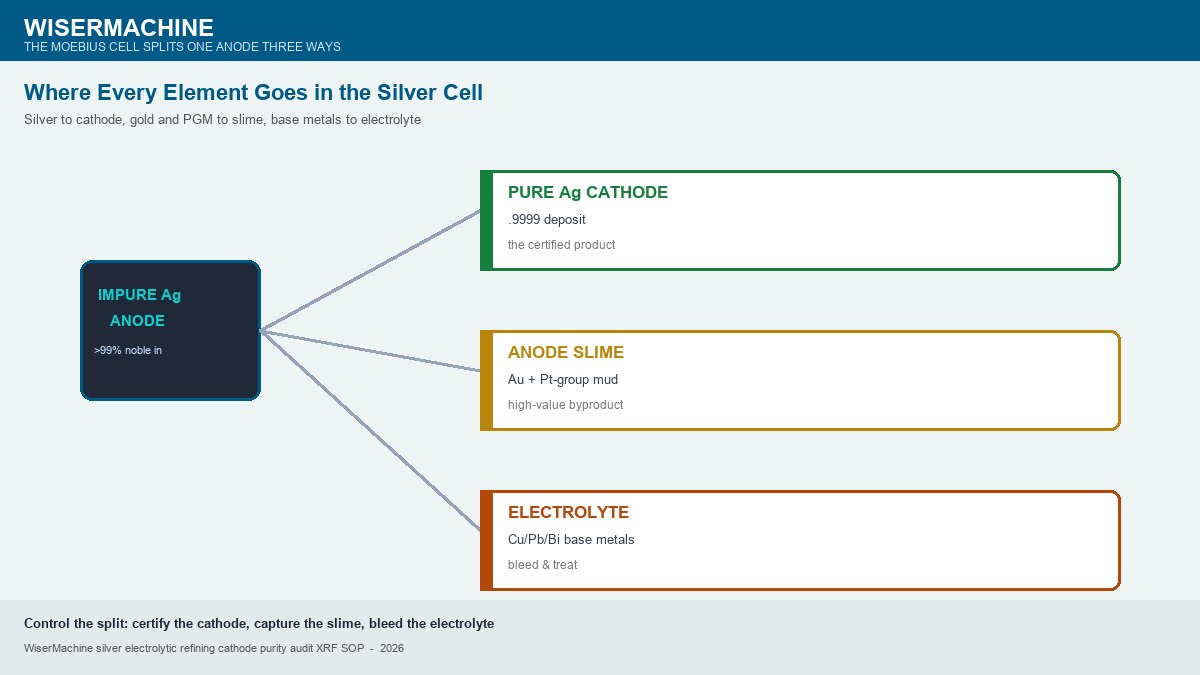
The single most important fact a silver electrorefining operator must internalize is that a Moebius cell does not guarantee purity — it concentrates it, and only when the inputs and the electrolyte are controlled. The cell works by dissolving an impure silver anode into a silver-nitrate electrolyte and re-depositing pure silver onto the cathode, while gold and the platinum-group metals, being more noble, do not dissolve and instead fall as anode slime. When the anode and electrolyte are clean, the cathode reaches .9999; when base-metal impurities accumulate, the same cell quietly produces cathode that no longer meets specification.
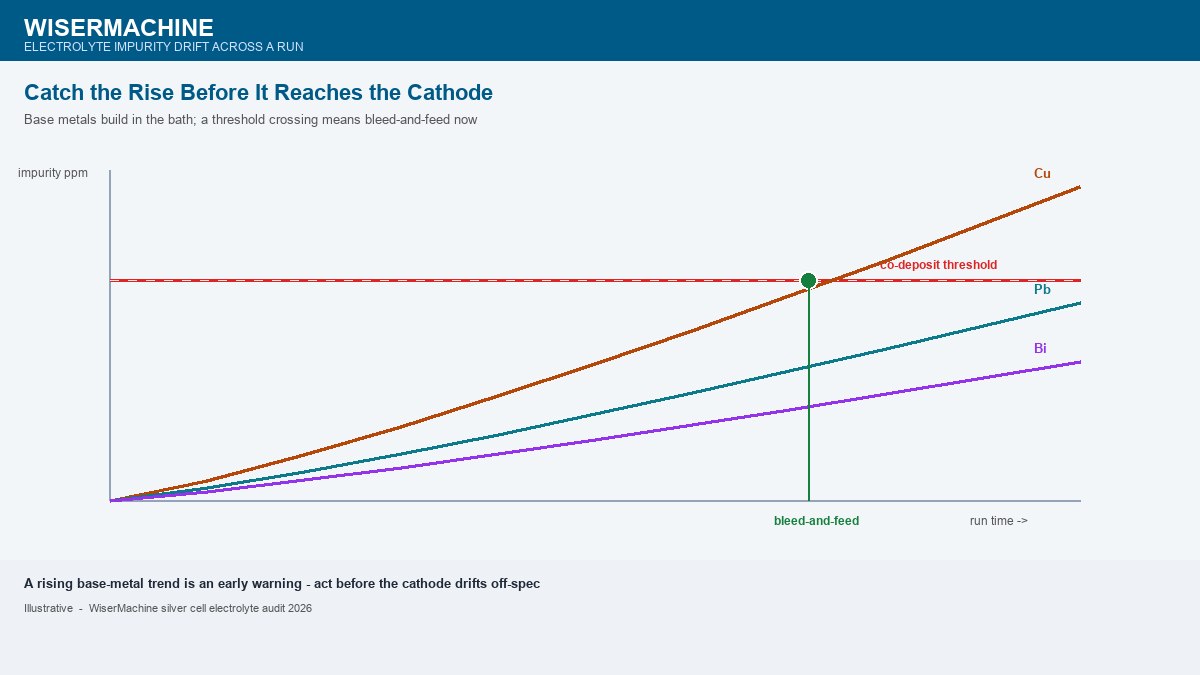
Electrolyte impurity drift is the silent failure mode. Base metals such as copper, lead, bismuth, antimony, and arsenic enter the electrolyte from the dissolving anode, and if their concentration is allowed to build, they begin to co-deposit with the silver or become entrained in the cathode deposit, lowering its fineness. The electrolyte therefore has to be actively balanced — pure silver nitrate fed in, base-metal-loaded electrolyte bled off and treated — to keep the impurity background below the threshold at which it contaminates the cathode. An operation that does not monitor this drift can run for a long time before a downgraded cathode reveals the problem, by which time a great deal of off-spec product has been made.
The anode itself sets the ceiling. Silver electrorefining is conventionally run with anodes that are already largely noble metal, because a high base-metal anode loads the electrolyte too fast and forces excessive electrolyte treatment. Auditing the anode composition before charge-in therefore predicts both the cathode quality the cell can reach and the electrolyte management burden the run will impose. XRF is the instrument that resolves all of this non-destructively — anode composition, electrolyte impurity proxies, and finished cathode fineness — turning a process that can drift invisibly into one that is measured at every stage.
The Economics of Cathode Certification and Slime Value
The financial case for a disciplined silver-cell audit protocol rests on two value streams that both depend on measurement: the cathode that must be certified to command its premium, and the anode slime that holds the operation’s hidden gold and platinum-group value. Miss either and the economics of the cell erode quietly.
Cathode certification is the first lever. Fine silver at .9999 commands a premium over .999, and both command a premium over off-spec material that has to be re-refined or sold down. A cathode that is assumed to be on-grade but has drifted is sold at a premium it does not merit until a buyer’s assay catches it — at which point the refiner faces a rejection, a re-refining cost, and a reputational hit. Verifying every cathode harvest against the target fineness with XRF converts an assumption into a certified number, so the product is sold at the grade it actually is and the premium is defensible.
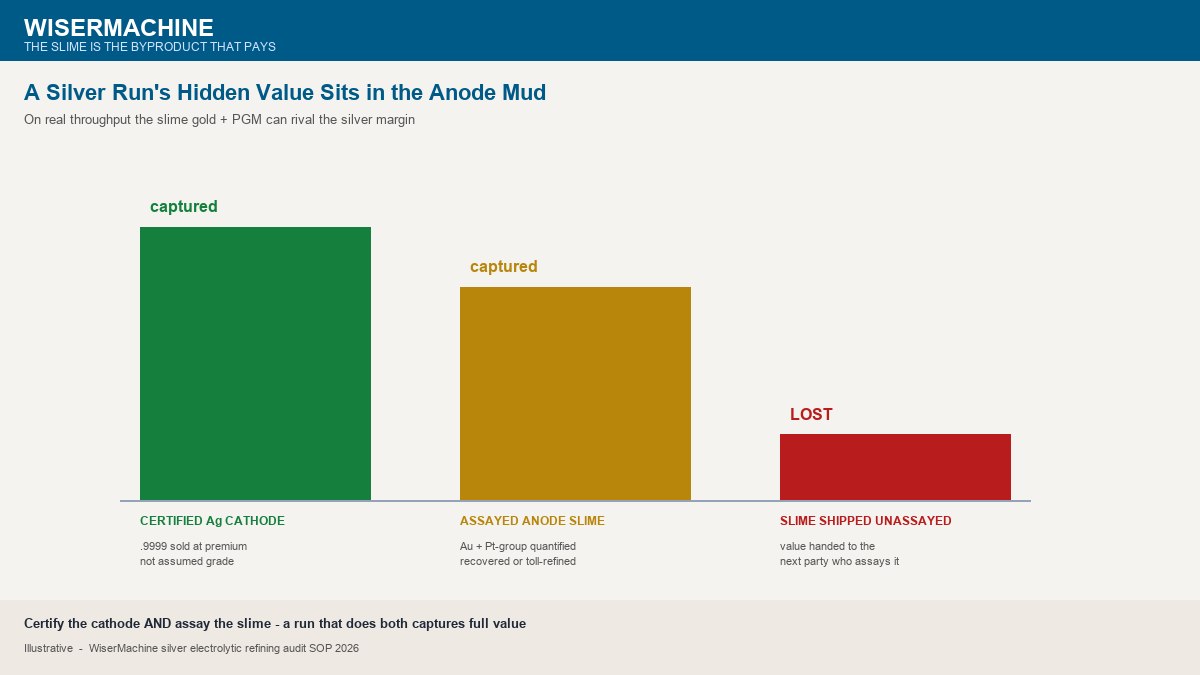
The anode slime is the second, larger lever and the one most easily overlooked. The slime carries the gold and platinum-group metals that did not dissolve, and on a meaningful silver throughput that gold content alone can rival or exceed the margin on the silver. Assaying the slime for its gold and platinum-group content turns it from a vaguely valuable residue into a quantified recovery stream that can be processed, sold, or toll-refined on documented terms. An operation that ships slime unassayed hands that value to whoever assays it next, the same buy-side asymmetry our industrial precious-metal recycling buyer’s guide documents across recovery streams.
Stage E0: Anode Charge-In Audit and Run Setup
The protocol begins before the current is switched on, with an audit of the anodes going into the cell. Each anode batch is logged with a unique run reference, the source of the metal — typically the doré or recovered silver that came through intake reconciliation — the anode weight, and an XRF composition read that establishes the silver content and the base-metal and noble-metal load. This composition is the run’s starting condition: it predicts the cathode quality achievable, the rate at which the electrolyte will load with base metals, and the gold and platinum-group content that will report to the slime.
Run setup decisions follow from the anode audit. A high-purity anode supports a long run with light electrolyte treatment; a base-metal-heavy anode signals frequent electrolyte bleed-and-feed and a shorter interval to cathode contamination, and may warrant pre-treatment before electrorefining. The expected gold and platinum-group content, read from the anode, sets the expectation for slime value and lets the operation reconcile actual slime recovery against the input later. Logging this at E0 is what makes the eventual mass balance — silver to cathode, gold and PGM to slime, base metals to electrolyte — reconstructable.
The E0 deliverable is a documented run setup: anode reference, weight, assayed composition, and the predicted cathode-quality and slime-value envelope. This record anchors every later measurement to a specific run and a specific anode charge, so a cathode certification or a slime settlement can always be traced back to what went into the cell.
Stage E1: Electrolyte Balance and Impurity-Drift Control
Once the cell is running, the protocol shifts to the electrolyte, because it is the medium through which impurities either stay out of the cathode or end up in it. The silver-nitrate electrolyte is monitored for its silver concentration and, critically, for the build-up of base metals — copper above all, then lead, bismuth, antimony, and arsenic — that dissolve from the anode and accumulate over the run.
Balancing is an active, ongoing operation rather than a set-and-forget condition. Pure silver nitrate is fed to maintain the silver concentration the deposition needs, while a portion of the base-metal-loaded electrolyte is bled off and treated to remove the accumulated impurities before it is returned or replaced. The goal is to hold the base-metal background below the concentration at which copper or lead begins to co-deposit with or become entrained in the silver cathode. Monitoring the electrolyte’s impurity load — whether by periodic sampling and analysis or by tracking the proxies that XRF and complementary methods provide — is what turns electrolyte management from reactive firefighting into controlled prevention.
The discipline here is to treat the electrolyte as a quality-control checkpoint, not just a consumable. A rising base-metal trend in the electrolyte is an early warning that the cathode is about to drift, caught before the off-spec deposit is made rather than after. This preventive monitoring mirrors the penalty-element vigilance our refinery penalty-element screening guide applies to incoming material, applied here to the live process bath.
Stage E2: Cathode Harvest and Fineness Verification
The cathode is where the cell’s output is realized, and Stage E2 verifies that every harvest actually meets the fineness it is sold as. When the deposited silver is harvested — whether stripped as cathode sheet or collected as crystal — representative pieces are read with XRF against the target standard, .999 or .9999, with the analyzer checked against a traceable silver reference at the start of the session.
The verification is multi-point and documented, not a single reassuring read. Because deposition can vary across a cathode and across a run, several points are read and the spread reported, so an uneven deposit or a localized contamination shows up rather than being averaged away. The headline output is the confirmed fineness and the residual impurity profile — the trace copper, lead, or bismuth that, if present above the threshold, signals electrolyte drift that the E1 monitoring should already have flagged. A cathode that reads on-grade with a clean impurity profile is certified; one that reads marginal or carries an impurity signature is set aside for re-refining and triggers a review of the electrolyte balance.
This closes the loop between electrolyte control and product quality. The E2 fineness verification is the proof that the E1 balancing worked, and a drift detected at E2 feeds straight back into E1 corrective action. The surface-sensitive nature of XRF is managed here exactly as in any fineness work — a clean measurement surface, multiple points, session standards — so the certified number is settlement-grade, the same rigor our silver purity analysis guide details across silver streams.
Stage E3: Anode Slime Assay for Gold and Platinum-Group Recovery
The protocol then turns to the anode slime, the high-value residue that is the silver cell’s most under-managed output. As the anode dissolves, the gold and platinum-group metals that are too noble to dissolve fall to the bottom of the cell or are caught in anode filters as a dark mud, and Stage E3 quantifies what that slime actually contains so it can be recovered or settled on a documented basis.
The slime is collected, dried, and homogenized before assay, because like any heterogeneous concentrate it cannot be characterized by a single spot read. A homogenized sample is then assayed for gold and platinum-group content, with XRF providing a fast composition screen and a melt-or-digest reference method providing the settlement-grade figure where the value justifies it. The output is the contained gold and platinum-group value of the slime, reconciled against the gold and PGM content read from the anode at E0 — a closed check that confirms the noble metals reported to the slime rather than disappearing into the electrolyte or the cathode.
The decision rule is value-driven. A slime rich in gold justifies a full reference assay and careful recovery; a thin slime may be aggregated across runs before processing. The cardinal point is that the slime is never treated as waste: it is the byproduct that often carries the larger margin, and assaying it is what converts it from a vaguely valuable mud into a quantified, sellable recovery stream. This staged screen-then-confirm logic is the same our PGM refinery settlement assay SOP applies to platinum-group settlement.
Stage E4: Certification and Mass-Balance Reconciliation
The protocol closes by converting the cathode verification and slime assay into a documented certification and a reconciled mass balance for the run. The E4 record ties the run reference to the full account: the anode weight and composition charged in, the certified cathode fineness and weight harvested, the assayed gold and platinum-group content of the slime, the base metals removed in electrolyte treatment, and the resulting reconciliation of silver to cathode, noble metals to slime, and base metals to electrolyte.
The certification is the product’s passport. A cathode lot sold with a documented XRF fineness verification, tied to a controlled run, is a certified product a buyer can trust without re-assaying, which protects the premium and the relationship. A cathode shipped on an assumed grade is a rejection waiting to happen. The certification record — fineness, impurity profile, run traceability — is what lets the refiner stand behind a .9999 claim and what a discerning buyer increasingly expects.
The mass balance is the operation’s integrity check. Because the silver in equals cathode plus electrolyte plus losses, and the noble metals in equal slime plus traces, a run that fails to balance signals either unrecovered value or an unmeasured loss — a leak the audit catches before it compounds across runs. The E4 deliverable is a complete chain — anode in, electrolyte controlled, cathode certified, slime assayed, balance closed — that proves both the product quality and the full recovery of the run’s precious-metal value, the same reconciliation discipline our intake reconciliation SOP applies at the front of the chain.
XRF Screening Versus Reference Assay in the Silver Cell
Understanding where XRF screening ends and reference assay begins is what lets a silver refinery apply the right method at the right checkpoint instead of over-testing routine cathode or under-confirming a valuable slime. The two are complementary, and the SOP sequences them by value and by the precision the decision requires.
XRF is fast, non-destructive, and multi-element, which makes it the right instrument for the high-frequency checkpoints: auditing anode composition at charge-in, tracking electrolyte impurity proxies through the run, and verifying cathode fineness at every harvest. It resolves silver fineness to a fraction of a percent and screens the base-metal impurities that signal drift, all in seconds and without consuming the product. Its limitation is that for the highest-precision fineness claims and for the definitive valuation of a gold-rich slime, it is a screening and process-control tool rather than the final certifying method.
Reference methods — fire assay for the definitive precious-metal content, and quantitative chemistry for trace-impurity certification — provide the settlement-grade and certification-grade numbers where a sale, a dispute, or a high-value slime demands them. The professional pattern is to run XRF on every cathode and every electrolyte check for fast process control and certification screening, and to escalate to fire assay or quantitative chemistry for the definitive cathode certification on premium lots and for the slime settlement. This gives the cell both the speed to control the process in real time and the certainty to defend a .9999 certification and a slime settlement.
Daily Operations: Running a Disciplined Silver Cell House
A protocol is only worth what the daily routine makes of it, and a silver cell house needs a repeatable rhythm that holds cathode quality and captures slime value across continuous operation. The daily discipline turns the five stages into standard practice rather than a reaction to a rejected lot.
The shift opens with an instrument standardization check against a certified silver reference and a review of the running cells: anode charge status, electrolyte impurity trend, and cathode harvest schedule. Cathodes are verified at harvest and certified or set aside; electrolyte samples are checked against the impurity thresholds and bleed-and-feed is adjusted to hold the balance; and slime is collected, logged, and queued for assay. The shift closes by reconciling certified cathode and assayed slime against the run’s anode input, so no cathode ships uncertified and no slime leaves unassayed, and the standard is re-read to bracket instrument drift.
Over time the run records become a process-optimization asset. Tracking cathode fineness against electrolyte impurity trends tunes the bleed-and-feed schedule; tracking slime gold content against anode composition sharpens the value expectation and the recovery process; and the cumulative mass-balance history surfaces any persistent leak. The cell house that runs this rhythm converts a process that can drift invisibly into a certified, reconciled operation that defends its cathode premium and captures its slime value run after run.
Frequently Asked Questions
How does a Moebius cell produce .9999 silver?
A Moebius cell dissolves an impure silver anode into a silver-nitrate electrolyte and re-deposits pure silver onto the cathode, while gold and the platinum-group metals, being more noble, do not dissolve and fall as anode slime. When the anode is largely noble metal and the electrolyte impurity background is kept low, the deposited cathode reaches .9999 fineness. The purity is not automatic, though — it depends on controlling base-metal impurities at the anode and in the electrolyte, which is exactly what the audit protocol verifies at each stage.
Why does electrolyte impurity drift downgrade the cathode?
Base metals such as copper, lead, bismuth, antimony, and arsenic dissolve from the anode into the silver-nitrate electrolyte and accumulate over a run. If their concentration is allowed to build past a threshold, they begin to co-deposit with the silver or become entrained in the cathode deposit, lowering its fineness below specification. Because this happens gradually, a cell can produce off-spec cathode for a while before it is noticed. Active electrolyte balancing — feeding pure silver nitrate and bleeding off base-metal-loaded electrolyte — holds the impurity background low enough to keep the cathode on grade.
What makes the anode slime valuable, and why assay it?
The anode slime carries the gold and platinum-group metals that were in the anode but were too noble to dissolve, so they fell out as a dark mud as the anode dissolved. On a meaningful silver throughput this gold and PGM content can rival or exceed the margin on the silver itself, which makes the slime the operation’s highest-value byproduct. Assaying it converts a vaguely valuable residue into a quantified recovery stream that can be processed, sold, or toll-refined on documented terms; shipping it unassayed gives that value to whoever assays it next.
Can XRF certify .9999 cathode on its own?
XRF verifies cathode fineness fast and non-destructively and is the right tool for checking every harvest, resolving silver to a fraction of a percent and screening the impurities that signal drift. For the highest-precision .9999 certification claims, however, and for definitive trace-impurity certification, fire assay and quantitative chemistry provide the settlement-grade numbers. The professional pattern uses XRF on every cathode for fast certification screening and process control, and escalates to reference assay for the definitive certification on premium lots, giving both speed and settlement-grade certainty.
What impurities matter most in silver electrorefining?
Copper is usually the dominant base-metal impurity to manage because it dissolves readily from the anode and builds in the electrolyte, followed by lead, bismuth, antimony, and arsenic, which affect cathode quality through co-deposition or entrainment. On the noble side, the gold and platinum-group metals are not contaminants but the valuable slime constituents to be recovered. XRF screens the base-metal impurities at the anode, in the electrolyte trend, and in the finished cathode, so the impurity story is tracked across the whole cell rather than discovered only in a rejected product.
How should anode composition be checked before electrorefining?
Each anode batch should be read with XRF before charge-in to establish its silver content, its base-metal load, and its gold and platinum-group content. This composition predicts the cathode quality the cell can reach, the rate at which the electrolyte will load with base metals, and the slime value the run will produce. A high-purity anode supports a long run with light electrolyte treatment; a base-metal-heavy anode signals frequent bleed-and-feed and a shorter interval to contamination, and may warrant pre-treatment. Logging the anode composition is also what makes the run’s mass balance reconstructable.
What is a cathode certification record and why does a buyer want it?
A cathode certification record documents the verified fineness and impurity profile of a cathode lot, tied to a controlled run with traceable instrument standardization. A buyer wants it because it lets them accept the silver at its stated grade without re-assaying, which protects both parties: the refiner sells at a defensible premium and the buyer trusts the number. A cathode shipped on an assumed grade risks a rejection, a re-refining cost, and a reputational hit when the buyer’s own assay catches a drift, so certification turns a claim into a documented, defensible product.
Why run a mass balance on a silver electrorefining cell?
A mass balance closes the loop on a run: the silver charged in should equal the silver in the cathode plus the silver in the electrolyte plus losses, and the noble metals in the anode should equal the gold and PGM recovered in the slime plus traces. A run that fails to balance signals either unrecovered value — gold that did not report to the slime, silver unaccounted for — or an unmeasured loss, both of which are leaks the audit catches before they compound across many runs. The mass balance is the integrity check that ties anode input, certified cathode, and assayed slime into one reconciled, defensible account.