
 Xrf Gold Analyzer
 Handheld Alloy Analyzer
 Handheld Mining Analyzer
 Other XRF Analyzer
Bottom line for recyclers and refinery buyers: mixed e-scrap can hide recoverable silver in plain sight. Solar panel ribbon, membrane switches, relay contacts, silver-plated connectors, thick-film ceramic parts, keyboard films, contactors, and selected industrial boards may all arrive in the same gaylord, pallet, or partial container. If the yard prices the lot as generic PCB scrap, the silver-rich fractions subsidize the low-grade material. If the yard separates the wrong fractions, it creates extra labor without better settlement. This SOP shows how to use XRF as a fast field-control instrument for sorting mixed silver-bearing e-scrap into defensible recovery lots before refining, sale, or toll settlement.
D8 completes the first Phase 5 silver loop. The EOL solar panel silver recovery SOP focuses on PV modules and ribbon as a dedicated stream. The silver bullion verification SOP focuses on dealer-side fake-silver control. The XRF silver purity analysis buyer’s guide explains how silver signals should be interpreted across 925, 999, and industrial material. This D8 workflow is different: it is for yards and processors receiving mixed silver-bearing e-scrap where the job is not only to measure silver, but to decide what should be separated, what should be blended, and what should be rejected or routed to a different recovery path.

Why Mixed Silver-Bearing E-Scrap Needs Its Own Sorting SOP
Mixed e-scrap is commercially messy because the silver is unevenly distributed. One tray may contain PV ribbon with a strong silver signal, relay contacts with cadmium or tungsten risk, low-grade PCBs where gold and copper dominate value, plated connectors with thin silver over base metal, and dirty mechanical scrap that should never enter a precious-metal sample. Averaging all of that into one assay number can make the lot look acceptable while hiding two problems: high-value silver fractions are diluted, and penalty or contamination fractions are spread through material that could otherwise settle cleanly.
The sorting goal is therefore not to chase every tiny silver reading. The goal is to create streams that a refiner can price rationally. A good yard-level SOP separates material by recovery behavior: PV ribbon and busbar, contact and switch scrap, silver-plated copper or brass, mixed PCB, ceramic or thick-film parts, and reject/penalty material. XRF supports the decision by identifying silver-rich points, base-metal carriers, and penalty elements quickly enough to make sorting practical during intake.
This matters most when the yard buys by gross weight and sells by refined content. If a buyer only records a generic e-scrap grade, the sales team may have no evidence to ask for a silver add-on, a split settlement, or a better toll-processing route. If the yard records XRF evidence by sub-lot, it can show why a tray of silver contacts should not be paid like mixed boards and why a PV ribbon fraction deserves a dedicated recovery quote.
The Six-Stage XRF Sorting Workflow
The workflow below treats XRF as a sorting and audit instrument, not as a magic settlement certificate. It is used to build a defensible lot structure before the material leaves the facility. Each stage creates a decision: accept as mixed PCB, pull a high-silver stream, isolate penalty material, route to PV recovery, route to contact recovery, or hold for refinery confirmation. That decision is what protects margin.
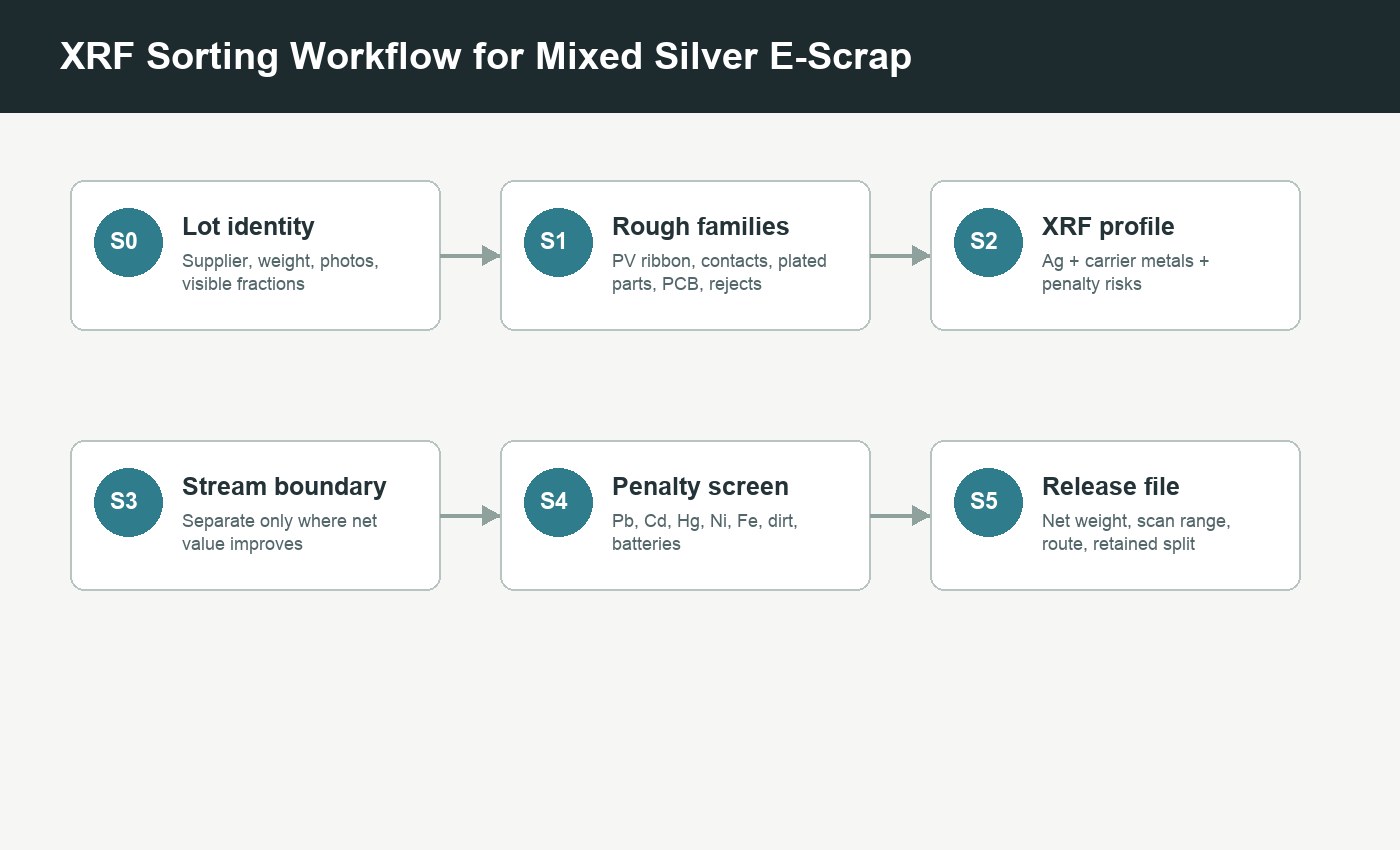
Stage S0: Lock the Lot Identity and Visible Fractions
Start before scanning. Assign a lot ID, record supplier, date, gross weight, packaging, pallet count, visible moisture, obvious hazards, and declared material type. Photograph the top and side of each container before material is disturbed. Then list the visible fractions: PV ribbon, broken module strip, PCB, connector, switch, relay, contactor, keyboard film, plated mechanical part, ceramic component, loose wire, dirt, and trash. The list does not need to be perfect; it needs to prevent a mixed load from becoming an anonymous pile.
Pull a first-pass inspection tray from multiple points in the lot. Avoid only sampling the clean top layer. For a gaylord or pallet, take from top, middle, edge, and bottom-accessible zones. For a partial container, stratify by source bin or visible material family. The first tray is not the final assay sample. It is the decision tray that tells the operator which sub-lots deserve separation.
Stage S1: Separate Obvious Silver-Rich Families Before Scanning
Operators often scan too early. If the material is visibly mixed, first make rough families: PV ribbon or busbar, relay/contact material, silver-plated connector or contact strip, mixed PCB, films or membrane switches, ceramic/thick-film parts, and rejects. This prevents the XRF session from becoming a random walk through clutter. The operator can then scan within each family and compare like with like.
The most important discipline is to keep PV silver separate from general PCB scrap. PV ribbon and metallization residues behave differently from boards in recovery and settlement. They may carry tin, lead, copper, aluminum, glass, polymer, and adhesive contamination, but their silver story is different enough that blending them into boards usually weakens the commercial argument. For PV-heavy loads, use the dedicated solar panel silver recovery XRF SOP as the deeper intake reference.
Stage S2: Build an XRF Signal Profile for Each Candidate Stream
For each rough family, take multiple XRF readings and record Ag, Cu, Sn, Pb, Ni, Zn, Fe, Au, Pd, and any risk elements your program tracks. The exact element list depends on the analyzer configuration and material type, but the principle is constant: silver alone is not enough. A silver reading on copper carrier, brass carrier, tin-lead solder, nickel alloy, or dirty ceramic can point to different recovery routes and settlement assumptions.
Do not overreact to a single high reading. Mixed e-scrap is surface-biased and heterogeneous. A plated contact can show strong Ag on one face and mostly copper or brass on a cut edge. A PV strip can show different results depending on whether the beam hits metallization, glass residue, solder, or exposed base metal. The SOP therefore records average, range, and visual description. The yard is building a sorting control band, not pretending that one handheld reading is a full refined assay.
Stage S3: Use the Sorting Matrix to Decide Stream Boundaries
After scanning, apply a stream boundary. Keep a high-silver stream only if it is visually repeatable, has enough mass to justify handling, and has a refinery route that will reward separation. A tiny handful of bright contacts may be worth pulling if it is part of a recurring program. The same handful inside a one-time mixed load may be better documented but not physically separated. The SOP is commercial: separation must create net value after labor, storage, and downstream settlement friction.
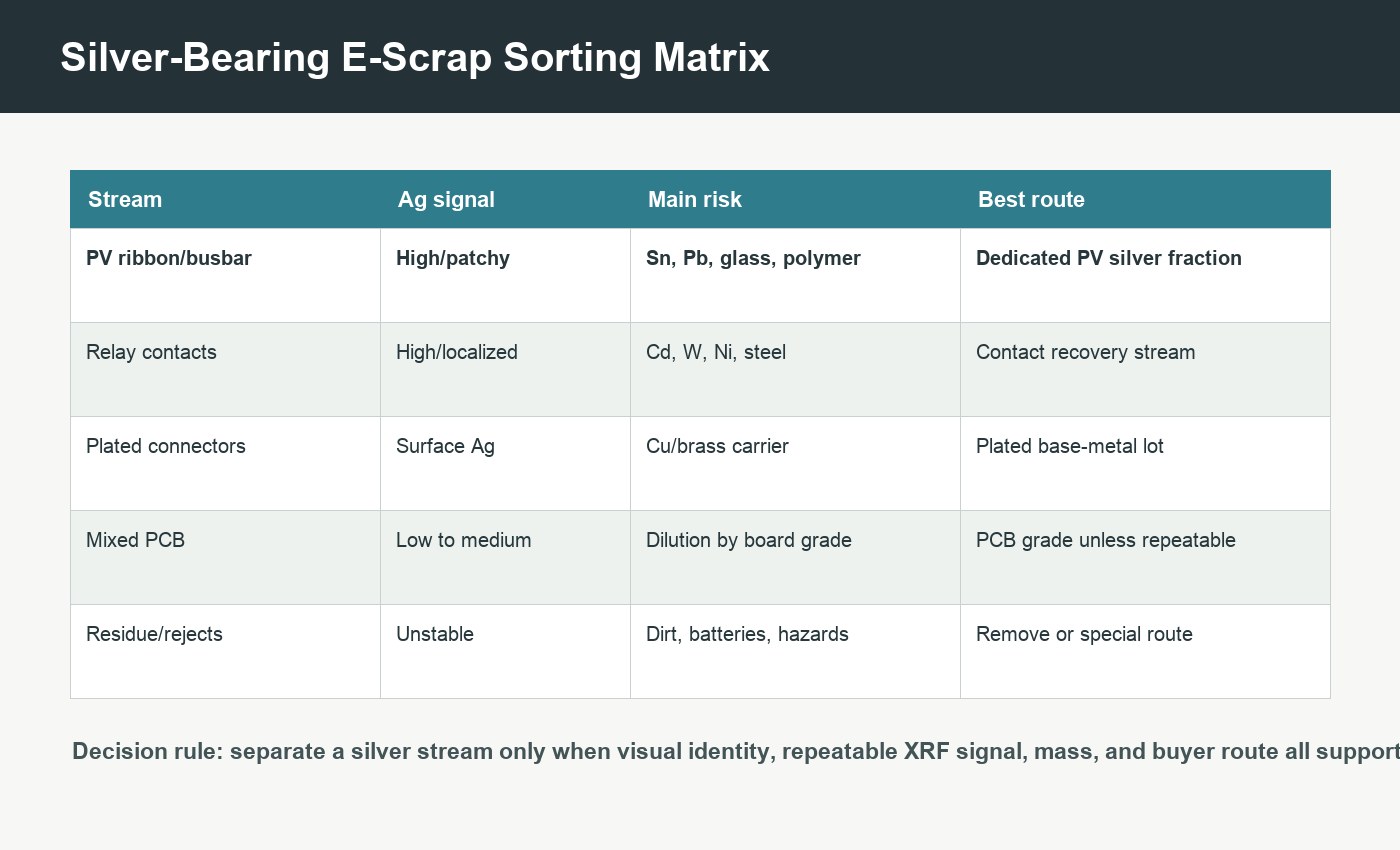
Typical stream decisions are straightforward. PV ribbon or busbar with repeatable Ag signal becomes a PV silver fraction. Relay and contact material with strong silver signal becomes a contact fraction, but penalty risks such as Cd, W, Ni, or excessive base metal need separate notes. Silver-plated copper or brass becomes a plated-base-metal fraction, not pure silver scrap. Mixed boards remain PCB unless a consistent silver-rich sub-family is present. Dirty residue, trash, batteries, mercury switches, or unknown hazardous pieces should be removed from the precious-metal lot rather than averaged into it.
Stage S4: Screen Penalty and Contamination Risks Before Sale
Silver-bearing material can still be a bad lot if it carries the wrong contaminants. Lead, cadmium, mercury, brominated plastics, excessive tin solder, nickel, iron, dirt, moisture, and battery contamination can change the route or price. XRF is useful because it can catch elemental red flags during sorting instead of after a buyer complains. A clean silver contact stream is very different from a contact stream contaminated with cadmium-bearing parts, mixed batteries, or plated steel fragments.
This is where the SOP protects the sales team. The yard should not present a stream as silver-rich without noting carrier metal and penalty exposure. A refiner or downstream buyer may accept the material but price it differently if it requires special handling. When penalty elements are documented early, the seller can choose the right route instead of discovering deductions at settlement.
Stage S5: Build Refinery-Ready Lots and a Settlement File
Once sorting is complete, each sellable stream should have a lot record: lot ID, gross weight, tare, net weight, visible material description, representative photos, XRF readings, average and range, known limitations, packaging count, and recommended route. If the stream is high value, retain a split sample or retain representative pieces with the same lot ID. The record should be strong enough that a sales manager can quote the lot without guessing and a refiner can understand why it is not generic e-scrap.
The settlement file should also include the reason for separation. For example: “PV ribbon stream separated from mixed boards because repeated XRF readings showed consistent Ag on ribbon/busbar and low value contribution from adjacent low-grade PCB.” That kind of sentence matters. It explains the business decision and helps the next operator repeat it.
How XRF Changes the Value Flow
Without XRF, a yard often blends everything into a conservative grade because the team cannot defend a higher claim. With XRF, the yard can create evidence-backed sub-lots: one for PV silver, one for contact silver, one for plated-base-metal, one for mixed PCB, and one for rejects. The total gross weight may be the same, but the value conversation changes. The high-silver stream can be quoted by a buyer who understands silver recovery, while the low-grade stream no longer dilutes it.
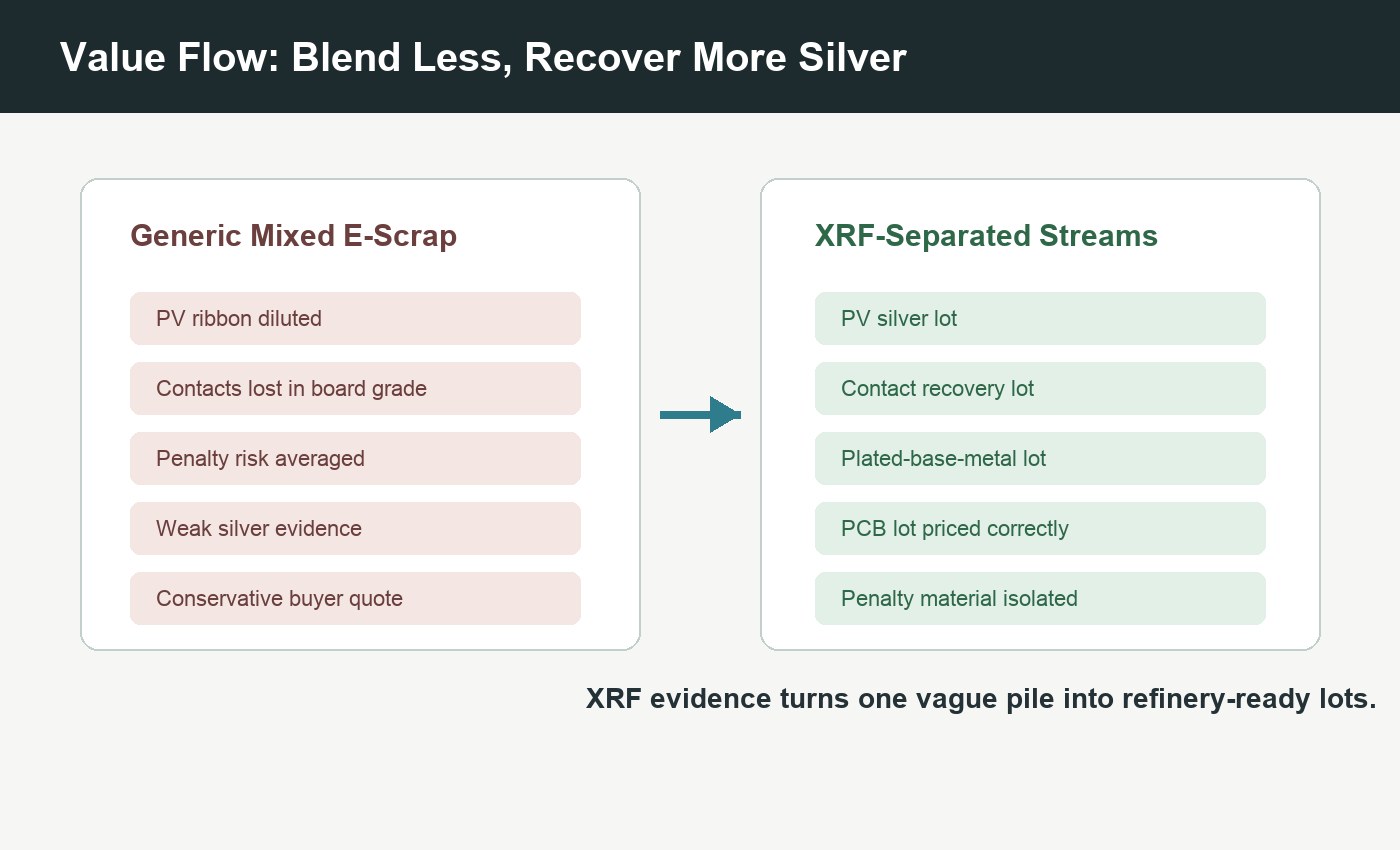
This does not mean every silver-bearing piece deserves a premium. Some plated material has thin silver over base metal and may not pay like a high-grade contact stream. Some mixed boards have silver but still settle mainly on copper, gold, and palladium. The value comes from knowing which case you are in before the lot is sold.
Where D8 Fits in the WiserMachine Silver and E-Scrap Cluster
This D8 SOP links the silver cluster to the industrial recycling cluster. For silver interpretation and analyzer selection, start with the XRF silver purity analysis buyer’s guide. For dedicated PV material, use the solar panel silver recovery SOP. For dealer-side bullion and fake-silver risk, use the silver bullion verification SOP. For refinery intake and cathode-side controls, see the sterling silver refinery intake SOP and the silver electrolytic cathode purity audit SOP. For container-scale PCB commercial workflows, compare the e-waste PCB container pre-sale grading SOP.
Frequently Asked Questions
Can XRF measure silver in all mixed e-scrap accurately?
No. XRF is a fast sorting and screening tool for mixed e-scrap, not a universal final assay. It is strongest when comparing similar material families and identifying silver-rich points, carrier metals, and contamination risks. For final settlement, especially on heterogeneous or high-value lots, refinery assay and agreed sampling procedures still matter.
Which silver-bearing e-scrap should be separated first?
Start with visually repeatable and commercially meaningful streams: PV ribbon or busbar, relay contacts, silver-plated contact strips, membrane or film contacts, and thick-film or ceramic parts where the silver signal is consistent. Do not spend labor separating tiny traces unless the stream recurs often enough to justify a standard route.
Why not blend PV ribbon with mixed PCBs?
PV ribbon and mixed PCBs have different recovery behavior and different commercial stories. Blending them can dilute the silver-rich fraction and make it harder to negotiate a dedicated silver recovery route. If PV ribbon is present in meaningful quantity, keep it separate and document the XRF signal profile.
What elements should be checked besides silver?
Check the base-metal carrier and penalty risks. Common useful signals include Cu, Sn, Pb, Ni, Zn, Fe, Au, Pd, Cd, and other elements relevant to the facility’s buyer or refinery contract. A silver reading over copper, brass, solder, nickel, or contaminated residue can point to different settlement outcomes.
How many readings should be taken per stream?
Use enough readings to understand the range, not only the best point. For a small uniform tray, several readings across faces and edges may be enough. For a mixed pallet or recurring stream, record a larger set by sub-lot and material family. The report should include average and range so the buyer can see heterogeneity.
When should a yard create a separate silver lot?
Create a separate lot when the silver-rich material is visually identifiable, repeatable under XRF, large enough to justify labor, and likely to receive a better refinery or buyer route than generic e-scrap. If separation costs more than the expected value gain, document the silver signal but keep the material in the appropriate mixed grade.
Can XRF detect fake or plated silver in e-scrap?
XRF can identify surface silver and many carrier metals, so it is useful for distinguishing plated-base-metal from solid or high-grade silver-bearing material. Because plated parts are surface-biased, operators should scan different faces and exposed edges where possible. The goal is to classify the recovery route, not to overstate the material as pure silver.
What should the final lot file include?
The final file should include lot ID, supplier, photos, fraction description, net weight, XRF readings, average and range, known limitations, contamination notes, packaging count, retained sample note, and recommended sales or refining route. This file turns a mixed pile into a defensible commercial lot.