
 Xrf Gold Analyzer
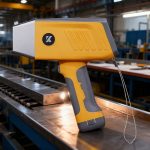 Handheld Alloy Analyzer
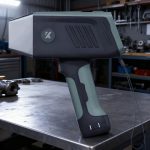 Handheld Mining Analyzer
 Other XRF Analyzer
Bottom line for precious-metal buyers: the best XRF analyzer is not always the unit with the lowest invoice price. Over a seven-year ownership cycle, the real cost includes operator training, calibration discipline, service response, downtime risk, resale value, sample throughput, report consistency, and the commercial value of avoiding one bad buy. A low purchase price can become expensive if it creates more retests, slower customer intake, weak documentation, or long downtime during peak trading weeks. This guide gives a practical 7-year TCO benchmark that pawnshops, bullion dealers, jewelry chains, recyclers, and small refineries can use before choosing an analyzer.
The model below is not a public price list and should not be read as a quote. It is a procurement framework. Actual cost depends on configuration, country, warranty scope, service plan, training package, duty, freight, financing, and workload. The goal is to show where XRF ownership cost really appears and how buyers should compare a WiserMachine configuration such as WM5800T, a higher-throughput unit such as WMK6000, and a compact workflow option such as WMKEY6000 against a generic entry-level or premium imported alternative.

Why Seven Years Is the Right XRF Ownership Window
Many buyers compare analyzers using only the first invoice. That is understandable, but it is incomplete. Precious-metal XRF analyzers are capital tools. A pawnshop may use the instrument every day for customer-facing intake. A bullion dealer may use it for incoming bar and coin verification. A recycler may use it to sort high-value scrap before sale. A refinery may use it as a fast screening and audit tool before destructive assay. In each case, the analyzer affects revenue, risk control, and customer confidence for years.
Seven years is a useful benchmark window because it is long enough to include the first training cycle, replacement operators, software changes, service events, calibration drift management, possible detector or tube service exposure, and the first serious trade-in decision. A tool that looks cheap over twelve months may look different once the buyer includes staff time, downtime, rejected reports, and lost opportunities. Conversely, a higher-spec unit does not automatically win if the workflow only needs moderate throughput. The correct decision is the lowest risk-adjusted cost for the job.
The Seven TCO Buckets Every Buyer Should Compare
A clean TCO comparison separates cost into seven buckets: acquisition, setup and training, calibration and quality control, routine service, downtime, consumables and accessories, and residual or trade-in value. Buyers should score each bucket before asking for a final quote. This keeps the purchasing conversation practical instead of turning it into a simple race to the lowest equipment price.
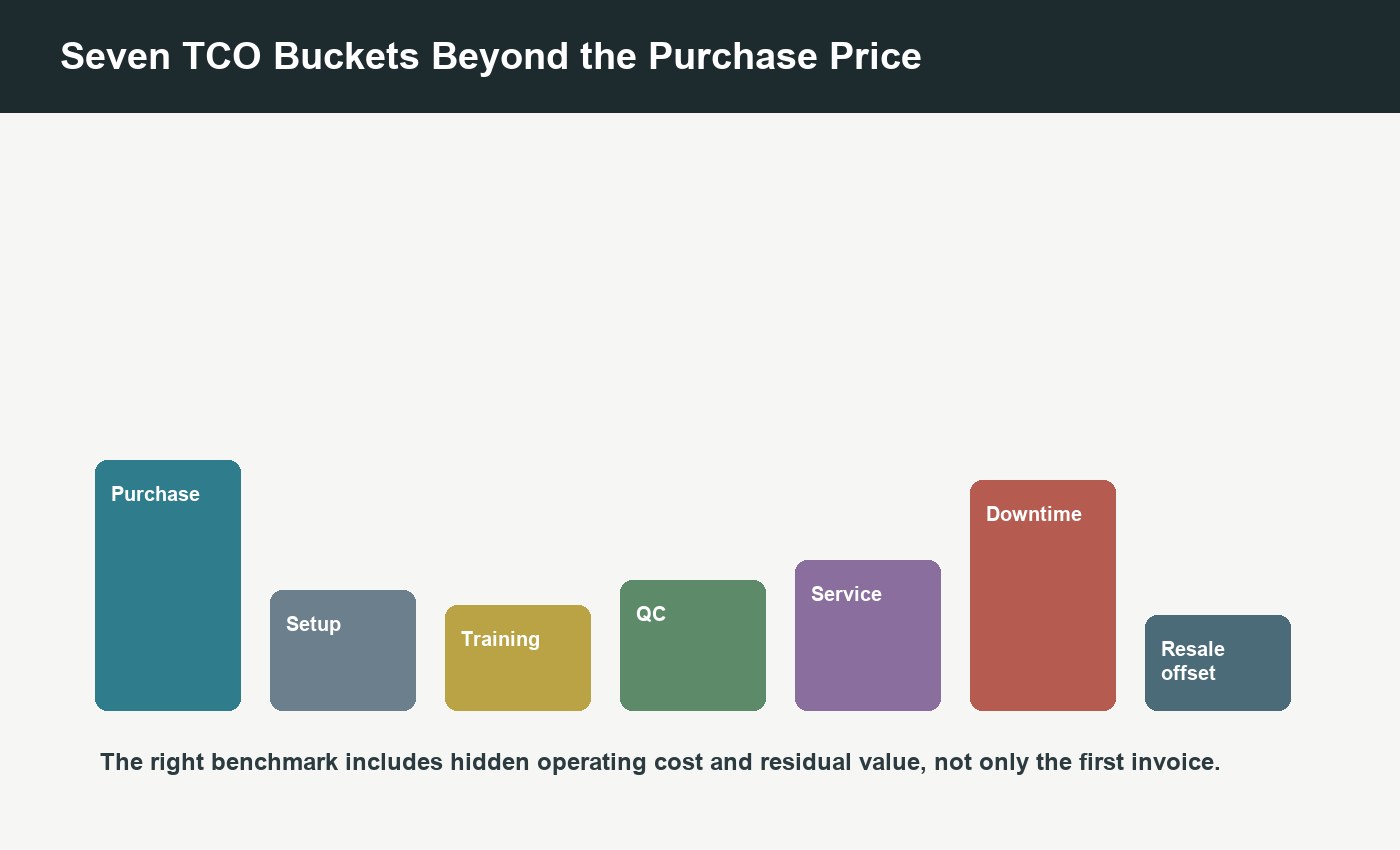
Acquisition cost includes the analyzer, configuration, software, computer or display needs, shipping, duty, tax, and installation. Setup and training includes initial operator onboarding, written SOPs, manager review, and the time required to make the instrument useful in the actual store or facility. Calibration and QC includes reference checks, daily verification routines, sample cups or fixtures, and periodic method review. Routine service includes cleaning, inspection, remote support, and scheduled checks. Downtime includes both repair time and the revenue or risk exposure caused when the analyzer is unavailable. Consumables include films, sample cups, printer/reporting supplies, protective windows, and fixtures. Residual value is the trade-in, resale, or internal redeployment value after several years.
A Practical 7-Year Benchmark Model
The table below uses a modeled comparison rather than public list prices. It is designed to help a buyer think. Replace the placeholders with your quoted numbers, local labor cost, expected volume, and service terms. The important point is not the exact number in the example; it is the relationship between visible and hidden costs.
| Cost bucket | Entry-level alternative | Balanced WiserMachine setup | Premium import setup |
|---|---|---|---|
| Initial acquisition | Lowest | Mid-range | Highest |
| Training burden | Medium to high if workflow support is thin | Moderate with clear SOP and product-fit selection | Moderate, often formal but slower to adapt |
| Calibration/QC discipline | Depends heavily on operator | Structured around daily and weekly checks | Structured, sometimes more complex |
| Downtime risk | Can become expensive if service path is unclear | Controlled by fit, support, and practical spare planning | Low to medium, but parts and service can be costly |
| Workflow speed | May be enough for low volume | Strong fit for routine precious-metal operations | Strong, sometimes more than a small buyer needs |
| Residual/trade-in value | Variable | Useful if upgrade path is planned | Often strong but tied to high starting price |
The model usually reveals three buyer types. The first is the low-volume buyer who needs dependable verification but does not need a large workflow stack. The second is the growing buyer who needs reliable daily throughput, reporting, and staff repeatability. The third is the high-volume lab or network buyer where uptime, multi-operator consistency, and reporting control matter more than the last dollar of purchase price. WiserMachine product selection should be matched to one of those use cases rather than treated as a single generic analyzer decision.
Where Low-Cost Equipment Becomes Expensive
Low-cost equipment becomes expensive when the buyer pays with time, retests, uncertainty, and downtime. A pawnshop that takes five extra minutes per intake may not notice the cost on a quiet day, but the cost compounds over hundreds of transactions. A recycler that cannot document a silver, gold, or PGM stream confidently may lose negotiation power with a downstream buyer. A jewelry chain that lets each store operate the analyzer differently may create inconsistent buy decisions and customer disputes.
There is also a risk-control cost. One missed tungsten-core item, one poorly documented high-value buyback, or one avoidable refinery settlement dispute can outweigh the apparent savings from a cheaper instrument. The TCO model should therefore include a risk offset: how much loss prevention does a better analyzer workflow provide? For some businesses, a single avoided mistake can justify a meaningful part of the ownership cost.
Where Premium Equipment Can Be Overbought
The opposite mistake is also common. Some buyers purchase a premium system because it looks safest, then use only a narrow part of its capability. A small pawnshop or jewelry counter may not need the same configuration as a refinery lab. A compact unit such as WMKEY6000 may be enough for a customer-facing precious-metal check, while a recycler or internal lab may benefit from the stronger bench workflow of WM5800T or WMK6000. The better question is not “Which analyzer is most advanced?” but “Which analyzer gives the lowest risk-adjusted cost for this workflow?”
Premium overbuying often hides inside training and complexity. If the instrument requires more steps than the staff will reliably follow, the theoretical accuracy advantage may not show up in daily decisions. The best ownership outcome is usually the instrument that staff can operate consistently, managers can audit easily, and the business can keep in service without drama.
Downtime: The TCO Bucket Buyers Underestimate Most
Downtime is the most underestimated cost bucket because it does not appear on the purchase invoice. If the analyzer is unavailable, a buyer may pause high-value transactions, accept more risk, send samples out, or lose customer confidence. For a small store, one unavailable week during a strong buying period can matter. For a recycler, a down analyzer can delay lot grading and weaken sale timing. For a refinery or bullion desk, downtime can push decisions back into slower destructive or third-party workflows.
Procurement should therefore ask practical questions: What support channel exists? What can be handled remotely? What parts or accessories should be stocked? How long does typical diagnosis take? Is there an upgrade path if the business grows? A lower purchase price cannot compensate for a weak downtime plan if the analyzer is central to daily revenue.
Seven-Year Cost Curve: What Usually Happens

In the first year, acquisition and training dominate. In years two and three, operator consistency and QC habits determine whether the analyzer becomes a reliable profit-control tool or a machine that staff use unevenly. In years four and five, service discipline, software expectations, and reporting needs become more visible. By years six and seven, the buyer should decide whether to continue, trade in, redeploy the unit to a lower-volume location, or upgrade to a better workflow.
This is why a seven-year benchmark should include a planned exit. If a buyer has no upgrade or redeployment plan, the old unit may become a hidden drag. If the buyer plans an upgrade path, the first analyzer can remain productive as a secondary station, training unit, or lower-volume branch tool.
Use-Case Fit: Pawnshop, Recycler, Refinery, or Chain
A pawnshop usually values speed, customer-facing clarity, and repeatable intake decisions. A bullion dealer values authentication confidence, documentation, and risk screening. A recycler values material sorting, batch evidence, and the ability to defend lot value. A refinery or small lab values audit traceability, method discipline, and sample workflow. A chain operator values standardization across stores and a training model that does not depend on one expert employee.
Those use cases point to different TCO priorities. A high-traffic store may pay back faster from throughput. A recycler may pay back through better lot segregation and fewer underpriced shipments. A refinery may pay back through fewer disputes and better pre-assay routing. A jewelry chain may pay back through consistent buy decisions across branches. The purchase should be modeled against the job, not against a generic analyzer category.
Decision Matrix for WiserMachine Buyers

Use a decision matrix before requesting the final quote. If your main risk is low daily volume and first-time use, choose the simplest system that still gives dependable reporting and operator discipline. If your main risk is mixed scrap, high-value lots, or staff turnover, prioritize workflow repeatability and support. If your main risk is network standardization, prioritize training, documentation, reporting, and upgrade planning. If your main risk is refinery settlement or audit evidence, prioritize sample handling discipline and record quality.
For many buyers, the best procurement path is to start with the right WiserMachine product for the current workflow, then plan a trade-in or expansion path as volume grows. That is a stronger approach than buying the cheapest tool now and replacing it under pressure later, or buying an overpowered system before the team is ready to use it well.
Procurement Checklist Before You Buy
- Define the daily sample count and peak-day sample count.
- List the material types: jewelry, bullion, dental scrap, silver, e-scrap, PGM, doré, or mixed lots.
- Decide who operates the analyzer and who audits the reports.
- Estimate the value of one avoided bad buy, underpriced lot, or settlement dispute.
- Ask what training, support, and workflow documentation is included.
- Build a seven-year cost sheet with downtime and residual value included.
- Choose the analyzer that fits the workflow, not only the lowest purchase price.
How WiserMachine Fits the TCO Conversation
WiserMachine’s role in a TCO conversation is not only to sell the device. It is to help the buyer match product, workflow, and risk. A recycler looking at silver-bearing or gold-bearing scrap should connect this guide with the industrial precious-metal recycling XRF buyer’s guide and the mixed silver-bearing e-scrap sorting SOP. A bullion or jewelry buyer should compare product fit through the silver bullion verification SOP and relevant product pages such as WM5800T, WMK6000, and WMKEY6000.
Related method guide: Best Gold Tester for Jewelry Stores and Pawnshops 2026. Before comparing ownership cost, confirm whether XRF is the right testing method for the buying workflow in the best gold tester guide.
Related XRF analyzer configurations to compare
Use these product pages as the short list when comparing 7-year ownership cost, service risk, testing volume, and resale value.
- WMKEY6000 portable gold analyzer: for mobile buying teams that need low setup time and quick field verification.
- WMG3000 handheld XRF metal analyzer: for shops comparing handheld flexibility against benchtop precision.
- WM9800 XRF analyzer: for jewelry stores and pawnshops modeling higher daily test volume.
- WM350D XRF spectrometer: for buyers who need a lab-style configuration for high-purity alloy checks.
Frequently Asked Questions
Is the cheapest XRF analyzer always cheaper over seven years?
No. The cheapest invoice can become more expensive if it creates extra retesting, weak reports, longer training, downtime, or lower resale value. The correct comparison is seven-year risk-adjusted cost, not only purchase price.
What is the biggest hidden cost in XRF ownership?
Downtime is often the largest hidden cost. If the analyzer is central to buying, sorting, or settlement decisions, unavailable days can delay revenue, weaken customer confidence, or force slower third-party testing.
How should a small pawnshop compare WMKEY6000, WM5800T, and WMK6000?
The pawnshop should start with daily sample volume, staff skill, customer-facing needs, and reporting expectations. A compact workflow may fit a smaller counter, while a higher-throughput bench workflow may make more sense when volume, staff turnover, or documentation requirements increase.
Should recyclers use the same TCO model as jewelry stores?
The buckets are the same, but the weights are different. Recyclers should emphasize lot segregation, material routing, downtime during sale windows, and documentation for downstream buyers. Jewelry stores usually emphasize speed, customer confidence, and consistent buy decisions.
How often should calibration and QC costs be reviewed?
Review QC routines at purchase, after initial training, after staff changes, and at least annually. A seven-year TCO sheet should include daily verification behavior and periodic method review, not only formal calibration events.
When does upgrading make financial sense?
Upgrading makes sense when throughput, reporting requirements, material complexity, or downtime risk exceed the capability of the current analyzer. A planned upgrade is usually cheaper than replacing a unit only after it becomes a bottleneck.
Can TCO include loss prevention?
Yes. For precious-metal buyers, loss prevention is part of ownership value. Avoiding one counterfeit buy, one underpriced scrap lot, or one settlement dispute can materially change the payback calculation.