
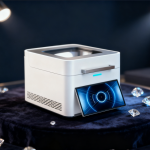
 Xrf Gold Analyzer
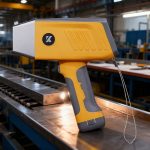 Handheld Alloy Analyzer
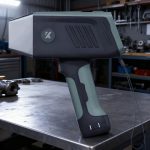 Handheld Mining Analyzer
 Other XRF Analyzer
The best gold tester is not the same device for every buyer. A jewelry store, a pawnshop, a mobile gold buyer, a bullion desk, and a recycler all face different risks. One buyer needs fast customer-facing screening. Another needs stronger report evidence. Another needs to separate mixed precious-metal lots before settlement. The right choice depends on what you test, how often you test, how much loss a wrong buy can create, and whether the result must stand up to staff review or customer explanation.
This 2026 guide compares the main gold testing methods used by professional buyers: acid testing, electronic testers, density checks, ultrasound support, and XRF analyzers. It is written for businesses comparing a simple testing kit against a professional XRF workflow such as WMKEY6000, WMK6000, or WM5800T.

Quick Answer: What Is the Best Gold Tester?
For a professional jewelry store or pawnshop, the best gold tester is usually an XRF analyzer when the business needs non-destructive testing, fast operation, multi-element screening, and a result that can be explained to staff or customers. Acid testing can still be useful as a low-cost rough check, but it is destructive, subjective, and weak for plated or complex items. Electronic testers can be convenient, but they often do not provide the broader alloy and trace-element view needed for serious buying decisions.
If the business buys only occasional low-value items, a basic test kit may be enough. If the business buys jewelry, bars, coins, scrap, or mixed precious-metal items every day, the cost of one bad buy can quickly exceed the savings from using a cheaper tester. That is why the best gold tester should be chosen by workflow and risk, not only by purchase price.
Gold Tester Methods Compared
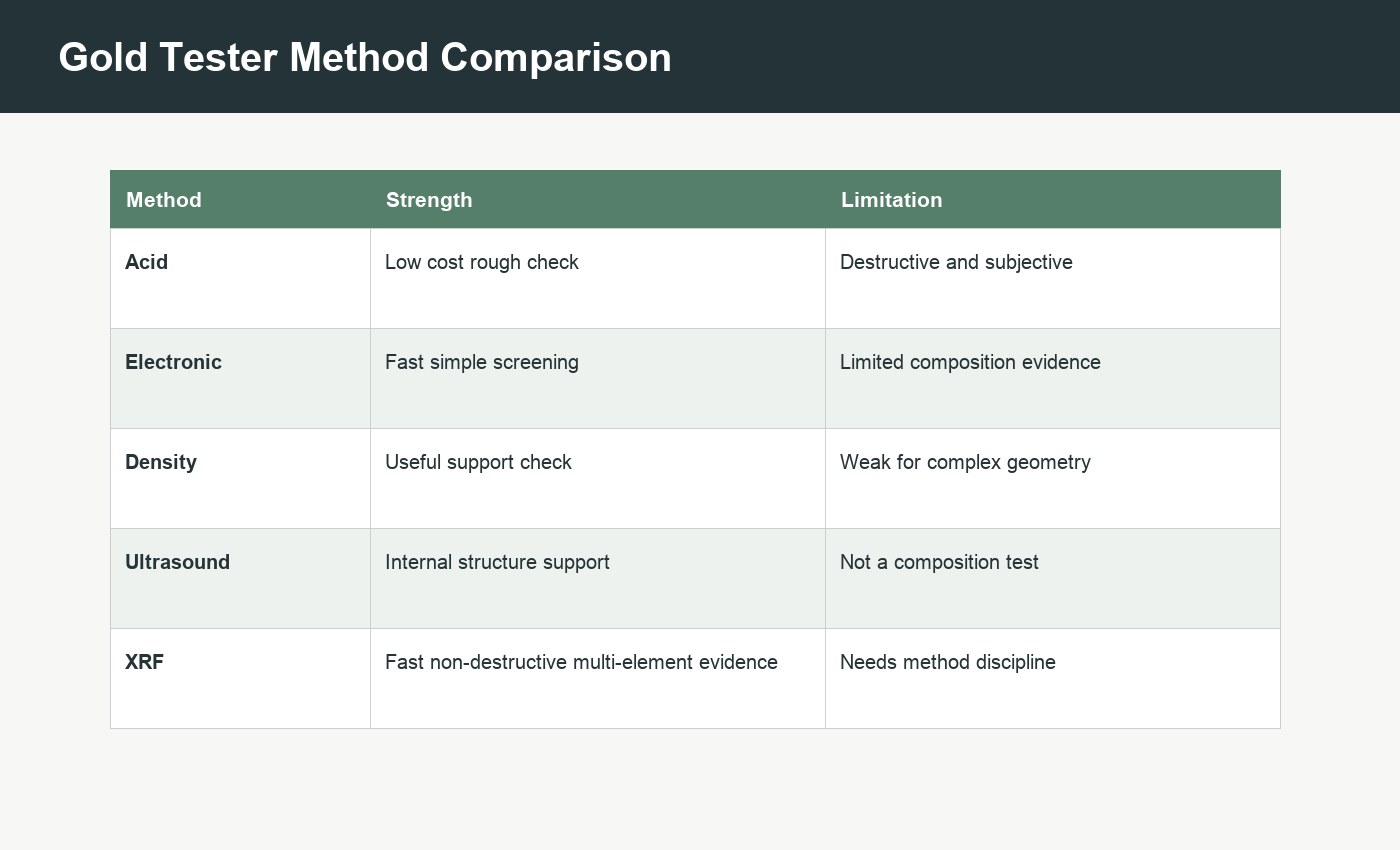
| Method | Best use | Main limitation | Professional fit |
|---|---|---|---|
| Acid test | Low-cost rough karat screening | Destructive, subjective, weak for plated items | Backup or first-pass only |
| Electronic tester | Fast counter check for simple jewelry | Limited material insight and can struggle with geometry | Light-duty screening |
| Density test | Support check for bars or simple shapes | Not enough for plated, hollow, or complex items | Secondary evidence |
| Ultrasound support | Internal structure check for some bullion | Does not replace composition analysis | Bullion workflow supplement |
| XRF analyzer | Non-destructive multi-element precious-metal testing | Requires correct method, sample placement, and training | Primary professional workflow |
Why Professional Buyers Usually Move Toward XRF
XRF is useful because it gives a fast, non-destructive elemental reading. For gold buyers, that means the operator can check Au content while also seeing common alloying or risk elements such as Ag, Cu, Ni, Zn, Pd, Pt, Rh, Pb, Cd, or other elements depending on configuration and method. This is a different level of evidence from a color change, a surface scratch, or a single electronic indication.
The value is not only accuracy. It is also repeatability. A pawnshop with rotating staff needs a workflow that can be taught. A jewelry store needs a result that can be explained politely to a customer. A bullion desk needs evidence that supports acceptance or escalation. A recycler needs sorting decisions that protect lot value. In these workflows, the best tester is the one that reduces business risk day after day.
When Acid Testing Is Still Useful
Acid testing is inexpensive and familiar. It can help small buyers make a first-pass decision on simple items, especially when purchase volume is low and the risk per item is limited. It can also serve as a secondary check when staff already understand its limitations.
The weakness is that acid testing removes material, depends on operator judgment, and can be fooled by plating or unusual construction. It also does not provide a clean report record. For a professional counter that wants better customer trust and lower dispute risk, acid testing alone is usually not the best long-term workflow.
When Electronic Gold Testers Fit
Electronic testers can be convenient for quick screening. They may fit a small counter that handles simple jewelry and wants a lower-cost step up from acid-only testing. They are usually easy to operate, and some staff prefer them because the process feels clean and simple.
The tradeoff is that electronic testers are not the same as a full elemental analysis workflow. Surface condition, item geometry, plating, and alloy complexity can still create uncertainty. If the business often handles high-value jewelry, mixed lots, bullion, or suspicious items, electronic testing should not be treated as the final authority.
Best Gold Tester by Business Type

Jewelry Stores
Jewelry stores need a gold tester that protects margin without damaging customer property. Non-destructive testing matters because customers may be standing at the counter. A clear result also helps staff explain why an item is accepted, rejected, or escalated. For many jewelry stores, a benchtop or compact XRF workflow is the strongest professional option.
Pawnshops
Pawnshops need speed, repeatability, and staff-friendly operation. The best gold tester should reduce bad buys without slowing the counter. If the store buys many items daily, the ROI case should include avoided loss, faster decisions, fewer disputes, and better staff confidence. The XRF analyzer ROI calculator for pawnshops and gold buyers is the next page to use after this method comparison.
Mobile Gold Buyers
Mobile buyers need portability and straightforward operation. A compact XRF workflow such as WMKEY6000 portable gold analyzer may be relevant when the buyer needs fast field checks and a simpler setup. The buying decision should still consider training, battery or power needs, reporting, and service support.
Bullion and Coin Dealers
Bullion and coin dealers often need layered evidence. XRF can support composition screening, while density, dimension, weight, magnetic response, and ultrasound may play supporting roles. The best workflow is not one single tool in isolation. It is a disciplined test stack with escalation rules for suspicious or high-value items.
Recyclers and Refineries
Recyclers and refineries need sorting and settlement discipline. They may test gold-bearing scrap, silver items, dental alloy, e-scrap contacts, plated parts, and mixed lots. In this environment, the best gold tester is usually part of a broader precious-metal XRF workflow, not a simple consumer-facing tester.
How to Choose Between Portable and Benchtop XRF
Portable and benchtop systems solve different problems. A portable analyzer can support field buying, mobile counters, and flexible inspection. A benchtop or counter-focused analyzer can support repeatable staff operation, better physical control, and a more consistent customer-facing process. The right answer depends on where the test happens and who runs it.
For a compact workflow, compare WMKEY6000. For a pawnshop or gold buyer that wants a stronger one-button counter workflow, compare WMK6000. For precious-metal recycling and broader intake operations, compare WM5800T.
Selection Checklist Before You Buy

- Material type: jewelry, bullion, coins, dental alloy, scrap, e-scrap, plated parts, or mixed lots.
- Daily volume: occasional checks, steady counter use, high-throughput buying, or batch sorting.
- Risk level: average item value, fraud exposure, dispute risk, and settlement impact.
- Operator profile: one trained specialist, rotating counter staff, branch staff, or field buyer.
- Evidence need: customer explanation, printed report, internal record, or audit trail.
- Support need: training, daily QC, warranty, remote support, spare parts, and downtime plan.
- Budget view: purchase price, total ownership cost, avoided bad buys, and payback period.
Common Buying Mistakes
The first mistake is buying the cheapest tester without calculating risk. A low-cost tester can be reasonable for occasional checks, but it can become expensive if it allows one wrong high-value purchase. The second mistake is buying a sophisticated analyzer without training staff or building a daily QC routine. The third mistake is comparing quotes only by equipment price while ignoring warranty, support, reporting, accessories, and service response.
Before requesting supplier pricing, use the XRF analyzer quote checklist. Before approving the budget, use the 7-year XRF analyzer TCO benchmark. These two steps keep the buying decision grounded in real ownership cost, not brochure claims.
Final Recommendation
For professional jewelry stores, pawnshops, gold buyers, and precious-metal counters, the best gold tester is usually the tester that creates the most reliable daily workflow, not the cheapest device. XRF becomes the strongest option when the business needs non-destructive testing, repeatable staff operation, multi-element evidence, and a clear path from screening to buying decision.
If you are choosing a gold tester now, send WiserMachine your sample types, daily volume, business type, report needs, and current testing process. The team can help compare compact, counter, and recycling workflows before you request a final quote.
Related non-destructive workflow: How to Test Gold Without Damaging Jewelry 2026. Use this guide when the shop needs a customer-facing testing process before any scratch or acid decision.
Frequently Asked Questions
What is the best gold tester for a pawnshop?
For a pawnshop that buys gold frequently, an XRF analyzer is usually the strongest professional option because it is non-destructive, fast, repeatable, and easier to explain to staff and customers than acid-only testing.
Is XRF better than acid testing for gold?
XRF is usually better for professional buying because it is non-destructive and provides multi-element evidence. Acid testing can still be useful as a rough low-cost check, but it is subjective and can damage the item.
Can electronic gold testers replace XRF?
Electronic testers can support light-duty screening, but they do not replace a full XRF workflow when the buyer needs alloy composition, report evidence, and stronger protection against plated or complex items.
What should a jewelry store consider before buying a gold tester?
A jewelry store should consider sample types, daily volume, customer-facing workflow, staff training, reporting, warranty, service support, and total ownership cost.
Which WiserMachine model should I compare first?
Compare WMKEY6000 for compact or mobile testing, WMK6000 for pawnshop and gold-buyer counter workflows, and WM5800T for broader precious-metal recycling and intake operations.