
 Xrf Gold Analyzer
 Handheld Alloy Analyzer
 Handheld Mining Analyzer
 Other XRF Analyzer
For pawnshops and gold buyers, XRF analyzer ROI is not only a laboratory calculation. It is a daily buying decision calculation. The payback comes from faster intake, fewer rejected or disputed purchases, better confidence on karat and alloy checks, more consistent staff decisions, and the ability to document why a customer-facing offer was made. A tool that prevents one serious counterfeit mistake or one underpriced high-value lot may recover a meaningful part of its cost before the accountant sees a neat monthly ROI report.
This guide gives a practical ROI calculator for precious-metal counters. It is designed for pawnshops, cash-for-gold stores, jewelry buyers, bullion desks, and small recycling buyers comparing products such as WMK6000, WMKEY6000, and WM5800T. It does not publish a fixed equipment price or promise a universal payback. Instead, it gives a decision model you can fill with your own quote, daily testing volume, staff cost, gross margin, local service terms, and risk exposure.

The Simple ROI Formula
The basic ROI formula is simple: divide the total analyzer ownership cost by the monthly value created by the analyzer. The difficult part is defining monthly value honestly. A pawnshop should not count imaginary revenue. It should count realistic improvements that can be observed in daily work: faster intake, fewer third-party tests, fewer bad buys, fewer disputes, better batch documentation, and stronger close rates when the customer sees a professional test process.
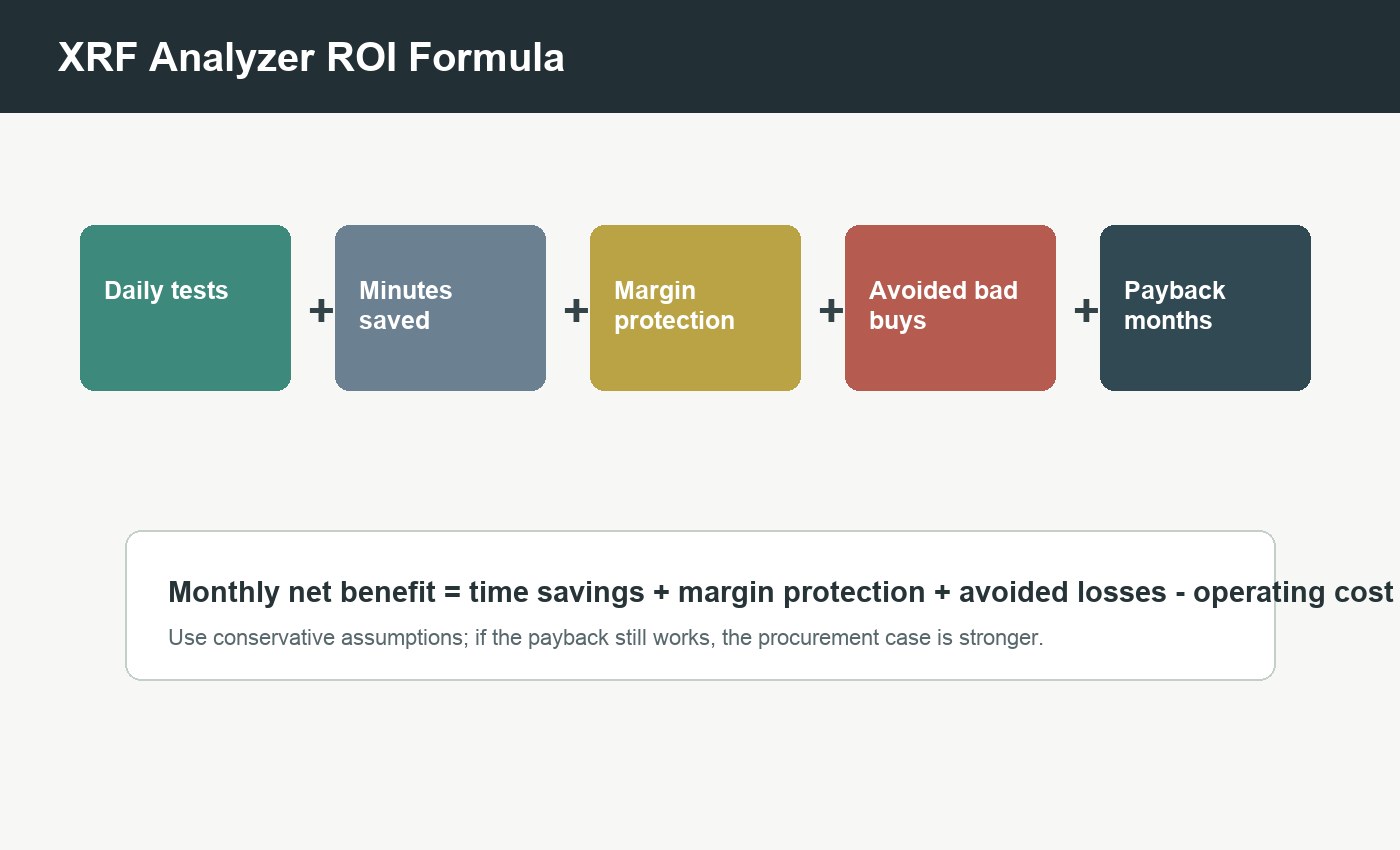
Use this starting formula:
| ROI item | How to estimate it |
|---|---|
| Monthly analyzer cost | Equipment cost, financing, service, consumables, training, and expected downtime reserve divided by the planned ownership period |
| Monthly time savings | Tests per month multiplied by minutes saved per test multiplied by loaded staff cost |
| Margin protection | Value of better karat/alloy decisions, better scrap sorting, and fewer underpriced or overpriced purchases |
| Avoided bad buys | Expected monthly loss avoided from counterfeit, plated, filled, tungsten-core, or misrepresented items |
| Documentation value | Reduced disputes, clearer customer explanation, and better internal audit evidence |
Payback months are then calculated as total analyzer cost divided by monthly net benefit. If the analyzer costs 100 units and creates 10 units of net monthly value, the payback is about 10 months. If it creates 5 units of value, the payback is about 20 months. The number matters, but the assumptions matter more.
What Pawnshops Usually Miss in ROI
Many pawnshops calculate ROI only from labor savings. That is too narrow. A precious-metal analyzer is also a risk-control tool. A faster acid test may save time, but it does not provide the same non-destructive elemental screen, report trail, or customer-facing confidence. A good ROI model should include the value of reducing uncertainty on karat jewelry, mixed gold lots, silver items, bullion, dental scrap, and unusual alloy pieces.
Another common mistake is treating all tests as equal. A ten-dollar low-risk item is not the same as a high-value gold chain, bullion bar, or mixed scrap lot. The better model groups tests by commercial value. Low-value routine checks may mainly save time. Medium-value buys may improve margin confidence. High-value buys may justify the analyzer by reducing the probability of one large mistake.
Input 1: Daily Testing Volume
Start with daily testing volume because it determines how quickly small improvements compound. Count real tests, not optimistic marketing numbers. A single-store buyer may run 5 to 20 meaningful checks per day. A busy pawnshop, jewelry buyer, or branch network may run far more. For each test, estimate how many minutes are saved compared with the current process and whether the XRF result changes the buy/no-buy decision.
For low-volume stores, the ROI may depend more on avoided mistakes and customer trust than pure throughput. For high-volume stores, even small time savings can become significant. Two minutes saved on 30 tests per day is one staff-hour per day. Over a month, that can be a real operating benefit, especially when the tool also improves consistency.
Input 2: Average Transaction Value and Margin Exposure
The analyzer’s value rises when average transaction value rises. A shop buying small silver jewelry has a different risk profile from a shop buying high-karat gold, bullion, dental scrap, or mixed estate lots. Estimate your average precious-metal buy value, gross margin, and the percentage of transactions where better elemental screening could change the offer or prevent a mistake.
Do not assume the analyzer increases margin on every transaction. That would exaggerate ROI. Instead, estimate a realistic impact rate. For example, if only 10 percent of transactions involve enough uncertainty to affect the offer, calculate value only on that 10 percent. Conservative ROI is more useful than a spreadsheet that looks good and fails in the store.
Input 3: Avoided Bad Buys
Avoided bad buys are often the largest ROI variable. Precious-metal buyers face plated items, filled jewelry, solder-heavy pieces, unusual alloys, counterfeit bullion, tungsten concerns, and customer claims that may not match the actual composition. XRF is not a magic answer for every fraud scenario, and thick plating or geometry can still require careful method design, but a disciplined XRF workflow gives the buyer better evidence than visual inspection alone.
For ROI, estimate your historical loss rate. How many questionable items did the store buy in the last year? What was the average loss? How many could a better screening process reasonably reduce? If one avoided mistake saves enough money to cover several months of ownership cost, the analyzer should be evaluated as a loss-prevention tool, not only a speed tool.
Input 4: Staff Consistency and Training
Pawnshop ROI improves when every employee follows the same testing and reporting routine. Inconsistent staff behavior quietly damages margins. One employee may overtrust stamps, another may overuse acid, another may avoid buying unfamiliar material. A standardized analyzer workflow can reduce that variation when it is paired with a written SOP, training, and manager review.
For a small store, the operator may be the owner. For a multi-branch buyer, the operator may change often. The second case usually needs a stronger ROI weight on training, report templates, and repeatable procedure. A compact counter workflow may fit one shop, while a bench model may fit a higher-volume branch or central buying desk.
Input 5: Report Evidence and Customer Confidence
Customer-facing confidence matters. When a buyer can explain the test process and show a professional report, customers often perceive the offer as more credible. This does not mean every customer will accept the offer, and it should not be modeled as guaranteed new revenue. But for a store competing with other gold buyers, better evidence can reduce negotiation friction and support a more professional brand position.
Documentation also matters internally. Reports help managers review large purchases, compare staff decisions, and resolve disputes. If a branch network wants consistent gold-buying behavior, report evidence can be as important as the raw test result.
Three Payback Scenarios

A low-volume store may test 5 to 8 meaningful items per day. Payback depends mainly on avoiding one or two costly mistakes per year and saving small amounts of staff time. A medium-volume store may test 15 to 25 items per day. Payback usually combines time savings, better offer confidence, and reduced loss exposure. A high-volume gold buyer or multi-branch operation may test many more items and may justify a higher-throughput workflow because staff consistency and queue speed become more important.
| Scenario | Typical ROI driver | Procurement focus |
|---|---|---|
| Low volume | Avoided bad buys and customer trust | Simple workflow, training, and clear reporting |
| Medium volume | Time savings plus margin protection | Repeatable counter process and service support |
| High volume | Throughput, branch consistency, and audit trail | Higher capacity workflow, report control, and upgrade path |
How to Choose Between WMKEY6000, WMK6000, and WM5800T
Use the ROI model to choose the product fit. WMKEY6000 is relevant when the buyer needs a compact precious-metal testing workflow and straightforward operation. WMK6000 is relevant when a pawnshop or jewelry buyer wants a stronger one-button workflow for daily counter testing. WM5800T is relevant when the business handles broader precious-metal recycling, mixed materials, or a more industrial intake process.
The right choice is the one that lowers risk-adjusted cost for your actual workflow. A small counter may not need an oversized system. A recycler or high-volume buyer should not underbuy and then lose time or confidence. This is the same logic explained in the 7-year XRF analyzer TCO benchmark: invoice price is only one line in the decision.
ROI Checklist Before Requesting a Quote

- Count real daily and monthly precious-metal tests.
- Separate low-value routine checks from high-value risk checks.
- Estimate current time per test and realistic minutes saved.
- List historical bad buys, disputed buys, and third-party testing costs.
- Estimate how many mistakes a disciplined XRF workflow could reduce.
- Include staff training, service, consumables, downtime, and ownership period.
- Compare compact, counter, and bench workflows against the same ROI assumptions.
- Ask for a quote that matches your sample types, report needs, and upgrade path.
Common ROI Mistakes
The first mistake is counting every test as new profit. Many tests only confirm what the buyer already expected. The second mistake is ignoring operator behavior. An analyzer only creates value if staff use it consistently. The third mistake is ignoring downtime. If the store depends on the analyzer for daily buying, service response and backup procedure affect ROI. The fourth mistake is comparing products without use-case fit. The cheapest product may not support the workflow, while the most advanced product may be unnecessary for a small counter.
A practical ROI sheet should be conservative enough that the owner believes it. If the analyzer still pays back under conservative assumptions, the purchase decision is stronger. If it only pays back under aggressive assumptions, the buyer should revisit volume, product fit, or workflow design before purchasing.
Final Procurement Rule
For pawnshops and gold buyers, the strongest XRF analyzer ROI usually comes from a combination of faster decisions, fewer avoidable losses, stronger customer explanation, and better staff consistency. Do not buy only from a brochure specification. Build a simple ROI sheet, choose the product that fits your daily workflow, and ask the supplier to explain training, service, reporting, and upgrade path in the same conversation as price.
If you are comparing analyzer options now, send WiserMachine your daily sample volume, main material types, average transaction value, and current testing process. The team can help match the ROI assumptions to WMKEY6000, WMK6000, WM5800T, or another configuration before you commit capital.
Related method guide: Best Gold Tester for Jewelry Stores and Pawnshops 2026. Use the best gold tester guide first if the buyer is still comparing XRF against acid, electronic, density, or handheld testing methods.
Product pages to use with the ROI calculation
After estimating avoided bad buys and payback months, compare the analyzer configuration against the workflow that produces those savings.
- WMKEY6000 portable gold analyzer: for counter service, buying trips, and mobile gold purchasing workflows.
- WM450 precious metals detector: for jewelry recycling teams that need rapid 0-24K screening.
- WM9800 XRF analyzer for pawnshops: for higher-throughput pawnshop and jewelry-store verification.
- WMG3000 handheld XRF metal analyzer: for operators who need handheld testing across mixed metal lots.
Frequently Asked Questions
How fast can an XRF analyzer pay back for a pawnshop?
Payback depends on equipment cost, daily testing volume, staff time, average transaction value, avoided bad buys, and service terms. Some buyers justify the analyzer mainly through loss prevention, while high-volume stores may justify it through both time savings and margin protection.
Should ROI include avoided counterfeit or plated-item losses?
Yes, but conservatively. Estimate historical losses and the realistic percentage a disciplined XRF workflow could reduce. Do not assume the analyzer eliminates every risk scenario.
Is ROI higher for pawnshops or recyclers?
The ROI drivers differ. Pawnshops often value counter speed, customer confidence, and consistent offers. Recyclers often value lot sorting, batch documentation, and reduced underpricing of mixed precious-metal streams.
Which WiserMachine product should a small gold buyer start with?
The starting point should be sample volume, material type, staff skill, and reporting needs. A compact workflow may fit a small counter, while higher-volume or mixed-material operations may need a stronger bench workflow.
Can XRF replace all other precious-metal tests?
No. XRF is a powerful non-destructive screening and decision-support tool, but geometry, plating, sampling, and unusual material structures still require proper procedure and sometimes additional verification.