
 Xrf Gold Analyzer
 Handheld Alloy Analyzer
 Handheld Mining Analyzer
 Other XRF Analyzer
Jewelry stores and pawnshops often need to test gold while the customer is standing at the counter. In that setting, damaging a ring, chain, coin, pendant, watch part, or heirloom item can create more trouble than the test result solves. A scratch mark, acid stain, bent clasp, or rough file mark can damage trust even when the item is genuine. That is why professional buyers need a non-destructive gold testing workflow, not only a gold tester.
This guide explains how to test gold without damaging jewelry in 2026. It compares visual inspection, magnet and weight checks, density support, acid testing, electronic screening, and XRF analysis. It also shows when a customer-facing shop should move from rough screening to a professional XRF workflow using analyzers such as WMK6000 or WMKEY6000.

Quick Answer: How Can You Test Gold Without Damaging It?
The safest professional method is to combine non-destructive pre-checks with XRF analysis. Start with visual inspection, stamp review, weight, magnet response, and geometry review. Then use XRF to check the surface elemental composition without cutting, scratching, or applying acid to the customer item. For suspicious, plated, filled, hollow, or high-value items, repeat the measurement at several points and escalate instead of making a single rushed decision.
Acid testing can identify some karat ranges, but it normally requires a scratch or touchstone transfer. That means it is not truly damage-free. For low-value scrap this may be acceptable. For customer jewelry, antique pieces, resale items, coins, or items with sentimental value, a non-destructive workflow is usually safer.
Why Damage-Free Testing Matters at the Counter
A jewelry store does not only test metal. It manages trust. If staff damage a customer item, the conversation changes from purity to responsibility. Pawnshops and gold buyers face the same issue. The buyer needs enough confidence to quote or reject the item, while the customer expects the item to be handled carefully.
Non-destructive testing is also useful for resale. A clean item is easier to photograph, grade, repair, polish, and sell. If testing leaves visible marks, the business may lose resale value even when the metal result is correct. This is why the best workflow is not the fastest aggressive test, but the safest reliable sequence.
Non-Destructive Gold Testing Workflow
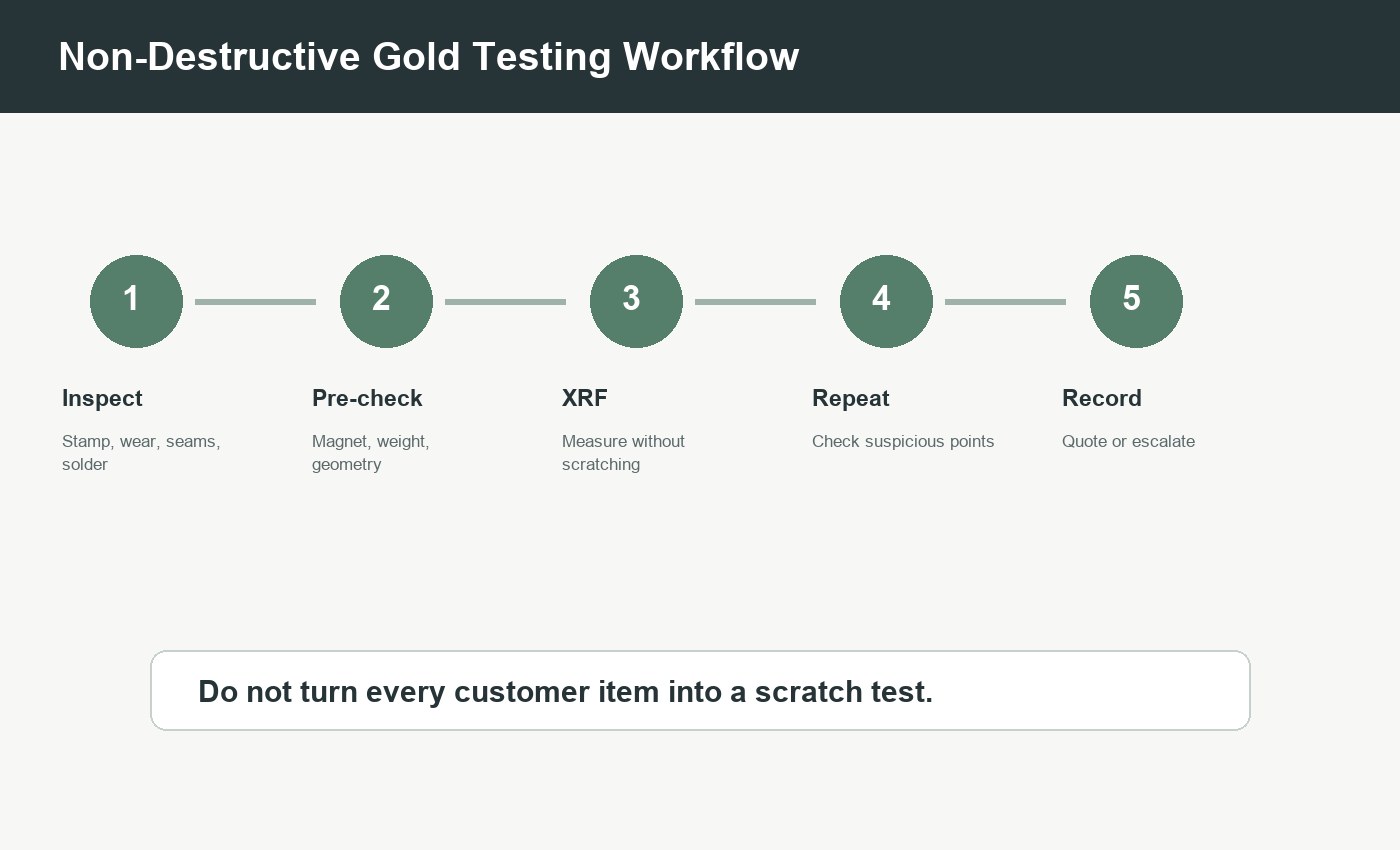
| Step | Purpose | Damage risk |
|---|---|---|
| Visual inspection | Check stamps, wear, solder joints, plating clues, and construction | None |
| Magnet and weight check | Screen obvious non-gold or suspicious construction | None if handled carefully |
| Geometry review | Identify hollow, plated, filled, or mixed-component items | None |
| XRF measurement | Read elemental composition without scratching the item | None when used correctly |
| Repeat and escalate | Confirm suspicious readings before buying or rejecting | None |
| Record result | Keep evidence for staff review, quote, or customer explanation | None |
Where Acid Testing Fits and Where It Fails
Acid testing is familiar because it is cheap and simple. For scrap items that will be melted, a small scratch may not matter. But for finished jewelry, acid testing can create visible marks or require abrasion on a touchstone. The operator also has to interpret reaction speed and color. Different staff may read borderline results differently.
Acid testing is especially weak when the item is plated, filled, dirty, heavily worn, soldered, or built from multiple components. A clasp may not match a chain. A plated item may show gold at the surface while hiding lower-value material underneath. Acid can be part of a backup workflow, but it should not be the only method for customer-facing, high-value, or dispute-prone jewelry.
Why XRF Is Useful for Damage-Free Gold Testing
XRF is non-destructive because it analyzes the item without cutting, dissolving, or scratching it. For jewelry stores and pawnshops, this lets the operator test a ring, chain, pendant, coin, or small item while keeping the surface intact. It also gives a multi-element reading, so staff can see gold along with alloying or risk elements instead of relying only on a single yes/no indication.
XRF still requires discipline. The operator should test clean, flat, representative areas where possible. Small links, curved rings, solder joints, stones, hollow areas, plating, and mixed parts can affect readings. Good staff do not treat one reading as magic. They use repeat tests, surface review, and escalation rules.
Common Risk Cases

Gold-Plated and Gold-Filled Items
Plated and filled items are the classic reason to avoid trusting one rough test. A surface check may see gold while the bulk value is much lower. For these items, staff should inspect wear points, edges, seams, and suspicious construction. XRF readings at multiple points help, but thick plating or layered construction may still need escalation.
Chains, Clasps, and Mixed Components
Chains can contain links, clasps, solder, repairs, and replacement parts that do not all match. A non-destructive workflow should test more than one point, especially on higher-value chains. If the clasp reads differently from the chain body, record that before making a quote.
Antique and Customer-Sentimental Jewelry
Antique pieces and heirlooms should be handled carefully. Even a tiny test mark can create a customer dispute. In this case, visual review, photography, non-destructive XRF, and conservative escalation are better than aggressive scratching.
Bullion, Coins, and Flat Items
Flat items are usually easier for XRF because the measurement surface is more stable. But counterfeit bullion can still require a layered test stack. Weight, dimensions, magnet response, XRF, and sometimes ultrasound support may all matter.
Customer-Facing SOP for Jewelry Stores and Pawnshops

- Explain that the item will be checked with a non-destructive workflow first.
- Photograph or note visible condition when the item is valuable or sentimental.
- Inspect stamps, wear points, seams, solder, clasp, and unusual color differences.
- Use simple non-destructive pre-checks such as magnet, weight, and geometry review.
- Run XRF on the most representative safe areas.
- Repeat readings on suspicious or high-value items before quoting.
- Record the result, note limitations, and escalate if the item may be plated, filled, hollow, or mixed.
Which WiserMachine Analyzer Should You Compare?
For a pawnshop or jewelry-store counter that wants a structured one-button workflow, compare WMK6000. For a compact or mobile workflow, compare WMKEY6000. If the business also handles mixed precious-metal scrap or broader intake work, connect this workflow with the XRF analyzer quote checklist before requesting a final configuration.
If you are still comparing test methods, start with the best gold tester guide for jewelry stores and pawnshops. If your team needs to justify the purchase internally, use the XRF analyzer ROI calculator and the 7-year TCO benchmark.
Final Recommendation
To test gold without damaging jewelry, avoid making the scratch test your first move. Build a non-destructive workflow first: visual review, careful handling, XRF measurement, repeat checks, documentation, and escalation for suspicious construction. This protects the customer item, protects staff confidence, and gives the business a cleaner basis for buying or rejecting the piece.
For a professional shop, the goal is not only to know whether an item contains gold. The goal is to make a reliable buying decision without damaging the item or the customer relationship.
Frequently Asked Questions
Can you test gold without scratching it?
Yes. A non-destructive workflow can use visual inspection, magnet and weight checks, and XRF analysis to test gold without scratching the item.
Is acid testing damage-free?
No. Acid testing usually requires a scratch or touchstone transfer, so it is not truly damage-free for finished jewelry or customer items.
Is XRF safe for jewelry testing?
XRF is widely used as a non-destructive testing method for jewelry and precious metals when operated according to the analyzer instructions and local safety requirements.
Can XRF detect gold plating?
XRF can help identify surface composition and suspicious differences across multiple points, but thick plating and layered construction may still require careful escalation.
What is the best method for pawnshop counter testing?
For frequent professional buying, a non-destructive XRF workflow is usually stronger than acid-only testing because it protects the item and creates clearer evidence for staff and customers.