
 Xrf Gold Analyzer
 Handheld Alloy Analyzer
 Handheld Mining Analyzer
 Other XRF Analyzer
Bottom line for PGM sellers, refiners, toll processors, and buyers: platinum, palladium, and rhodium settlement risk usually does not come from one obvious mistake. It comes from small differences stacked together: a moisture deduction that was not reconciled, a split sample that drifted from the lot average, a rhodium number that moved after fusion, a payable percentage applied to the wrong basis, or a penalty element that quietly changed the net value. On a high-value PGM lot, those small differences can exceed the profit on the shipment. This guide gives a practical settlement-assay audit SOP for using XRF as the fast independent screen that keeps the refinery statement honest before the commercial settlement is closed.
This is deliberately not another catalytic-converter grading guide. WiserMachine already covers converter and spent-catalyst recovery workflows in the catalytic converter PGM recovery SOP and the spent catalyst PGM reclaim SOP. The D6 angle is narrower and more commercial: after a PGM-bearing lot is already identified and routed to a refinery, how does the seller or buyer audit the settlement assay, compare the internal XRF screen with the refinery certificate, and decide whether the variance is normal process noise, sampling error, or a dispute that needs an umpire assay?

Why PGM Settlement Assays Need a Separate Audit Discipline
PGM lots are commercially unforgiving because the unit value is high and the settlement chain has many places where a basis can shift. A refinery statement may report dry weight, gross wet weight, fire assay result, ICP confirmation, payable metal, treatment charge, refining charge, penalty elements, returnable metal, lot fees, financing, and minimum deductions. Every number can be individually reasonable while the final settlement still underpays the seller if the bases do not reconcile. That is why a PGM settlement audit is not just an assay check; it is a basis, math, and evidence check.
Platinum and palladium usually receive most of the attention because they dominate many lots by mass, but rhodium is often where the settlement sensitivity becomes extreme. Rhodium may be present in smaller absolute quantity, yet a small percentage-point movement can change the lot value sharply. A seller who only reviews the headline Pt/Pd numbers can miss a rhodium drift, a split-sample mismatch, or a recoverability assumption that has a larger value effect than the visible treatment charge.
XRF does not replace a definitive refinery assay. Its role is to provide a fast, independent, non-destructive control number before and during settlement. When the XRF screen, intake record, sample-preparation log, and refinery certificate point in the same direction, the settlement is easier to close. When they diverge, the operator has evidence early enough to isolate the cause rather than arguing after the metal has moved through the process.
The Seven-Point PGM Settlement Audit Map
A defensible audit separates the settlement into seven checkpoints: lot identity, weight basis, sample representativeness, XRF pre-screen, refinery assay, payable-metal math, and dispute threshold. The mistake many sellers make is treating the final assay certificate as a single truth document. In practice, the certificate is only one part of a chain. The audit asks whether the lot that was received is the same lot that was sampled, whether the sample represents the lot, whether the measured values match the expected PGM fingerprint, and whether the settlement math used the correct basis.
The workflow below uses XRF at the places where speed and independent control matter most: incoming screen, split-sample comparison, lot-to-lot anomaly detection, penalty-element screening, and final variance review. XRF is strongest when it is used repeatedly as a control instrument instead of once as a ceremonial reading. A single scan tells you something; a documented sequence tied to the lot record tells you whether the refinery statement is coherent.
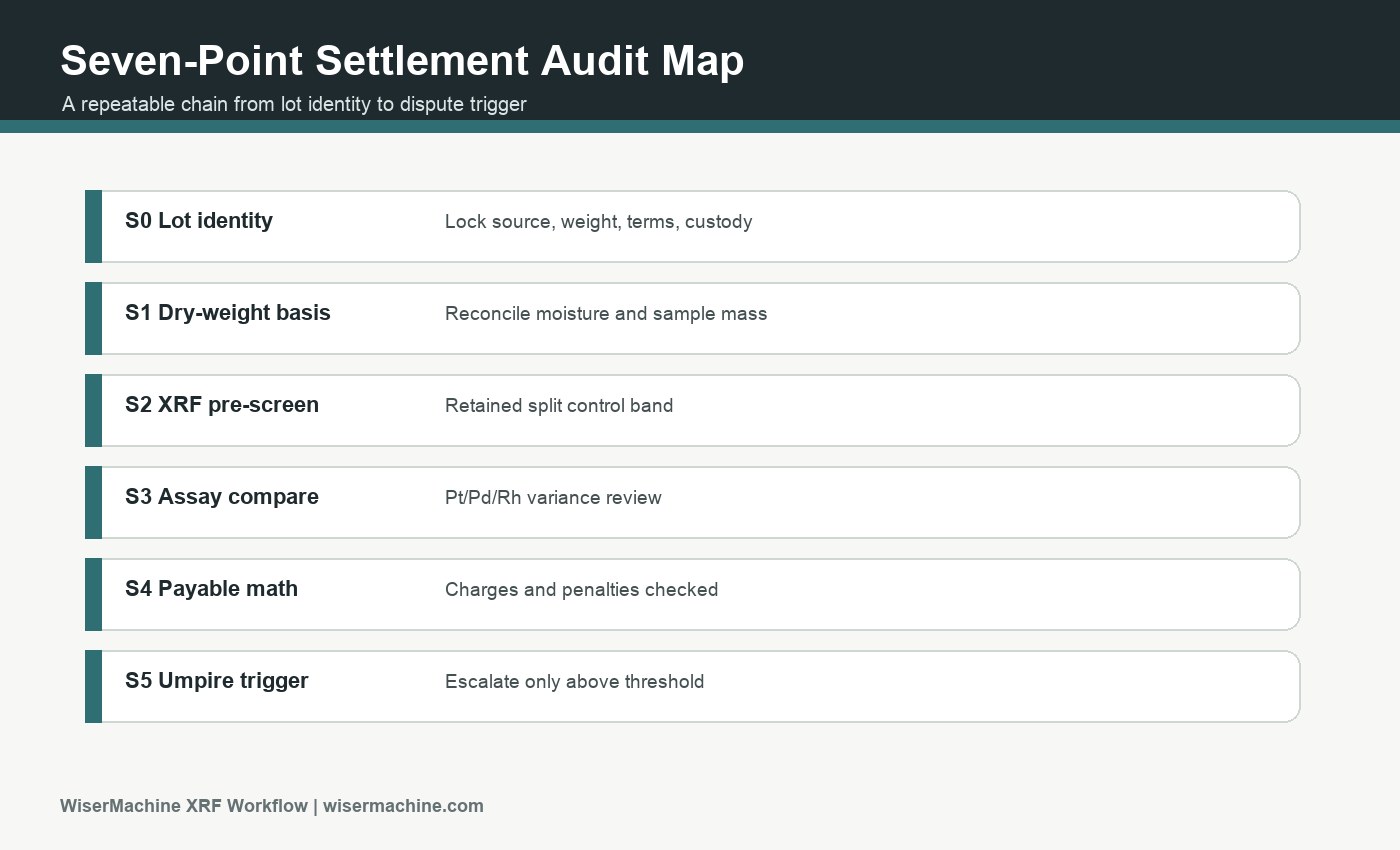
Stage S0: Lock the Lot Identity Before Any Assay Argument Starts
The audit begins with lot identity because a settlement dispute is almost impossible to resolve if the lot record is weak. Assign a unique lot ID, photograph the received material, record supplier, container count, gross weight, packaging, moisture condition, declared material type, and any previous assay information. If the lot contains mixed PGM-bearing fractions, do not blend them for convenience before sampling; record the fractions first, then decide whether they should be settled separately or composited under a defined rule.
The intake record should also capture commercial terms before the assay is known: payable percentages, refining charge, treatment charge, minimum lot charge, moisture basis, penalty elements, umpire-assay clause, and who pays for dispute testing. This matters because an assay variance can look large or small depending on the basis used. If the agreement says settlement is dry-weight payable metal, then gross wet weight and visible moisture cannot be ignored in the audit file.
Stage S1: Reconcile Weight, Moisture, and Sample Basis
Many PGM disputes start as assay disputes but end as weight-basis disputes. The SOP therefore reconciles gross received weight, tare, net wet weight, drying loss, dry basis, sample mass, retained split mass, and rejected oversize or foreign material. The audit file should make it clear whether the refinery percentage is applied to wet weight, dry weight, prepared sample weight, or a corrected basis after moisture and contamination deductions.
Moisture is not a clerical detail. A one-percent moisture difference on a high-value lot changes payable metal even if the assay percentage is unchanged. The seller should either run an agreed drying procedure or document why the refinery moisture value is accepted. When the XRF screen and the refinery assay disagree, check the basis first: the numbers may not be measuring the same prepared material.
Stage S2: Use XRF to Pre-Screen the Representative Split
Once the lot has been prepared and split, XRF becomes the fast control screen. Read multiple points on the retained split, record Pt, Pd, Rh, and relevant matrix or penalty elements, and calculate a simple average and range. The goal is not to claim that handheld XRF is the final settlement method for every PGM matrix; the goal is to establish whether the retained split is compositionally plausible against the incoming lot and whether the refinery result falls inside a range that the operator can explain.
For metallic PGM-bearing scrap, jewelry melt residues, alloyed material, and many high-grade concentrates, XRF can provide a strong practical fingerprint. For ceramic catalyst powders, carbonaceous residues, or heavily heterogeneous prepared material, XRF is still valuable as a screen but the SOP treats it as an anomaly detector rather than the final judge. The operator records matrix limitations explicitly so the audit does not overstate what the instrument can certify.
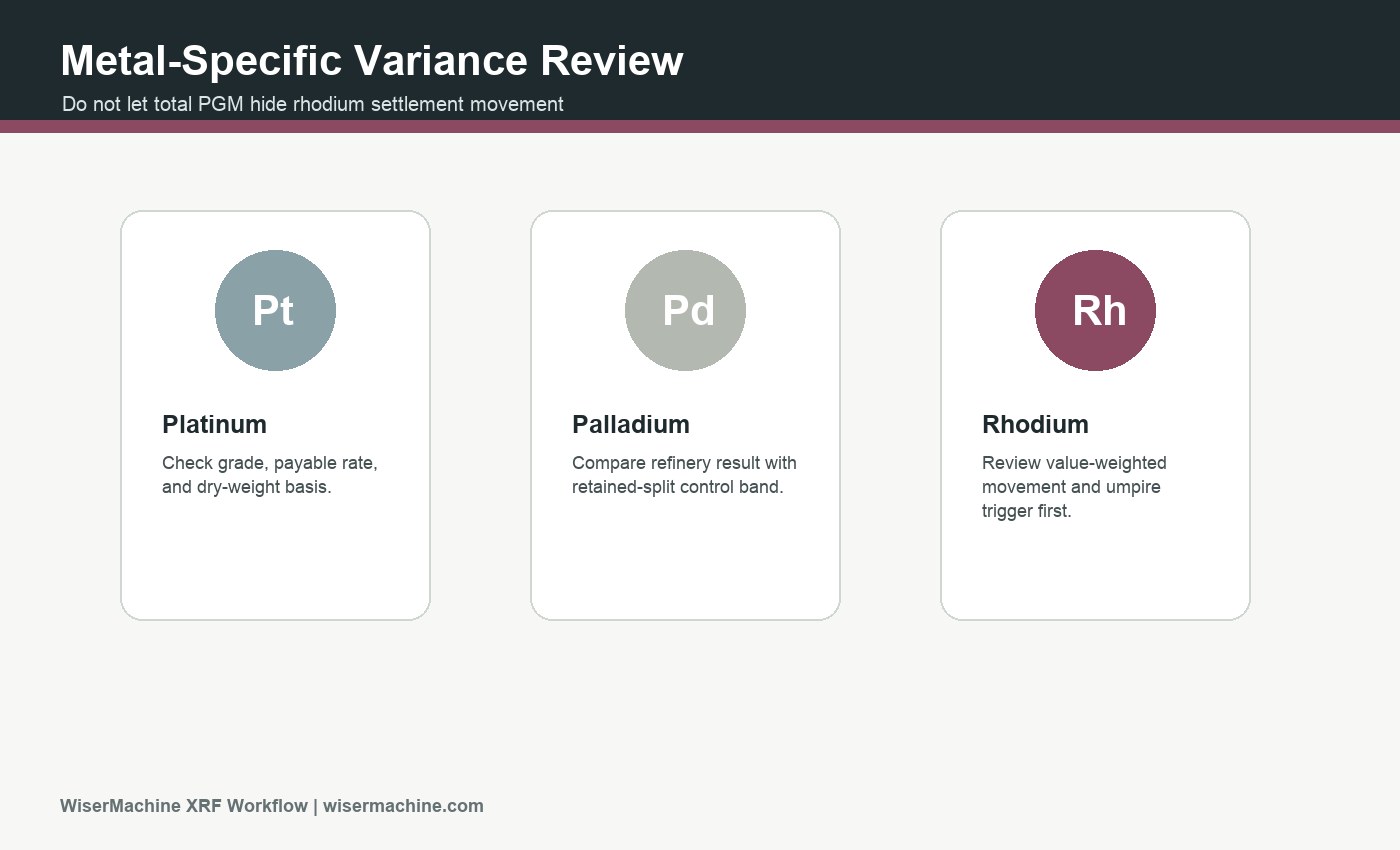
Stage S3: Compare Refinery Assay Against the XRF Control Band
When the refinery certificate arrives, compare each payable metal against the XRF control band and against the historical profile of similar lots. A normal settlement file should show a rational relationship: the refinery result may be more precise and method-specific, but it should not contradict the retained split without explanation. Large movement in one metal, especially rhodium, should trigger a review of sample preparation, method suitability, and split identity before commercial settlement is accepted.
The comparison should be metal-by-metal, not only total value. A lot can show a small total PGM movement while rhodium alone moves sharply and platinum moves the other direction. Because commercial value is metal-specific, the audit needs a Pt variance, Pd variance, Rh variance, and value-weighted variance. The value-weighted view prevents a low-value metal from hiding a high-value metal dispute.
Stage S4: Audit Payable Metal Math, Charges, and Penalties
After the assay comparison, audit the settlement math. Calculate payable platinum, payable palladium, and payable rhodium independently from the agreed basis: dry weight multiplied by assay grade, multiplied by payable percentage, less any agreed deductions. Then compare your calculation with the refinery statement line by line. This catches errors that do not appear in the assay certificate itself, including a payable rate applied to the wrong metal, a dry-weight basis applied inconsistently, or a minimum charge duplicated across sub-lots.
Penalty elements need the same discipline. Lead, arsenic, mercury, selenium, tellurium, base-metal contamination, and excessive carbon or moisture can all change the net settlement depending on the refinery contract. XRF can screen many of these risk elements quickly, which helps a seller challenge a surprise penalty or accept it with evidence. The key is to record penalty-element readings before the statement arrives, not after the dispute begins.
Stage S5: Define Umpire Triggers Before Emotion Takes Over
A professional PGM audit does not escalate every variance. It defines thresholds. For each metal, set an acceptable analytical variance, a value-weighted variance threshold, and an automatic umpire trigger for high-value movement. A small platinum drift may be normal; a rhodium variance above the commercial threshold may justify retaining an umpire sample, requesting method details, or initiating the contract’s dispute process.
The best trigger is commercial, not emotional: if the variance exceeds the cost and friction of an umpire assay, and the retained split supports the challenge, escalate. If the variance is within the agreed tolerance or the XRF screen is too matrix-limited to support a dispute, record the variance and close the file. This keeps the seller credible and prevents the audit process from becoming a routine argument over every certificate.
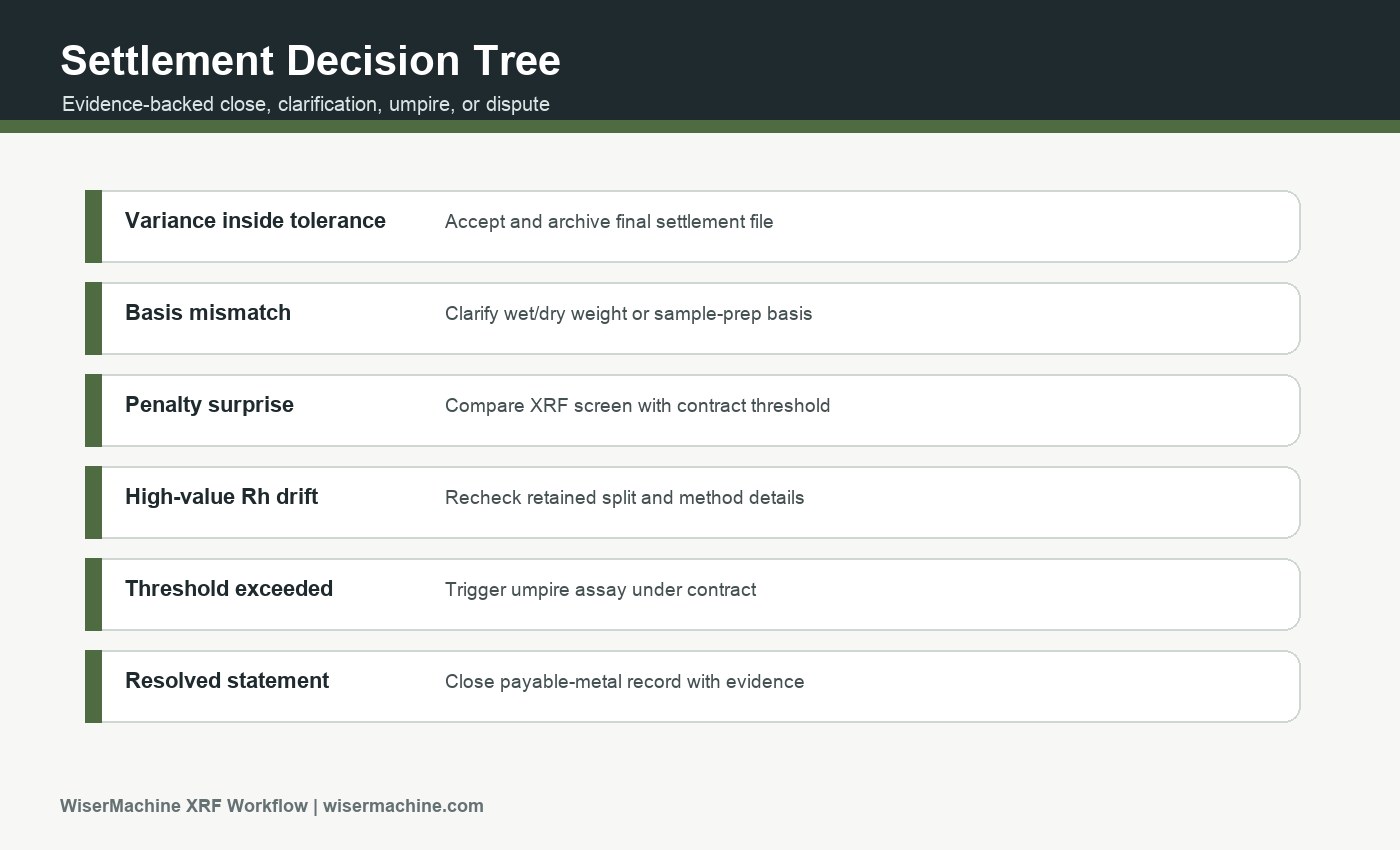
What the Final Settlement File Should Contain
The output of the SOP is a settlement file that can survive buyer review, refiner review, and internal accounting review. It should contain the lot ID, intake photos, gross and net weights, moisture record, sample-preparation log, retained split ID, XRF session file, refinery certificate, independent payable-metal calculation, charge and penalty review, variance table, decision note, and final accepted or disputed settlement. The file should make the commercial decision reconstructable without relying on memory.
For a recurring PGM program, this file becomes a sourcing tool. It identifies which suppliers produce stable assay profiles, which materials show high variance, which refiners settle tightly against internal control numbers, and which matrices need more rigorous sampling. Over time, the audit system improves buying terms as much as it prevents disputes.
How This SOP Fits WiserMachine’s PGM and Precious-Metal Cluster
This article sits between recovery operations and commercial settlement. For upstream lot routing, use the catalytic converter PGM recovery SOP and spent petrochemical catalyst PGM reclaim SOP. For broader precious-metal refinery intake logic, see the industrial precious-metal recycling XRF buyer’s guide. For silver-side Phase 5 context, see the XRF silver purity analysis buyer’s guide and the sterling silver refinery intake reconciliation SOP.
Frequently Asked Questions
Can XRF replace refinery fire assay or ICP for PGM settlement?
No. XRF should be treated as a fast independent control screen, not a universal replacement for contractual refinery assay. Its value is that it gives the seller or buyer a retained-split fingerprint before the final certificate arrives. When the XRF control band and the refinery assay agree, the settlement is easier to close. When they diverge, XRF helps identify whether the issue is sampling, matrix limitation, method mismatch, or a commercial dispute that needs an umpire assay.
Which PGM metals should be checked separately?
Platinum, palladium, and rhodium should be checked separately because they do not have the same commercial sensitivity. A small rhodium variance can outweigh a larger platinum variance in value terms. The audit should therefore record Pt variance, Pd variance, Rh variance, and value-weighted variance instead of relying only on a total PGM figure.
Why does moisture matter in a PGM settlement?
Moisture changes the basis on which payable metal is calculated. If the refinery assay is applied to dry weight but the seller is comparing it to gross wet weight, the numbers can appear inconsistent even when the assay itself is not the main issue. A one-percent moisture difference on a high-value PGM lot can be commercially meaningful, so the SOP requires gross weight, tare, net wet weight, drying loss, and dry basis to be reconciled before judging the assay variance.
When should a seller request an umpire assay?
A seller should request an umpire assay when the metal-specific or value-weighted variance exceeds the contract threshold, the retained split supports the challenge, and the expected value difference is larger than the cost and friction of escalation. The SOP discourages emotional disputes over every small movement. It favors pre-defined triggers that make the escalation commercially rational and evidence-backed.
What penalty elements can affect PGM settlement?
Penalty elements depend on the material and the refinery contract, but common risk categories include lead, arsenic, mercury, selenium, tellurium, base-metal contamination, high carbon, excess moisture, and foreign material. XRF can quickly screen many elemental risks before the refinery statement arrives, giving the operator evidence to accept, challenge, or prevent a surprise penalty.
How many XRF readings should be taken on a retained split?
The number depends on the homogeneity of the prepared split. For a uniform metallic or well-prepared sample, multiple readings across different points may be enough to establish a practical control band. For heterogeneous powders, residues, or mixed matrices, the operator should increase the number of readings and treat the result as an anomaly screen rather than a final settlement number. The key is to record both average and range, not only one convenient reading.
How is this different from catalytic converter grading?
Catalytic converter grading focuses on identifying and valuing material before or during recovery routing. This SOP focuses on settlement after the lot has already entered a refinery or toll-processing commercial chain. It audits the refinery statement, payable-metal math, moisture basis, penalties, and dispute triggers. The instrument may be the same, but the operational question is different.
What should be kept in the final audit file?
The final file should include lot ID, intake photos, weight and moisture records, sample-preparation log, retained split ID, XRF session data, refinery certificate, independent payable-metal calculation, charge and penalty review, variance table, decision note, and accepted or disputed settlement status. The goal is to make the commercial decision reconstructable months later without relying on memory.