
 Xrf Gold Analyzer
 Handheld Alloy Analyzer
 Handheld Mining Analyzer
 Other XRF Analyzer
Air absorbs low-energy X-rays more strongly than vacuum or helium, so measurement atmosphere can affect sensitivity for light elements. Vacuum is commonly considered for suitable dry solids, while helium can be used when a sample cannot safely be evacuated, such as certain liquids or sensitive materials. Many precious-metal tasks involving heavier elements work in air, and some modern systems measure selected light elements without purge, so the required atmosphere must be proven for the actual samples.
Quick answer
| Decision | xrf air vs vacuum vs helium |
| First check | Confirm sample construction, geometry, target elements and the exact business decision. |
| Before quotation | Send clear sample photos with dimensions, daily volume, destination, voltage and reporting needs. |
Start with elements and sample form
- List the lightest element that must be quantified, its required range and the matrix around it.
- Separate dry, stable solids from liquids, volatile materials, wet powders and samples that could be damaged or contaminate a vacuum path.
- Confirm whether the application requires identification, screening or defensible quantitative results near a limit.
- Do not buy a purge option only because it appears in a competitor specification.
Compare atmosphere tradeoffs
- Air is operationally simple but attenuates low-energy fluorescence more than vacuum or helium.
- Vacuum reduces the air path for suitable solids but requires safe sample compatibility, seals, pump maintenance and contamination control.
- Helium reduces absorption while avoiding evacuation of some samples, but requires gas supply, regulators, leak control and operating cost.
- Detector window, chamber path, calibration and sample film can still limit light-element performance regardless of atmosphere.
Request application evidence
- Ask for detection and precision data using the proposed atmosphere, detector, test time and sample preparation.
- Include blanks and representative matrices because supporting films and contaminants can add or absorb signals.
- Confirm purge volume, stabilization time, gas consumption, vacuum cycle time and safety interlocks when relevant.
- Validate the delivered method and never expose an incompatible liquid or fragile sample to vacuum.
Practical decision table
| Sample or condition | Action | Reason |
|---|---|---|
| Heavy-element precious-metal screen | Air may be sufficient | Verify actual method |
| Dry solid with light elements | Compare air and vacuum evidence | Reduced absorption may help |
| Liquid or volatile sample | Evaluate helium-compatible setup | Avoid unsafe evacuation |
| Unknown sample compatibility | Do not apply vacuum | Protect sample and instrument |
Evidence and method boundary
Use the model manual, an approved method and suitable reference materials before making purchase, release or compliance decisions. Technical references include the Malvern Panalytical Theory of XRF, Thermo Fisher ARL QUANT’X atmosphere options. These sources explain the method boundary; they do not replace model-specific configuration, laboratory confirmation or local legal advice.
Recommended WiserMachine path
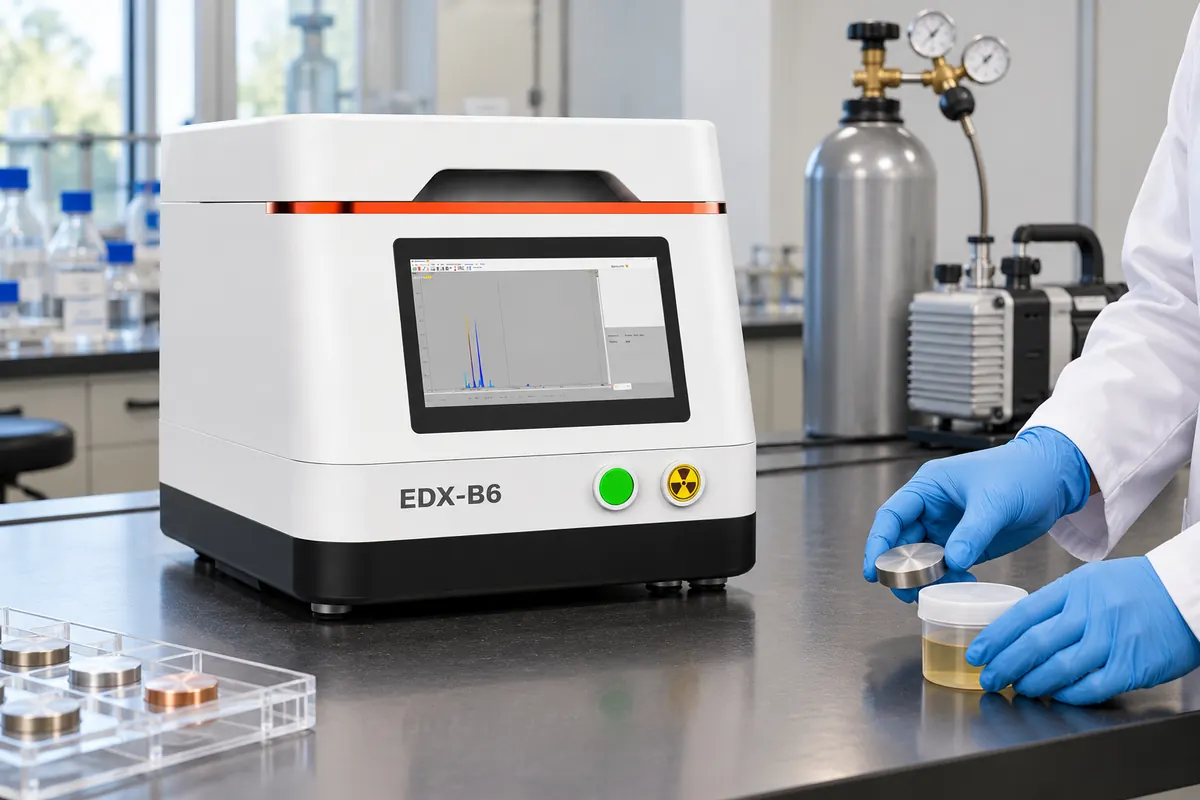
Review WM-EDX-B6 and compare WM5000. The exact detector, collimator, calibration, software and reporting configuration must be confirmed against real samples before ordering. You can also browse the complete XRF product catalog.
Related guides
Continue with light-element XRF calibration, mixed-jewelry sample preparation, Si-PIN versus SDD detector selection, or use the support center for preparation, operation and service guidance.
Match the XRF atmosphere to the lightest required element
Send sample photos, dimensions, target elements, expected range, daily volume, reporting needs, voltage and destination. WiserMachine will confirm a suitable configuration and freight plan before quotation.
Frequently Asked Questions
Does every XRF analyzer need helium?
No. The need depends on the required elements, sample, detector and performance target.
Is vacuum always better than air?
No. It may improve light-element sensitivity for compatible solids, but adds cycle time, maintenance and sample restrictions.
Can liquids be measured under vacuum?
Do not assume so. Liquids or wet samples may evaporate or contaminate the system; use only an approved configuration and procedure.