
 Xrf Gold Analyzer
 Handheld Alloy Analyzer
 Handheld Mining Analyzer
 Other XRF Analyzer
An XRF primary beam filter is placed between the tube and sample to reduce selected parts of the excitation spectrum. The correct material and thickness can suppress tube-line scatter, lower background or control count rate around target elements, but it also removes useful photons. Filter choice must be tied to tube target, voltage, detector, matrix and element range rather than judged by the number of filters in a brochure.
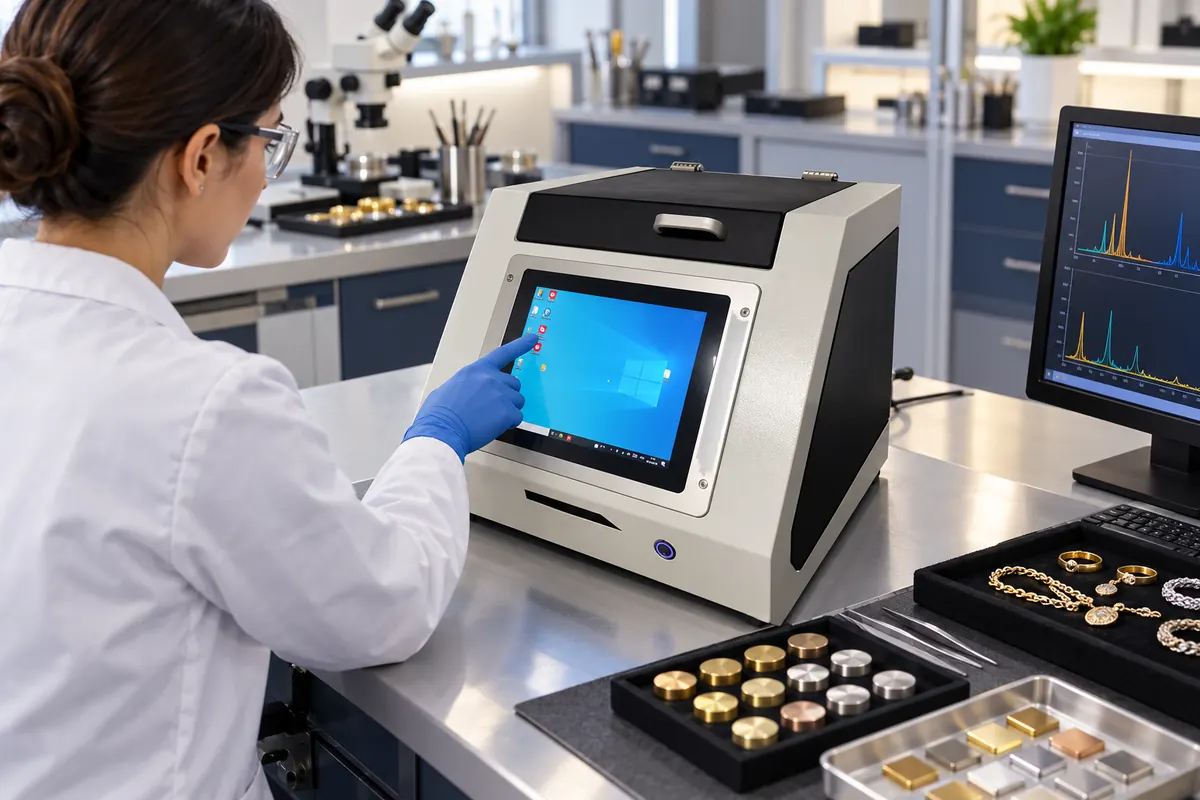
Quick answer
| Decision | xrf primary beam filters |
| First check | Confirm sample construction, geometry, target elements and the exact business decision. |
| Before quotation | Send clear sample photos with dimensions, daily volume, destination, voltage and reporting needs. |
Know what a primary filter does
- Absorber foils reshape the primary spectrum before it reaches the sample; they do not filter the emitted spectrum after measurement.
- A filter can reduce unwanted characteristic tube radiation and improve peak-to-background conditions for selected elements.
- Reducing background or count rate may improve interpretability, but excessive filtration can reduce sensitivity or require longer tests.
- Filter material, thickness and tube voltage work as one excitation condition.
Compare filter control and method design
- Ask whether filters are fixed, manually changed, selected by the operator or automatically controlled by the method.
- Confirm that software records the active filter and prevents incompatible settings where traceability matters.
- Request the filter schedule for each element group, matrix and concentration range used in production.
- Check how filter changes affect elapsed time when several conditions are combined into one result.
Validate on difficult real samples
- Use alloys containing likely interferences, solders and expected minor elements instead of only clean pure-metal coupons.
- Compare raw spectra, backgrounds, peak fit and repeated quantitative results under the proposed filter program.
- Verify that the delivered analyzer and method use the same filter materials and thicknesses as the demonstration.
- Treat a large filter count as flexibility, not proof of better performance without application evidence.
Practical decision table
| Sample or condition | Action | Reason |
|---|---|---|
| High background near target peak | Evaluate suitable filter | May improve signal-to-background |
| Count rate is excessive | Review filter and tube settings | Can reduce overload |
| Weak low-energy signal | Avoid unnecessary absorption | Filter may remove useful photons |
| Automatic filter wheel | Verify method logging | Supports repeatable setup |
Evidence and method boundary
Use the model manual, an approved method and suitable reference materials before making purchase, release or compliance decisions. Technical references include the Bruker introduction to XRF instrumentation, Getty Conservation Institute handheld XRF guide. These sources explain the method boundary; they do not replace model-specific configuration, laboratory confirmation or local legal advice.
Recommended WiserMachine path
Review WM5800 and compare WM6000. The exact detector, collimator, calibration, software and reporting configuration must be confirmed against real samples before ordering. You can also browse the complete XRF product catalog.
Related guides
Continue with dead time, live time and count rate, spectral overlap and matrix effects, energy resolution and FWHM, or use the support center for preparation, operation and service guidance.
Verify the filter program on representative alloys
Send sample photos, dimensions, target elements, expected range, daily volume, reporting needs, voltage and destination. WiserMachine will confirm a suitable configuration and freight plan before quotation.
Frequently Asked Questions
Do more XRF filters mean a better analyzer?
No. Useful performance depends on whether the available filters and methods suit the required elements and matrices.
Can one filter be used for every element?
A single condition may be adequate for a narrow task, but broad methods often use multiple excitation conditions for different element groups.
Should operators choose filters manually?
Only under an approved method. Automatic method control usually improves consistency, but the configured selections still require validation.