
 Xrf Gold Analyzer
 Handheld Alloy Analyzer
 Handheld Mining Analyzer
 Other XRF Analyzer
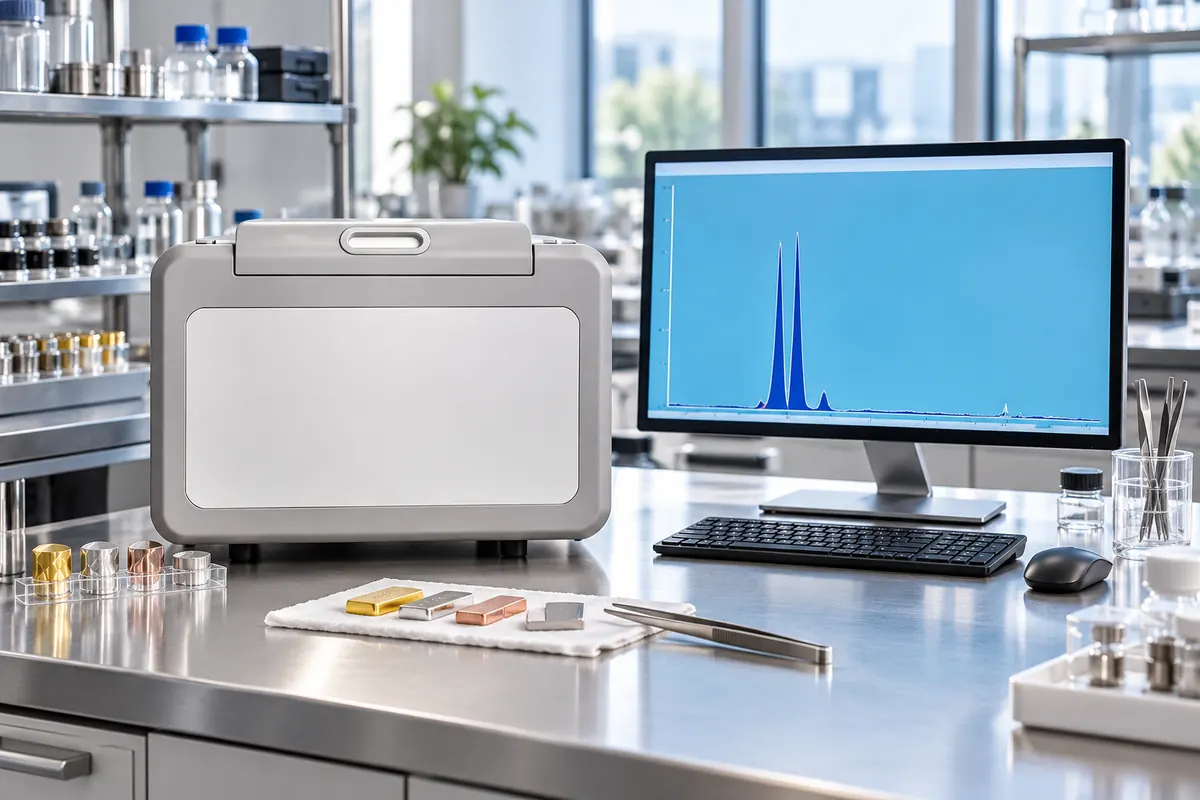
XRF energy resolution is commonly reported as the full width at half maximum, or FWHM, of a specified X-ray peak. A smaller FWHM can help separate nearby peaks, but the number is meaningful only when the reference energy, detector, shaping or peaking time, count rate and test conditions are stated. It does not by itself prove lower detection limits or better accuracy on real gold, platinum or palladium alloys.
Quick answer
| Decision | xrf energy resolution fwhm |
| First check | Confirm sample construction, geometry, target elements and the exact business decision. |
| Before quotation | Send clear sample photos with dimensions, daily volume, destination, voltage and reporting needs. |
Read the FWHM specification correctly
- Confirm the X-ray line used for the stated value because peak width changes with energy.
- Ask whether the value is typical, guaranteed or measured on the delivered detector under documented conditions.
- Record shaping or peaking time and input count rate; a value measured at a slow laboratory setting may not represent production throughput.
- Compare like with like: detector material, active area, window, electronics and temperature all affect useful performance.
Connect resolution to the alloy decision
- Better peak separation can help where target and interfering lines sit close together, but software deconvolution and calibration still matter.
- Request spectra and results from representative Au, Ag, Pt, Pd, Rh or solder-containing samples rather than accepting one detector number.
- Check repeatability, bias and reporting limits at the commercial decision range, not only on a pure-element target.
- Treat coatings, curved jewelry and mixed components as separate geometry or sampling problems that FWHM cannot solve.
Build a defensible supplier comparison
- Send the same blind or characterized samples to shortlisted suppliers and require the same test time and method purpose.
- Ask for raw spectra, fit residuals, repeated results and the complete detector configuration.
- Separate must-have element separation from optional speed or throughput preferences.
- Write acceptance criteria around sample performance, not a brochure FWHM value alone.
Practical decision table
| Sample or condition | Action | Reason |
|---|---|---|
| FWHM value has no reference line | Request energy and conditions | The number is not comparable |
| Nearby element peaks matter | Review real spectra and fit | Resolution is one part of separation |
| Fast counter workflow | Compare at production count rate | Slow settings may mislead |
| High-value alloy decision | Use sample acceptance tests | Verify complete system performance |
Evidence and method boundary
Use the model manual, an approved method and suitable reference materials before making purchase, release or compliance decisions. Technical references include the Amptek X-ray detector selection guide, Amptek detector-performance tutorial. These sources explain the method boundary; they do not replace model-specific configuration, laboratory confirmation or local legal advice.
Recommended WiserMachine path
Review WMEDS6000T and compare WM6000P. The exact detector, collimator, calibration, software and reporting configuration must be confirmed against real samples before ordering. You can also browse the complete XRF product catalog.
Related guides
Continue with spectral overlap and matrix effects, Si-PIN and SDD detector comparison, XRF detection-limit verification, or use the support center for preparation, operation and service guidance.
Compare XRF resolution with real alloy evidence
Send sample photos, dimensions, target elements, expected range, daily volume, reporting needs, voltage and destination. WiserMachine will confirm a suitable configuration and freight plan before quotation.
Frequently Asked Questions
Is a lower FWHM always a better XRF analyzer?
Not automatically. It can indicate narrower peaks under stated conditions, but calibration, count rate, geometry, software and sample suitability determine useful results.
What energy should an FWHM value reference?
The supplier should name the reference peak and measurement conditions. Values without a specified energy and setup should not be compared directly.
Does energy resolution equal accuracy?
No. Resolution describes peak width or separation capability; accuracy requires suitable calibration, references and validation on the intended samples.